
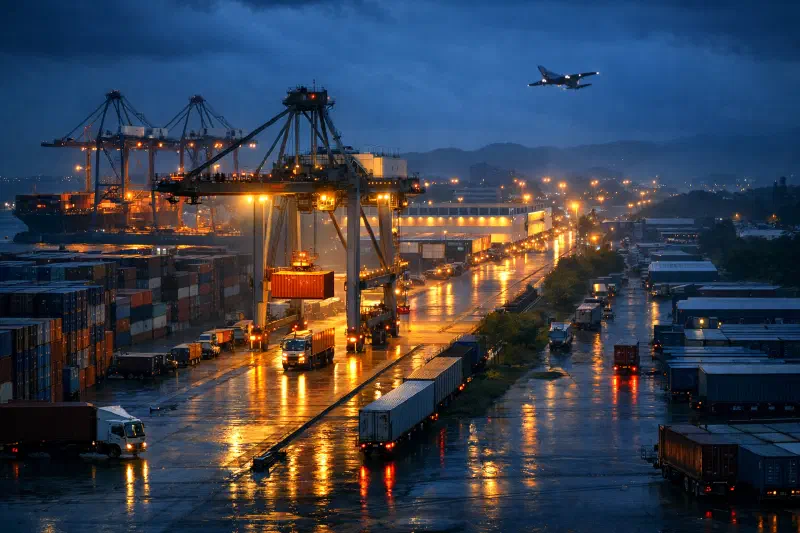
By late July, ASEAN has enough moving cargo, surviving export volume, and still-busy terminals to tempt an easy conclusion: the region’s supply chains have proved resilient. That is too easy.
What Q3 peak has actually proved is narrower. Trade is still moving, but calm, predictable, profitable movement now belongs to a smaller set of routes, assets, and balance sheets than the headline volume story suggests.
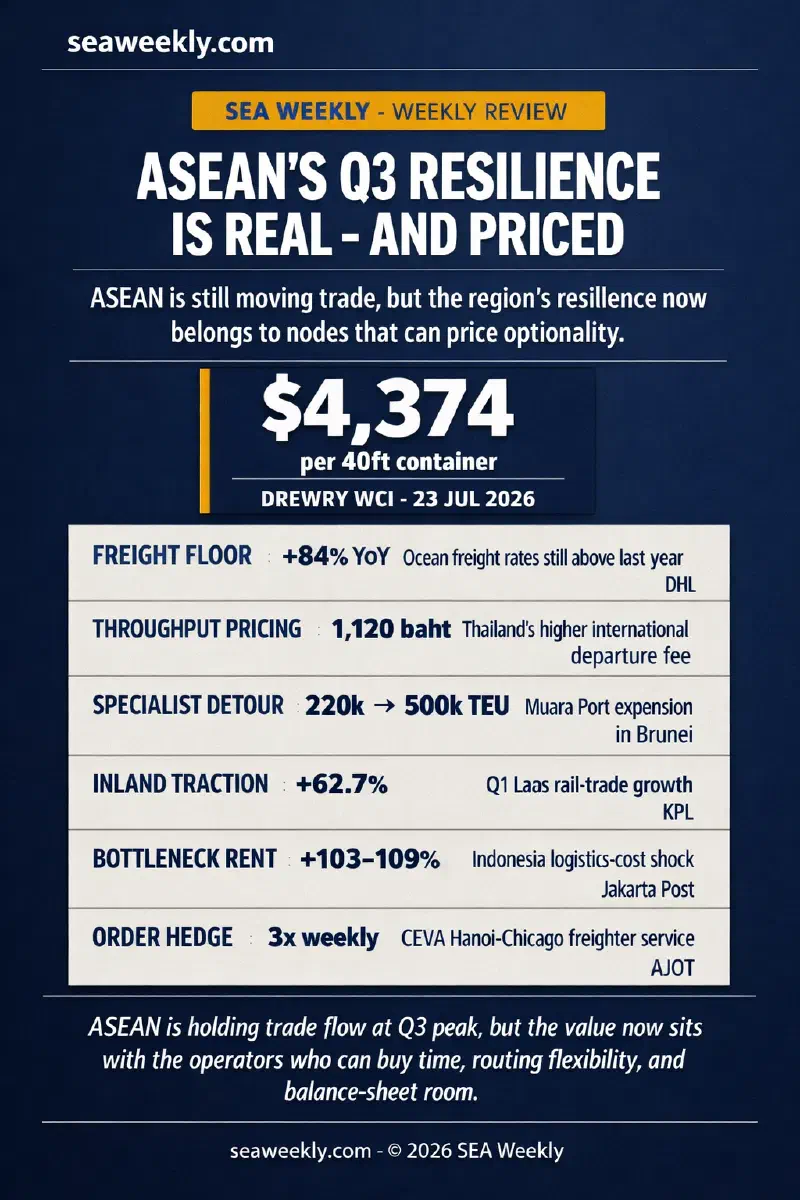
Drewry’s World Container Index fell 4% on July 23 to $4,374 per 40ft container, its second straight weekly decline. But DHL’s July ocean update still says freight rates are 84% above last year, effective capacity remains constrained by port congestion and Suez detours, and Asia-led demand continues to outrun comfortable capacity (Drewry, July 23, 2026; DHL, July 2026). The market has eased a little. It has not normalized.
The wrong test for resilience #
The simplest way to misread ASEAN right now is to use the wrong metric. Containers are still moving, airports are still full enough, and rail corridors are still adding volume. Those are continuity metrics, not resilience metrics.
Resilience at the end of July means something harder: how much time a system can lose without blowing up margin, how many handoffs it can reroute without breaking customer confidence, and how much additional working capital it can absorb before the balance sheet starts flinching. As I argued in my July 11 SEA Weekly, logistics and freight signals were already becoming the leading indicators for H2 growth. By July 25, the evidence is visible in how this week’s reporting fits together.
Portcast’s latest congestion snapshot still puts Manila South Harbor in high-congestion territory at 3.08 days of median waiting time, with Manila more broadly at 1.96 days and Belawan in Indonesia at 2.46 days (Portcast, July 21, 2026). Reuters’ July 16 survey on Hormuz disruption framed the macro layer correctly: the risk is not just oil at roughly $85 a barrel, but that businesses may now permanently price in a higher geopolitical premium because the question is physical movement, not theoretical supply (Reuters, July 16, 2026). ADB’s July outlook cut developing Asia-Pacific growth to 4.9% and lifted inflation to 4.3%, explicitly citing higher import costs, weaker demand pockets, and continued supply-chain strain (ADB, July 8, 2026).
In other words, the macro environment still says the system is expensive, noisy, and politically fragile. If resilience exists, it has to be found inside how individual ASEAN chains are managing that noise.
Thailand and the Philippines show the difference between throughput and resilience #
Monday’s Thailand-Philippines comparison is the cleanest illustration of the distinction. Thailand and the Philippines are both still moving tourists in volume, but they are not handling pressure in the same way.
Thailand is increasingly pricing and instrumenting throughput. The reporting arc there was operational, not rhetorical: 16.21 million foreign visitors in the first half, THB782.57 billion in tourism revenue, a higher 1,120-baht international departure fee after the 50% hike, and airport-side service upgrades expected to cut congestion materially. That is a system trying to turn stress into a paid premium.
The Philippines looks different. It is still busy enough to produce headline confidence - NAIA posted a record January earlier this year, and visitor arrivals reached 3.16 million in H1 - but the operating chain is still absorbing stress in a less monetizable way. International capacity cuts, later bookings, value packaging, and a heavier domestic tilt show a system working around bottlenecks instead of charging confidently through them. The tourism flow survives; the resilience economics are thinner.
That distinction matters beyond tourism. It tells us that not every still-functioning ASEAN chain is equally strong. Some are converting volatility into yield. Others are still converting it into hidden leakage.
Brunei and Laos show why specialist nodes are gaining leverage #
Tuesday’s Brunei piece and Wednesday’s Laos-China Railway analysis sharpen the same argument from two different directions.
Brunei’s strategic value is rising faster than its visible throughput. Muara Port’s planned expansion from 220,000 to 500,000 TEU, Brunei LNG’s established export infrastructure, the 38,500-tonne urea sale to Australia, and Hengyi’s refinery expansion all point to a specialist node becoming more useful as energy and freight routes stay politically noisy. But Brunei is not suddenly becoming a mass ASEAN logistics hub. Its value is specific: if primary energy lanes remain unstable, Brunei becomes a more attractive detour for certain cargos.
Laos tells a parallel but more inland story. The China-Laos Railway has already won the proof-of-volume argument: Q1 trade value rose 62.7% to 6.81 billion yuan, more than 10 million tonnes had moved by mid-June, and peak frequency hit 23 trains per day. But as Nguyen Minh An argued on Wednesday, motion is becoming less scarce than orchestration. The real rent now sits at Thanaleng Dry Port, in customs, gauge transfer, warehousing, cold chain, and onward routing.
That is exactly why Laos cannot be read lazily as a generic connectivity success. China-Vietnam’s rail corridor is also getting faster and cleaner. Once multiple inland routes improve together, the winner is not the line that exists. It is the one that lets cargo owners predict total friction more accurately.
Brunei and Laos therefore point to the same regional lesson. Specialist and inland nodes are becoming more valuable under Q3 stress, but only if they control more than the headline asset. A port, a railway, or a refinery alone does not create resilience. The service layer around it does.
Indonesia and the electronics corridor show who gets to keep the margin #
The hardest verdict came from Thursday’s Indonesia nickel value-chain article and Friday’s Malaysia-Vietnam semiconductor piece. Together they show that the supply chain is still working, but the resilience rent is being captured very unevenly.
Indonesia’s nickel chain is a good example of resilience being mistaken for broad health. The sector still matters, shipments still move, and the country’s downstream ambition remains intact. But the actors best placed to defend margin are not “Indonesia” in the abstract. They are the ones already inside the bottleneck: the state, through quota and export-policy control, and the integrated industrial-park operators that already control ore, power, labor, and berth access. Logistics costs remain 103-109% above earlier levels from geopolitical shocks. That is not a neutral background condition. It is a sorting mechanism. The chain is resilient mainly for the people already holding the gate.
Malaysia and Vietnam show the same sorting logic in a less political form. The sharpest insight from Friday’s article was that freight stress does not erase competition. It segments the order book. Malaysia’s calmer logistics environment fits delay-sensitive semiconductor and precision-electronics work, where a late shipment can destroy more value than high freight rates do. Vietnam remains better positioned for scale-heavy programs where buyers still want the larger manufacturing footprint and can tolerate more transport friction.
That is a much more mature reading of ASEAN resilience than the old winner-takes-all country comparison. The region is not converging toward one logistics hierarchy. It is becoming more explicit about which systems are good at certainty and which are good at scale.
My verdict #
So what is the verdict on ASEAN supply-chain resilience as Q3 trade flows reach their peak?
It is real, but it is not broad. It is increasingly concentrated in the nodes that can do one of four things: price throughput, monetize specialist detours, orchestrate inland handoffs cleanly, or control enough of the bottleneck to keep margins from evaporating. Everyone else may still be shipping, but they are doing so with a weaker hand.
That is why I would be careful with celebratory language. ASEAN has not demonstrated that disruption no longer matters. It has demonstrated that a smaller set of routes, facilities, and operators can keep functioning after disruption has already been priced in.
The finance layer matters here too. When Gan Kim Yong said in June that a more fragmented world needs trusted connectors, he was speaking about Singapore’s financial role, but the phrase applies neatly to this wider regional picture as well (MAS, June 25, 2026). The systems holding up best are not just moving cargo. They are connecting cargo to reliable processing, financing, insurance, customs, and mode-switching capacity. The systems that cannot buy resilience do not escape the stress; they pass it through into thinner margins, weaker service confidence, higher consumer prices, or more fragile policy choices.
The Q3 peak, then, is not telling us that ASEAN trade is safe. It is telling us which ASEAN systems deserve the premium because they can still make volatility look manageable.
The bill for surviving disruption is now part of the business model.
Have a view from the dock gate, dry port, freight desk, or procurement side of ASEAN trade? I would like to hear how you are pricing resilience into H2 decisions.
Email me at editorial@seaweekly.com
References #
- Drewry (July 23, 2026). “World Container Index - 23 Jul.” https://www.drewry.co.uk/supply-chain-advisors/supply-chain-expertise/world-container-index-assessed-by-drewry (Accessed July 25, 2026)
- DHL (July 2026). “Ocean Freight Market Update.” https://www.dhl.com/th-en/home/global-forwarding/latest-news-and-webinars/ocean-freight-market-update.html (Accessed July 25, 2026)
- Portcast (July 21, 2026). “Port Congestion Snapshot: Live Vessel Wait Times (Updated Weekly).” https://www.portcast.io/blog/port-congestion-snapshot (Accessed July 25, 2026)
- Reuters (July 16, 2026). “Most Gulf area economies face deeper downturns this year on Hormuz disruption.” https://www.reuters.com/world/middle-east/most-gulf-area-economies-face-deeper-downturns-this-year-hormuz-disruption-2026-07-16/ (Accessed July 25, 2026)
- Asian Development Bank (July 8, 2026). “ADB Sees Slower Growth for Asia and the Pacific in 2026 Amid Global Energy Crisis.” https://www.adb.org/news/adb-sees-slower-growth-asia-and-pacific-2026-amid-global-energy-crisis (Accessed July 25, 2026)
- Monetary Authority of Singapore (June 25, 2026). “Singapore as a Trusted Connector in a Changing World.” https://www.mas.gov.sg/news/speeches/2026/singapore-as-a-trusted-connector-in-a-changing-world (Accessed July 25, 2026)
- SEAWeekly / Chloe Tan (July 11, 2026). “SEA Weekly: Why ASEAN logistics and freight signals are emerging as the new leading indicators for H2 growth.” https://seaweekly.com/posts/2026-07-11-sea-weekly-asean-logistics-freight-signals-leading-indicators-h2-growth/ (Accessed July 25, 2026)
- SEAWeekly / Pichayya P’Chai Srisuk and Maria Lourdes Reyes (July 20, 2026). “How Thailand vs Philippines tourism supply chains are managing cost and capacity pressures in peak season.” https://seaweekly.com/posts/2026-07-20-thailand-philippines-tourism-supply-chains-cost-capacity-peak-season/ (Accessed July 25, 2026)
- SEAWeekly / Daniel Lim and Siti Aishah Rahman (July 21, 2026). “Why Brunei’s logistics position in ASEAN energy trade is being reassessed as regional freight routes shift.” https://seaweekly.com/posts/2026-07-21-bruneis-logistics-position-asean-energy-trade-freight-routes-shift/ (Accessed July 25, 2026)
- SEAWeekly / Nguyen Minh An (July 22, 2026). “What’s driving Laos-China Railway freight economics as ASEAN inland logistics competition intensifies?” https://seaweekly.com/posts/2026-07-22-laos-china-railway-freight-economics-asean-inland-logistics-competition/ (Accessed July 25, 2026)
- SEAWeekly / Marcus Wijaya (July 23, 2026). “Who is winning Indonesia’s nickel value chain as downstream logistics costs and margins rebalance in H2?” https://seaweekly.com/posts/2026-07-23-indonesia-nickel-value-chain-logistics-margins-rebalance-h2/ (Accessed July 25, 2026)
- SEAWeekly / Siti Aishah Rahman and Nguyen Minh An (July 24, 2026). “How Malaysia vs Vietnam semiconductor logistics are competing for H2 electronics orders.” https://seaweekly.com/posts/2026-07-24-malaysia-vietnam-semiconductor-logistics-h2-electronics-orders/ (Accessed July 25, 2026)