
The next electronics order in Southeast Asia is not going to the lowest-cost factory. It is going to the factory whose logistics stack gives a procurement manager the fewest ways to miss a delivery window.
That is why the Malaysia-versus-Vietnam debate is being misframed when it is presented as a single race for semiconductor leadership. In H2 2026, buyers are not awarding one prize. They are sorting orders by value density, delay tolerance, and the cost of being wrong.
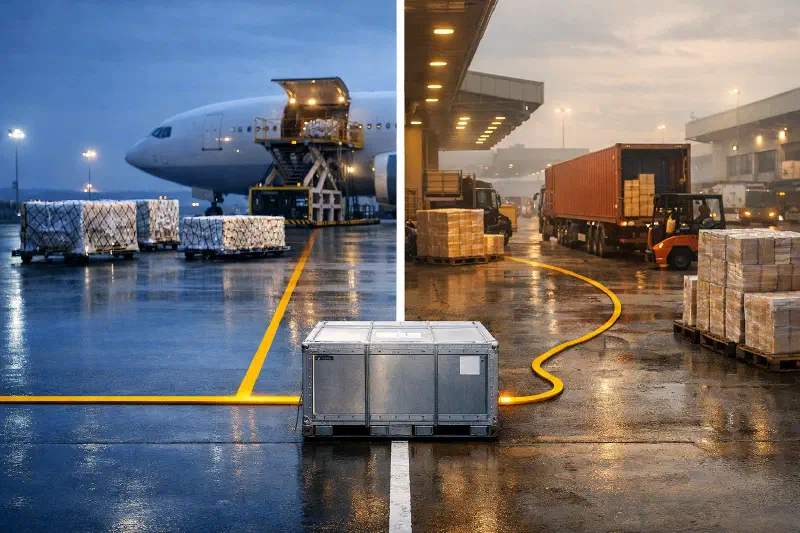
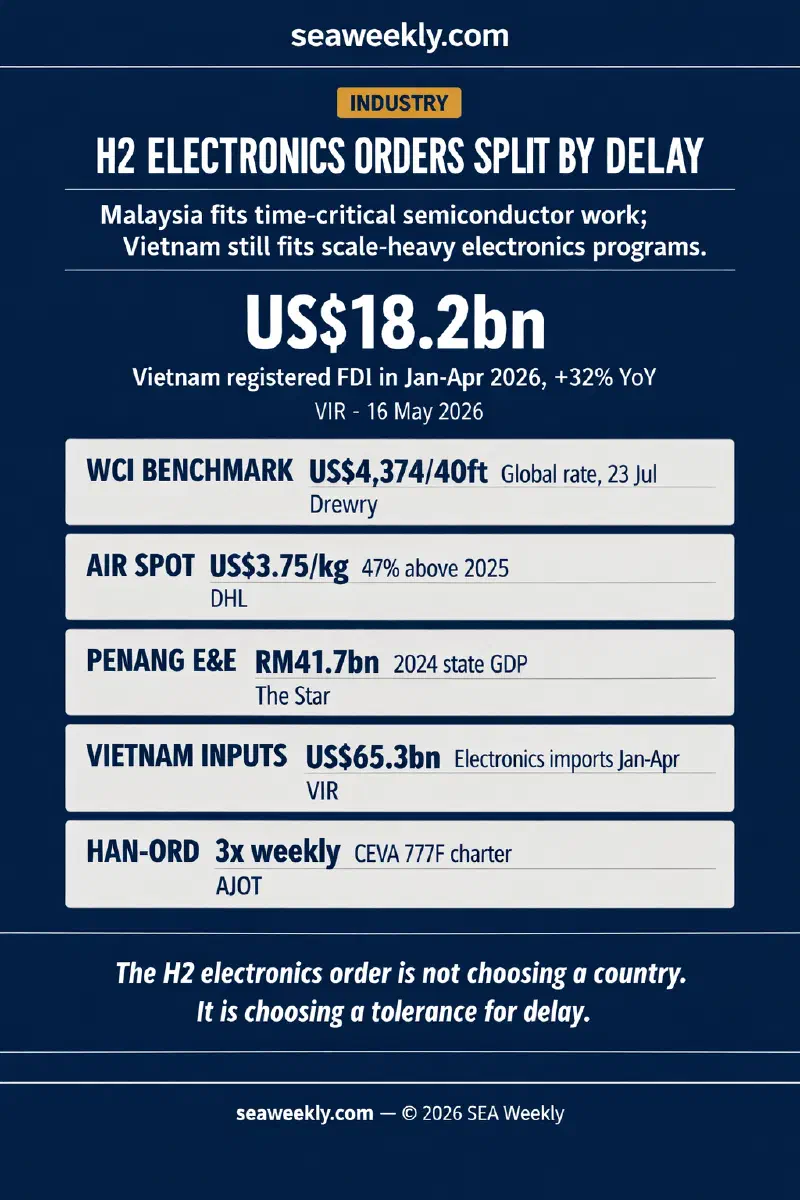
The difference matters because freight is still expensive enough to distort decisions. DHL’s July ocean market update says global container demand is up 4 percent year-to-date, effective capacity remains constrained by port congestion and Suez detours, and rates are still 84 percent above last year. Drewry’s July 23 World Container Index, despite a second straight weekly decline, still sat at US$4,374 per 40ft container while carriers prepared new emergency fuel surcharges for August amid Strait of Hormuz uncertainty (DHL, July 2026; Drewry, July 23, 2026).
Air is no cheap escape hatch either. DHL’s June air-freight update showed global spot rates at US$3.75 per kilogram, 47 percent above last year, with semiconductors and AI infrastructure still supporting demand growth even as capacity stayed tight (DHL, June 2026). When sea is expensive and air is also expensive, the live decision is not “which country is cheaper?” It is “which shipment justifies certainty?”
The H2 order book is splitting by delay tolerance #
This is the point missing from most Malaysia-Vietnam comparisons. The question is no longer whether both countries can attract electronics work. They clearly can. The question is which part of the electronics book each country can serve with the least operational noise.
For a low-margin, bulky, ocean-dependent program, the decisive variable is still scale and ecosystem depth. For a high-value semiconductor, advanced component, or precision-electronics order where one missed handoff can blow up a customer commitment, the decisive variable becomes schedule confidence. That is why Malaysia is gaining ground where buyers want logistics discipline more than another point of labor arbitrage, while Vietnam is still winning where the order is large enough to reward scale and supplier absorption.
That is also why this article needs a different angle from our June 26 deep dive on Malaysia and Vietnam’s electronics supply chain upgrades and my July 8 piece on Malaysia’s logistics-cost advantage. The strategic ambition has already been mapped. The sharper H2 question is what type of order each logistics system can now credibly protect.
Malaysia’s proposition is lower execution noise #
Malaysia’s case starts with density. Penang contributed RM41.7 billion to state GDP through electrical and electronics output in 2024, with manufacturing accounting for 46.1 percent of total state output. The state still counts more than 350 multinationals and over 6,500 manufacturing-related SMEs, while approved foreign direct investment reached RM15.2 billion in the first nine months of 2025. Just as important, the industrial cluster is anchored by real logistics nodes rather than a policy slide: Penang International Airport, the North Butterworth Container Terminal, and the broader Port Klang gateway for the national export system (The Star, June 26, 2026).
That matters more for semiconductor logistics than headline freight rates do. A buyer moving high-value chip-related cargo does not need the cheapest lane in Asia. A buyer needs a lane with fewer uncertain handoffs, faster recovery options when something slips, and enough ecosystem density to consolidate, reroute, or upgrade mode without rebuilding the whole shipment plan.
Malaysia’s product mix is also moving in the right direction for that kind of order. SkyeChip, the only pure-play semiconductor intellectual property company listed in the region, is now commercially deployed in HBM3/HBM3E memory interface IP, grew revenue per engineer to RM425,000 in FY2026, and saw the United States become 23.1 percent of its revenue as Samsung Foundry Connect opened South Korean customer access in February. Apex Research’s projected 48 percent FY2026-FY2029 core earnings CAGR is a valuation story on paper. Operationally, it signals what matters more: Malaysia is trying to win business whose value density is high enough that freight cost matters less than the penalty for delay (The Star, June 26, 2026).
That is the part of the semiconductor logistics story many investors still flatten into a general “Malaysia is good at chips” narrative. The more useful read is narrower. Malaysia is increasingly well positioned for the H2 order types where a missed schedule does disproportionate damage: urgent semiconductor subassemblies, precision electronics modules, engineering samples, replacement components, and premium program runs tied to a customer launch window. In that universe, a logistics system that feels slightly more expensive but materially calmer is often the cheaper one.
Vietnam’s advantage is scale, but the logistics tax is still real #
Vietnam is still the harder country to dismiss if the order book is large. Registered FDI reached US$18.2 billion in the first four months of 2026, up 32 percent year on year, with manufacturing taking about 69 percent of newly registered and expanded capital. Disbursed FDI hit US$7.4 billion, the highest four-month level in five years, while electronics and computer-component imports surged 52.3 percent to US$65.3 billion. That is not the profile of a country losing electronics relevance. It is the profile of a country still being loaded with capacity (VIR, May 14, 2026).
The order data tells the same story, with an important warning attached. Vietnam’s PMI rose to 52.8 in May and stayed in expansion territory at 51.8 in June. New orders grew in both months, and new export orders turned positive again. But the pace of export-order growth remained marginal, while transport costs, logistics issues, challenges importing goods, and longer supplier delivery times kept appearing in the survey commentary (VIR, June 1, 2026; VIR, July 1, 2026). That is the H2 tension in one line: Vietnam has order momentum, but it is still asking buyers to absorb more logistics friction than Malaysia.
The composition of new investment matters here. Coherent’s June move to lease 30,000 square metres of ready-built factory space in Dong Nai for a second plant is not a generic assembly story. The company sits inside advanced materials, optics, ceramics, and semiconductor-related component chains, and Savills explicitly linked the location case to access to Cat Lai Port, the future Long Thanh International Airport, and the wider southern industrial network (VIR, June 25, 2026). Interflex’s US$18 million share purchase in Korea Circuit Vina, following US$28 million invested in 2025, reinforces the same point from the north: Vietnam is not just attracting more factories, but increasingly the PCB and mid-chain electronics work that used to sit more comfortably inside Malaysia’s upgrade ambitions (VIR, June 17, 2026).
Resolution 10 makes the policy intent explicit. The June 8 Politburo resolution shifts support toward performance, localisation, and actual economic contribution rather than raw project size, while setting targets of 45-50 percent localisation in key manufacturing industries and 10,000 Vietnamese companies inside multinational supply chains by 2030. Semiconductors are named directly alongside AI, big data, cloud computing, advanced energy, and new materials (VIR, June 18, 2026). In other words, Vietnam is not passively waiting for orders. It is trying to move up the chain fast enough that the logistics discount buyers still demand begins to narrow.
Nguyen Minh An’s take: Vietnam is not losing the order race. It is being assigned the scalable end of it #
What outside buyers often miss is how much Vietnam’s logistics layer has improved even without becoming frictionless.
The cleanest example is dedicated air capacity. CEVA launched a Hanoi-Chicago charter on June 24 operating three times a week with a Boeing 777 full freighter, offering same-day departure and arrival for high-tech, industrial, retail, and e-commerce customers. It is also consolidating cargo across Hanoi, Danang, and Ho Chi Minh City, which means the service is doing more than adding planes. It is creating a controlled national export channel for urgent cargo (AJOT, June 24, 2026). FedEx’s additional outbound Hanoi flight, first announced last September, gives northern Vietnam one-day faster transit to Asia and Europe and better reliability into North America during peak season (FedEx Newsroom, September 25, 2025). FedEx’s own March analysis put Vietnam’s 2025 air-cargo throughput at about 1.3 million metric tons, up 22 percent, with electronics making up more than one-third of total exports (FedEx Business Insights, March 20, 2026).
The sea and inland layers are widening too. SITC’s new 36,000 sq.m Danang depot, announced on July 10, extends a five-depot national container network covering roughly 450,000 sq.m across northern, central, and southern Vietnam, while Danang continues to pitch itself as a central-Vietnam logistics node tied to the East-West Economic Corridor (VIR, July 14, 2026). None of this removes the survey evidence of longer lead times or harder input sourcing. It does, however, shorten the list of orders Vietnam must surrender on logistics grounds alone.
That distinction matters. For scale-heavy electronics programs, mid-tier components, PCB work, and production runs where ecosystem expansion matters more than near-perfect scheduling, Vietnam still makes strong operational sense. The mistake is to read every new charter or depot as proof that Vietnam has already matched Malaysia’s logistics certainty. It has not. The more accurate conclusion is that Vietnam is making it progressively harder for buyers to say no to its next order on logistics grounds alone.
The real H2 split is between certainty and scale #
The cleanest way to think about H2 electronics orders is not as a single Malaysia-Vietnam ranking. It is as a segmentation exercise.
If the cargo is high-value, delay-sensitive, and small enough that air optionality or premium handling is economically rational, Malaysia’s proposition is cleaner. Penang’s ecosystem density, the national air-sea handoff, and the shift toward higher-value semiconductor work give buyers a calmer operating environment for the most schedule-critical part of the order book.
If the program needs broader supplier absorption, faster ecosystem build-out, or a larger manufacturing footprint and can tolerate some logistics friction in exchange for scale, Vietnam still looks compelling. The FDI numbers, import surge, PCB expansion, and policy reset all say buyers continue to believe the Vietnam pipeline is worth the operational work.
The caveat on the Malaysia side is that calm logistics do not automatically scale into national semiconductor leadership. Penang’s own debate about moving beyond the old low-cost model and Malaysia’s latest push to create 100,000 qualified Bumiputera talents by 2030, including 10,000 “value creators,” both underline the same problem: the next bottleneck is talent, not only freight (The Star, June 26, 2026; The Star, July 23, 2026). The caveat on the Vietnam side is more immediate. As Nguyen argued in his June 30 analysis of factory order visibility and his July 15 piece on air-freight hedging, the country still needs to convert order optimism into repeatable fulfillment under transport stress.
That is why the most useful H2 conclusion is not that Malaysia beats Vietnam or Vietnam beats Malaysia. It is that buyers are assigning the two countries different jobs inside the same electronics strategy.
The H2 electronics order is not choosing a country. It is choosing a tolerance for delay.
Have a view from Penang, Port Klang, Hanoi, or the wider ASEAN electronics corridor? I would like to hear how procurement teams are thinking about delivery risk in H2.
Email me at editorial@seaweekly.com
References #
- Drewry (July 23, 2026). “World Container Index - 23 Jul.” https://www.drewry.co.uk/supply-chain-advisors/supply-chain-expertise/world-container-index-assessed-by-drewry (Accessed July 24, 2026)
- DHL (July 2026). “Ocean Freight Market Update.” https://www.dhl.com/th-en/home/global-forwarding/latest-news-and-webinars/ocean-freight-market-update.html (Accessed July 24, 2026)
- DHL (June 2026). “Air Freight Market Update.” https://www.dhl.com/vn-en/home/global-forwarding/latest-news-and-webinars/air-freight-market-update.html (Accessed July 24, 2026)
- The Star (June 26, 2026). “Penang primed to prosper.” https://www.thestar.com.my/business/business-news/2026/06/26/penang-primed-to-prosper (Accessed July 24, 2026)
- The Star (June 26, 2026). “SkyeChip profit forecast to grow at 48% CAGR from FY26 to FY29.” https://www.thestar.com.my/business/business-news/2026/06/26/skyechip-profit-forecast-to-grow-at-48-cagr-from-fy26-to-fy29 (Accessed July 24, 2026)
- The Star (July 23, 2026). “Yayasan Peneraju targets 100,000 Bumiputera talents by 2030.” https://www.thestar.com.my/business/business-news/2026/07/23/yayasan-peneraju-targets-100000-bumiputera-talents-by-2030 (Accessed July 24, 2026)
- Vietnam Investment Review (May 14, 2026). “Vietnam enters manufacturing and investment-led growth phase.” https://vir.com.vn/vietnam-enters-manufacturing-and-investment-led-growth-phase-152649.html (Accessed July 24, 2026)
- Vietnam Investment Review (June 1, 2026). “Vietnamese manufacturers record a rebound in new orders in May.” https://vir.com.vn/vietnamese-manufacturers-record-a-rebound-in-new-orders-in-may-153853.html (Accessed July 24, 2026)
- Vietnam Investment Review (June 17, 2026). “South Korea’s Interflex to expand PCB manufacturing in Vietnam.” https://vir.com.vn/south-koreas-interflex-to-expand-pcb-manufacturing-in-vietnam-154965.html (Accessed July 24, 2026)
- Vietnam Investment Review (June 18, 2026). “Resolution 10 marks new chapter in Vietnam’s foreign investment strategy.” https://vir.com.vn/resolution-10-marks-new-chapter-in-vietnams-foreign-investment-strategy-154983.html (Accessed July 24, 2026)
- Vietnam Investment Review (June 25, 2026). “US giant Coherent expands business in Vietnam.” https://vir.com.vn/us-giant-coherent-expands-business-in-vietnam-155424.html (Accessed July 24, 2026)
- Vietnam Investment Review (July 1, 2026). “Manufacturing sector ends the first half of 2026 on a positive note.” https://vir.com.vn/manufacturing-sector-ends-the-first-half-of-2026-on-a-positive-note-155872.html (Accessed July 24, 2026)
- Vietnam Investment Review (July 14, 2026). “SITC launches container depot in Danang.” https://vir.com.vn/sitc-launches-container-depot-in-danang-156681.html (Accessed July 24, 2026)
- AJOT (June 24, 2026). “CEVA boosts Asia Pacific-U.S. air cargo with two charters connecting Vietnam, China to U.S.” https://www.ajot.com/news/ceva-boosts-asia-pacific-u.s-air-cargo-with-two-charters-connecting-vietnam-china-to-u.s (Accessed July 24, 2026)
- FedEx Newsroom (September 25, 2025). “FedEx Enhances Network from Northern Vietnam to Asia and Europe.” https://newsroom.fedex.com/newsroom/asia-english/fedex-enhances-network-from-northern-vietnam-to-asia-and-europe (Accessed July 24, 2026)
- FedEx Business Insights (March 20, 2026). “Vietnam’s Air Cargo Growth: Opportunities For Exporters And Manufacturers.” https://www.fedex.com/en-sg/business-insights/tech-innovation/vietnam-air-cargo-growth-opportunities.html (Accessed July 24, 2026)
- SEAWeekly / Siti Aishah Rahman (July 8, 2026). “Why Malaysia logistics cost efficiency is becoming a competitive differentiator in ASEAN electronics supply chains.” https://seaweekly.com/posts/2026-07-08-malaysia-logistics-cost-efficiency-asean-electronics-supply-chains/ (Accessed July 24, 2026)
- SEAWeekly / Siti Aishah Rahman, Nguyen Minh An, and Miguel Santos (June 26, 2026). “How Malaysia industrial policy is competing with Vietnam for electronics supply chain upgrades.” https://seaweekly.com/posts/2026-06-26-malaysia-industrial-policy-vietnam-electronics-supply-chain-upgrades/ (Accessed July 24, 2026)
- SEAWeekly / Nguyen Minh An (June 30, 2026). “Why Vietnam factory order visibility is the key test for ASEAN export recovery in H2 2026.” https://seaweekly.com/posts/2026-06-30-vietnam-factory-order-visibility-asean-export-recovery/ (Accessed July 24, 2026)
- SEAWeekly / Nguyen Minh An (July 15, 2026). “Why Vietnam air freight capacity is becoming a strategic hedge against sea route congestion in H2 2026.” https://seaweekly.com/posts/2026-07-15-vietnam-air-freight-capacity-strategic-hedge-sea-route-congestion-h2-2026/ (Accessed July 24, 2026)