
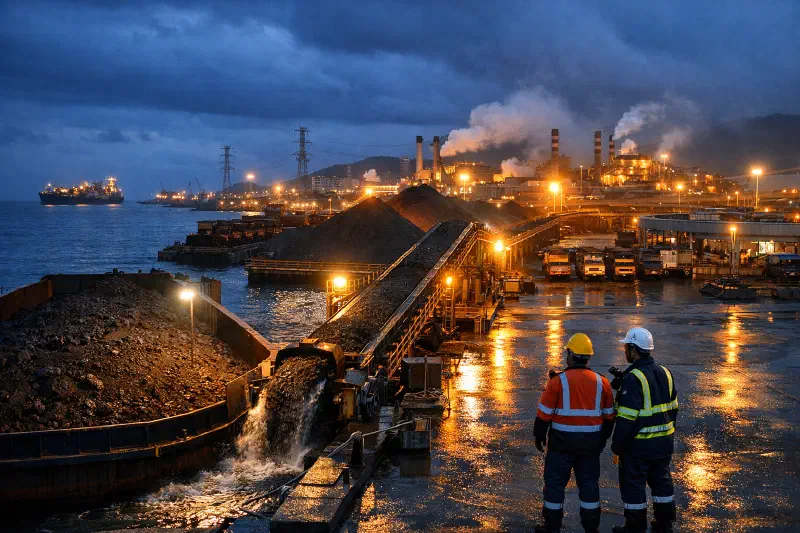
The most important margin in Indonesia’s nickel chain is no longer being set on the London Metal Exchange. It is being decided inside permit files in Jakarta and on the captive shoreline between ore barges, power blocks, and smelter gates in Morowali and Weda Bay.
That is the real meaning of H2’s so-called rebalance. Indonesia is not exiting the squeeze that hit nickel processors at the start of July. It is deciding who gets relief first.
In my June 18 analysis of nickel value capture, the key question was which layer of the chain was winning. In my July 3 article on downstream cost pressure, the question was why freight, geography, and policy were hitting processors simultaneously. Three weeks later, the picture is sharper. The state still wins first. The installed integrated parks defend margin best. The weakest layer remains the next wave of battery-material projects that still need fresh ore certainty to make their numbers work.
Rebalance does not mean relief #
The word rebalance is doing too much work in Jakarta’s nickel conversation. It sounds like a return to normal. It is not that.
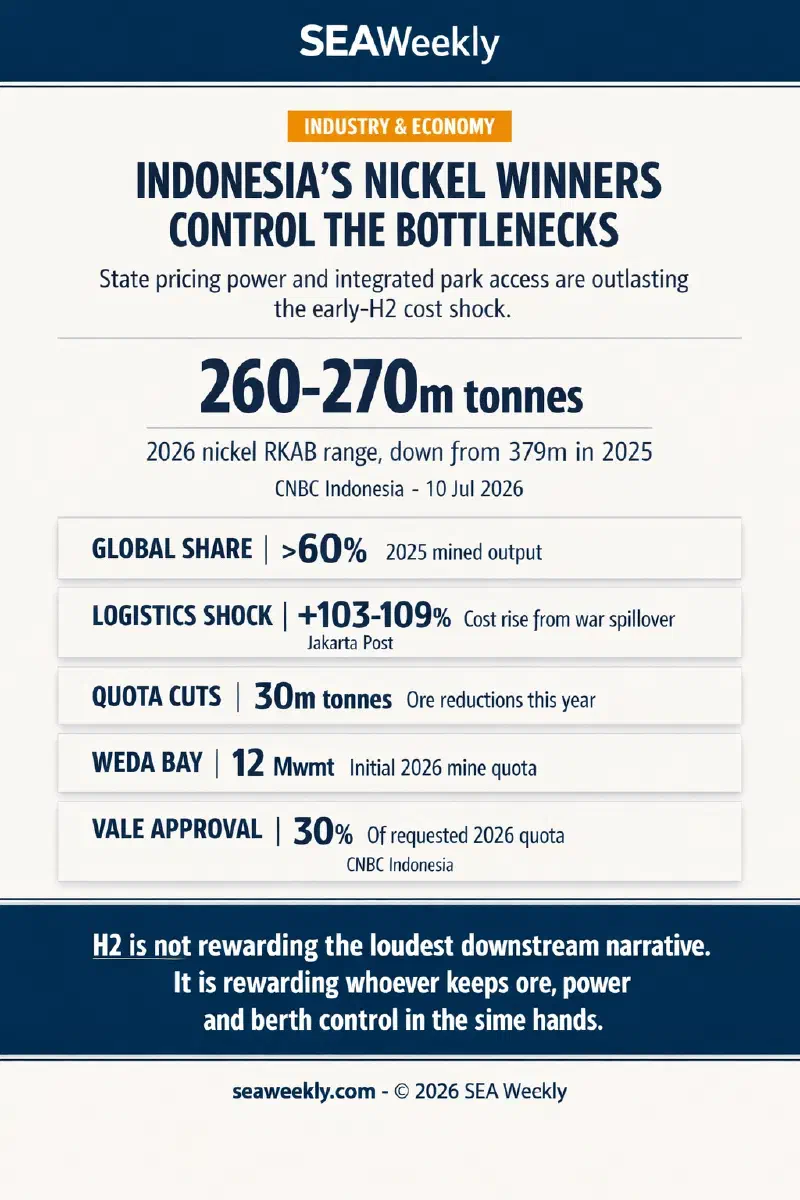
On July 10, the Energy Ministry said there would be no significant increase in nickel ore production this year. The working range for 2026 remains 260 million to 270 million tons, and any RKAB revisions will be selective, aimed only at smelters that are still short of ore rather than at reopening the taps across the system (CNBC Indonesia, July 10, 2026). That is already a very different stance from the 379 million ton RKAB benchmark for 2025 that industry participants had used as their comparison point earlier this year (CNBC Indonesia, June 8, 2026).
Reuters reported in May that Chinese firms said total ore reductions this year had reached 30 million metric tons, with cuts above 70% for some large mines. That complaint mattered not because it proved the industry was collapsing, but because it showed how tight the government’s new supply discipline had become (Reuters, May 13, 2026).
Then came the adjustment. On May 22, Jakarta exempted nickel pig iron, the bulk of Indonesia’s nickel exports, from its centralized export policy while keeping ferronickel inside the scheme (Reuters, May 22, 2026). That was not deregulation. It was calibration. The state stepped back just enough to avoid choking the volume engine while preserving the wider architecture of control.
So H2’s rebalance is not broad relief. It is selective survivability.
The state still wins first #
If the question is who wins first when the nickel chain is recalibrated, the answer is still the state.
In late March, Energy Minister Bahlil Lahadalia said President Prabowo had instructed him to find new mineral-sector revenue and that the nickel HPM benchmark would likely be raised because the state’s take had not been fair enough (CNBC Indonesia, March 27, 2026). In May, Reuters reported that exports of key commodities would move under the oversight of PT Danantara Sumber Daya during a transition period, with the explicit goals of limiting under-invoicing, boosting state earnings, stabilizing the rupiah, and enlarging foreign-exchange reserves (Reuters, May 20, 2026).
That is the deeper change in Indonesia’s nickel political economy. Jakarta is no longer satisfied with collecting royalties and taxes after the fact. It wants more influence over benchmark pricing, export routing, and foreign-currency capture before the margin is distributed downstream.
This matters because it clarifies why the government can keep talking about downstream ambition while still tightening ore supply. From Jakarta’s perspective, those are not contradictory moves. They are sequencing moves. First, protect the state’s claim on the resource. Then decide which parts of the industrial chain are strategic enough to be kept comfortably fed.
For private operators, that means relief arrives second.
The real downstream winner is the integrated park, not every smelter #
It is fashionable to read every investor complaint as evidence that Indonesia’s nickel model is breaking. The June 5 Reuters report makes the more sober case. Yes, Chinese groups such as Tsingshan and Lygend are exploring Madagascar, Tanzania, and New Caledonia as policy pressure rises. But the same report says those alternatives still lack Indonesia’s combination of scale, infrastructure, and ore access. Indonesia’s share of global mined nickel output rose to more than 60% in 2025, up from just over 30% in 2020 (Reuters, June 5, 2026).
That is why the real downstream winner in H2 is not “foreign capital” in the abstract and not even “the smelter sector” in the abstract. It is the installed operator sitting inside an integrated park that already has ore flows, berths, power, labor, and waste handling connected inside one system.
Reuters described PT Indonesia Morowali Industrial Park in February as Indonesia’s largest nickel-processing hub, with more than 50 tenants producing stainless-steel and EV-battery materials, and noted that Tsingshan is among its shareholders (Reuters, February 19, 2026). That concentration creates risk. It also creates resilience of a particular kind. When freight is expensive, inspections are slow, and ore allocations are tight, the best-positioned operator is the one minimizing external handoffs.
That is the hidden margin story of Morowali and Weda Bay. The value is not only in the furnace. It is in reducing the number of times a shipment needs somebody else’s truck, somebody else’s storage yard, or somebody else’s berth slot before revenue is realized.
Capex 2.0 is where the squeeze still sits #
The place where H2 still looks genuinely fragile is not the installed stainless-steel and midstream base. It is the next investment wave that Indonesia wants to sell as proof of deeper battery-industrial success.
CNBC Indonesia’s June 8 reporting laid out the problem in unusually concrete terms. PT Weda Bay Nickel said its initial 2026 approval was limited to 12 million wet metric tons, enough only until mid-May before the mine prepared for care-and-maintenance while awaiting a revision. PT Vale Indonesia said it had received approval for only 30% of its requested 2026 ore quota, even as it tries to feed three smelter projects with an estimated investment bill of US$8.7 billion (CNBC Indonesia, June 8, 2026).
The ore requirement numbers are the real warning. Vale said Pomalaa alone needs 21 million tons of limonite and 7 million tons of saprolite a year. Morowali needs another 10.4 million tons of limonite and 5.5 million tons of saprolite. Sorowako needs 11.5 million tons of limonite. Those are not small top-up requests. They are multi-year industrial commitments that need feedstock confidence before they need marketing language.
When Chinese investors complained in mid-June, Bahlil’s answer was telling: the government had not changed production capacity allocations, and companies needing extra feedstock could collaborate with others holding larger RKAB approvals (CNBC Indonesia, June 15, 2026). That response favors existing networks. It favors players already embedded in the system. It does not meaningfully solve the confidence problem for the next layer of HPAL and battery-material expansion.
This is why H2’s margin winner is narrower than the government’s downstream rhetoric suggests. The installed base can survive thinner spreads. The expansion layer still needs certainty it has not fully been given.
Logistics still decides who keeps the spread #
Even if Jakarta is becoming more selective about who gets ore relief, the logistics burden that hit the chain in early July has not disappeared. Indonesia’s manufacturing PMI fell to 46.9 in June, new export orders suffered their steepest fall since August 2021, and input price inflation reached its highest level since September 2013 (The Jakarta Post, July 1, 2026). A day later, the Indonesian Employers Association said geopolitical shocks had pushed logistics costs up by 103-109%, while exporters pressed the government to cut inspection friction and simplify quarantine rules (The Jakarta Post, July 2, 2026).
That is why the integrated-park advantage matters so much. The quota regime determines who gets ore. The logistics system determines whether that ore becomes margin.
A company with captive jetty access, internal material handling, and a clearer route from stockpile to furnace to export berth can still operate under stress. A company that relies on more fragmented trucking, more paperwork stops, and more third-party handoffs keeps paying the shock at every gate. The government’s promised single-inspection and single-submission reforms are directionally right. They do not erase the H2 hierarchy quickly enough to change the winner today.
Even the strongest operators are not immune. Reuters’ February report on the Morowali landslide, which halted operations in a mine-waste zone at a PT QMB site and killed one contractor, is a reminder that concentrated control also concentrates operational risk (Reuters, February 19, 2026). But concentrated control still gives incumbents a better chance of absorbing the shock inside one system instead of across five different ones.
So who is winning Indonesia’s nickel value chain in H2? The state is still winning in rent capture and control. The integrated industrial-park incumbents are winning in relative survivability. The next-wave HPAL and battery-material projects are only conditional winners, and only if selective relief turns into durable feedstock confidence rather than ad hoc calibration.
That is the uncomfortable update to the Indonesia nickel story. The chain is not yet rewarding the broad promise of downstreaming equally. It is rewarding the actors that already own the bottlenecks.
H2 is not rewarding the loudest downstream narrative. It is rewarding whoever keeps ore, power and berth control in the same hands.
Have a question, correction, or on-the-ground signal from Indonesia’s nickel corridor? I would like to hear it.
Email me at editorial@seaweekly.com
References #
- Reuters (February 19, 2026). “Landslide in Indonesia’s Morowali nickel hub kills one, halts operations.” https://www.reuters.com/world/asia-pacific/landslide-indonesias-morowali-nickel-hub-kills-one-halts-operations-2026-02-19/ (Accessed July 23, 2026)
- CNBC Indonesia (March 27, 2026). “Siap-Siap Harga Patokan Mineral Nikel Naik, Ini Alasannya.” https://www.cnbcindonesia.com/news/20260327112813-4-721838/siap-siap-harga-patokan-mineral-nikel-naik-ini-alasannya (Accessed July 23, 2026)
- Reuters (May 13, 2026). “Chinese firms warn Indonesia’s nickel quotas, tax hikes threaten investment.” https://www.reuters.com/world/asia-pacific/chinese-firms-warn-indonesias-nickel-quotas-tax-hikes-threaten-investment-2026-05-13/ (Accessed July 23, 2026)
- Reuters (May 20, 2026). “What is Indonesia’s new plan to control export of key commodities?” https://www.reuters.com/business/energy/what-is-indonesias-new-plan-control-export-key-commodities-2026-05-20/ (Accessed July 23, 2026)
- Reuters (May 22, 2026). “Indonesia to exempt nickel pig iron and some palm oil derivatives from centralised export policy.” https://www.reuters.com/world/asia-pacific/indonesia-exempt-nickel-pig-iron-some-palm-oil-derivatives-centralised-export-2026-05-22/ (Accessed July 23, 2026)
- Reuters (June 5, 2026). “Focus: Chinese investors behind Indonesia’s nickel boom scout alternatives as policy changes bite.” https://www.reuters.com/world/asia-pacific/chinese-investors-behind-indonesias-nickel-boom-scout-alternatives-policy-2026-06-05/ (Accessed July 23, 2026)
- CNBC Indonesia (June 8, 2026). “Bahlil Pastikan Kapasitas Pabrik Hilirisasi & RKAB Seimbang.” https://www.cnbcindonesia.com/news/20260608160941-4-741108/bahlil-pastikan-kapasitas-pabrik-hilirisasi-rkab-seimbang (Accessed July 23, 2026)
- CNBC Indonesia (June 15, 2026). “Investor Smelter Nikel China Keluhkan RKAB Tambang, Ini Jawaban Bahlil.” https://www.cnbcindonesia.com/news/20260615190330-4-743055/investor-smelter-nikel-china-keluhkan-rkab-tambang-ini-jawaban-bahlil (Accessed July 23, 2026)
- The Jakarta Post (July 1, 2026). “RI factories slide into contraction in June amid soaring costs, weak demand.” https://www.thejakartapost.com/business/2026/07/01/ri-factories-slide-into-contraction-in-june-amid-soaring-costs-weak-demand (Accessed July 23, 2026)
- The Jakarta Post (July 2, 2026). “Businesses urge easing of quarantine rules amid rising logistics costs.” https://www.thejakartapost.com/business/2026/07/02/businesses-urge-easing-of-quarantine-rules-amid-rising-logistics-costs (Accessed July 23, 2026)
- CNBC Indonesia (July 10, 2026). “Pemerintah Pastikan Smelter Nikel Takkan Kekurangan Suplai Bijih.” https://www.cnbcindonesia.com/news/20260710200447-4-749976/pemerintah-pastikan-smelter-nikel-takkan-kekurangan-suplai-bijih (Accessed July 23, 2026)