
Brunei is not suddenly becoming ASEAN’s next great shipping hub. What is changing is the price the region is willing to pay for a smaller energy node that can still load LNG, fertilizer and refined products into Asian demand lanes when the straight line through the Gulf looks politically unsafe.
That distinction matters because the peacetime ranking of ports is not the same as the stressed-market ranking of useful logistics assets. When the question changes from “who moves the most volume?” to “who can still get molecules and cargo moving when the obvious route looks risky?”, Brunei starts to look less peripheral than its port statistics suggest.
Route stress changed what “position” means #
The simplest way to misread Brunei in 2026 is to use a calm-year map. The market is not operating on a calm-year map.
Reuters’ Jul. 16 poll on Gulf economies made the commercial point bluntly: the issue is not only oil price but the physical ability to move hydrocarbons, goods and people through one of the world’s most important chokepoints, with businesses increasingly at risk of permanently pricing in a higher geopolitical premium (Reuters, Jul. 16, 2026). Nikkei Asia reported two weeks earlier that tanker traffic through the Strait of Hormuz had climbed after the U.S.-Iran memorandum, but still only to 25% of prewar level (Nikkei Asia, Jun. 26, 2026). Reuters followed on Jun. 29 by noting that outbound Persian Gulf crude exports had rebounded to at least 75% of pre-war levels, yet traffic remained far from fully recovered because insurance, mines and route risk were still weighing on shipowners (Reuters, Jun. 29, 2026).
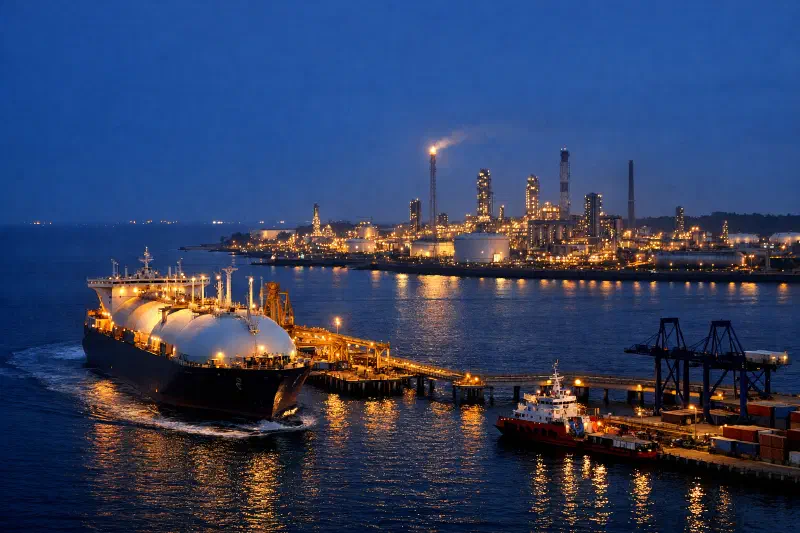
That is why Brunei’s position is being reassessed. Not because it can replace Gulf volumes. It cannot. But because a small exporter sitting inside Asia-Pacific demand circuits and outside the chokepoint itself becomes more useful when buyers, traders and shipping managers stop assuming the shortest route is automatically the safest one.
Nikkei’s Jun. 28 Caixin-backed report on Chinese ship managers captured the operating version of the same point. Even after diplomacy resumed, maritime security incidents were still extending voyage times and complicating scheduling, leaving companies to manage a new normal rather than a clean reset (Nikkei Asia, Jun. 28, 2026). In that kind of market, redundancy itself becomes a product.
Brunei’s energy stack is more tradeable than outsiders assume #
This is where Brunei’s story gets more interesting than its usual caricature as a quiet hydrocarbon monarchy with good reserves and thin market relevance.
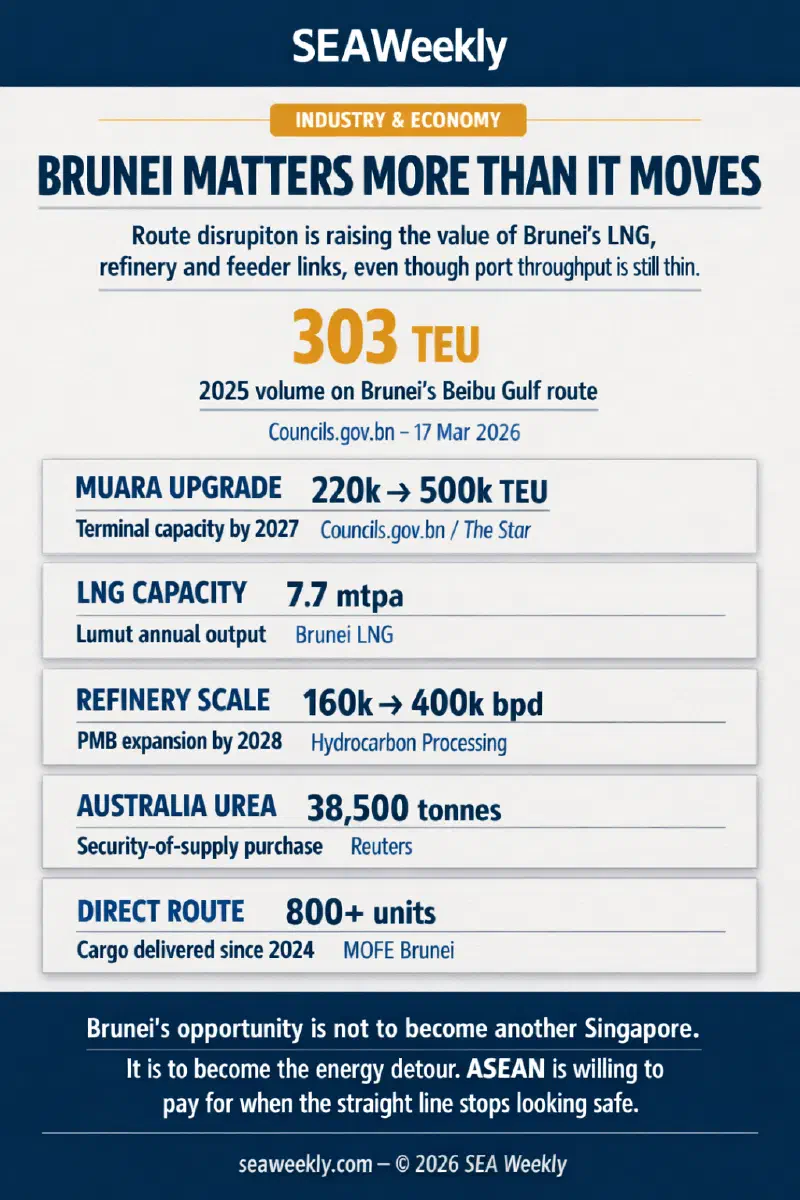
Brunei LNG says its Lumut complex can produce about 7.7 million tonnes of LNG a year, with cargo loaded onto dedicated carriers serving customers across the Asia-Pacific region (Brunei LNG, Products). The plant page adds the more logistical detail that matters in a stressed routing cycle: five liquefaction trains, a B$500 million rejuvenation program, two new storage tanks, a modern loading jetty, and total storage of 195,000 cubic metres (Brunei LNG, The Plant). Those are not abstract national-balance-sheet facts. They are loading, storage and reliability facts.
The same applies further down the value chain. Reuters reported in May that Australia secured 38,500 metric tons of urea from Brunei through a new A$7.5 billion fuel and fertiliser security facility created to manage Iran-war disruption (Reuters, May 19, 2026). That is one of the cleanest signs available that Brunei has already entered the region’s security-of-supply calculation. The country was not being discussed as an ideological diversification case. It was being used as a practical source of molecules in a disrupted market.
The refinery layer deepens that story. In January, Hengyi confirmed it would proceed with phase two of its Pulau Muara Besar refinery and petrochemical project, taking total refining capacity to 20 million metric tons per year, or 400,000 barrels a day, by the end of 2028 from the current 160,000 barrels a day (Hydrocarbon Processing, Jan. 6, 2026, The Business Times, Jan. 6, 2026). Diesel, paraxylene, benzene and polypropylene are not just industrial policy outputs. They widen the set of products Brunei can send into regional demand when route security matters more than textbook efficiency.
That connects directly to an argument Siti and I made in our June 11 piece on Brunei’s diversification effort: the downstream asset base is real, but the pieces are not yet fully connected. What is new in late July is that route volatility makes those downstream pieces strategically more valuable even before Brunei has perfected the broader ecosystem around them.
The logistics layer is real, but still thin #
This is where the article needs discipline. The risk in writing about Brunei now is to confuse higher relevance with hub status.
Muara Port Company says the Muara Container Terminal handles all containerized import and export cargoes in Brunei. The operating footprint is real: a 250-metre berth, 12.5-metre draught, reefer capability, dangerous-goods handling, and performance targets of 23 quay-crane units an hour, 33 vessel units an hour, and a 30-minute haulier turnaround (Muara Port Company). That is a serious working terminal. It is not a mega-hub.
The Brunei state’s own disclosures make that contrast even clearer. In March, the transport minister said the Muara expansion project would double capacity from 220,000 TEU to 500,000 TEU by 2027 while also supporting a wider trade-zone and service build-out (The Star, Mar. 15, 2026). But the more revealing figure came from the Department of Councils of State two days later: the Guangxi Beibu Gulf-Muara route recorded only 303 TEU in 2025, and some shipments still needed transshipment through intermediary ports because cargo volume remained underdeveloped (Councils.gov.bn, Mar. 17, 2026).
That tiny number is the best reality check in the whole story. Brunei’s strategic value may be rising faster than its live throughput.
Yet the same report is why the reassessment is not imaginary. Officials highlighted maiden calls that were widening connectivity to China, Vietnam, Malaysia, Thailand and Singapore, plus studies into ship-to-ship facilities, lay-up areas, free-trade services and incentive mechanisms to attract shipping lines. In February, the Finance Ministry launched NEXT Bahtera Maritime’s direct service linking Brunei with major ports in China, South Korea, Indonesia and the Philippines, noting that the vessel had already carried more than 800 units of cargo to Brunei since 2024 and was expected to deliver more than 100 more that month (MOFE, Feb. 2, 2026).
From a Singapore lens, these are small numbers. From a Brunei lens, they are strategic because they buy the country something it has often lacked: a little more schedule control and a little less dependence on somebody else’s routing priorities.
That is the logistics version of the intermediation problem I described in my June 25 comparison of Brunei and Singapore. In finance, Brunei has credibility without enough velocity. In logistics, it has energy molecules without enough service depth around them. The current reassessment matters because it suggests the service layer is starting to move, even if from a low base.
Siti’s take: The market will not reward Brunei simply for owning useful energy assets. It will reward Brunei if those assets sit inside a logistics system that can hold inventory, stage cargo, shorten handoffs and offer enough shipping certainty for a buyer to pay for the fallback option. The urea shipment to Australia is a proof point, not a finished strategy. Hengyi’s second phase can broaden Brunei’s exportable energy-product stack, and Muara’s expansion can improve the physical port layer. But unless ship-to-ship services, trade-zone activity, storage, and direct-route density scale with those assets, a lot of the premium will still be captured by traders, shipowners and larger redistribution hubs elsewhere. In other words, Brunei is becoming more useful. The harder question is whether it becomes more profitable.
What Brunei can actually win #
The smartest Brunei reading for H2 2026 is narrower than the grand rhetoric and stronger than the old dismissal.
Brunei is not about to out-Singapore Singapore on velocity. Daniel’s July 17 article on Singapore’s logistics integration showed what a full resilience-rental model looks like: port, air cargo, warehousing and finance stacked tightly enough that shippers can pay a premium for recovery speed. Brunei does not yet have that stack.
What it may have instead is something smaller and more believable: a specialized energy detour. A place where LNG, LPG, fertilizer and eventually a larger slate of refined products can move into Asia-facing demand even when the obvious corridor is politically noisy. A BIMP-EAGA and Borneo-facing maritime node that becomes more interesting as regional buyers care less about theoretical network breadth and more about whether a real cargo can actually be loaded this month.
That is also the most defensible way to read the state’s own maritime strategy. When MTIC launched MPABD’s Navigating 2030 plan, it framed maritime and ports as a pillar of competitiveness and resilience, with diversified port activities, expanded maritime services, digitalization and a more active ASEAN and BIMP-EAGA role explicitly on the agenda (MTIC, Dec. 11, 2025). The strategy is not subtle: Brunei wants to turn maritime relevance into a larger part of its non-upstream economic future.
Whether that ambition sticks will depend less on speeches than on execution. Watch whether Muara’s expansion stays on schedule. Watch whether the direct services scale beyond hundreds of units. Watch whether ship-to-ship and lay-up services move from study phase to billable reality. Watch whether Brunei’s energy assets are increasingly tied to port-adjacent logistics services rather than just loaded and sent away.
If those pieces connect while route risk stays elevated, Brunei’s logistics position will keep improving. If they do not, the current reassessment will prove to be a temporary premium on geography rather than a durable upgrade in capability.
Brunei’s opportunity is not to become another Singapore. It is to become the energy detour ASEAN is willing to pay for when the straight line stops looking safe.
References #
- Reuters (July 16, 2026). “POLL Most Gulf area economies face deeper downturns this year on Hormuz disruption.” https://www.reuters.com/world/middle-east/most-gulf-area-economies-face-deeper-downturns-this-year-hormuz-disruption-2026-07-16/ (Accessed July 21, 2026)
- Nikkei Asia (June 26, 2026). “Hormuz tanker traffic climbs to 25% of prewar level.” https://asia.nikkei.com/spotlight/iran-tensions/iran-war/hormuz-tanker-traffic-climbs-to-25-of-prewar-level (Accessed July 21, 2026)
- Nikkei Asia / Caixin (June 28, 2026). “How China’s ship managers help fleets navigate a changing Strait of Hormuz.” https://asia.nikkei.com/spotlight/caixin/how-china-s-ship-managers-help-fleets-navigate-a-changing-strait-of-hormuz (Accessed July 21, 2026)
- Reuters (June 29, 2026). “Oil settles up on US-Iran strikes; cautious hopes for shipping cap gains.” https://www.reuters.com/business/energy/oil-climbs-following-renewed-us-iran-strikes-middle-east-2026-06-28/ (Accessed July 21, 2026)
- Reuters (May 19, 2026). “Australia secures more jet fuel from China, urea from Brunei.” https://www.reuters.com/world/asia-pacific/australia-secures-more-jet-fuel-china-urea-brunei-2026-05-19/ (Accessed July 21, 2026)
- Brunei LNG. “Our Products.” https://bruneilng.com/products/ (Accessed July 21, 2026)
- Brunei LNG. “The Plant.” https://bruneilng.com/the-plant/ (Accessed July 21, 2026)
- Hydrocarbon Processing (January 6, 2026). “China’s Hengyi Petrochemical to proceed with Brunei refinery expansion.” https://www.hydrocarbonprocessing.com/news/2026/01/chinas-hengyi-petrochemical-to-proceed-with-brunei-refinery-expansion/ (Accessed July 21, 2026)
- The Business Times (January 6, 2026). “China’s Hengyi pushes ahead with Brunei oil refinery expansion.” https://www.businesstimes.com.sg/companies-markets/energy-commodities/chinas-hengyi-pushes-ahead-brunei-oil-refinery-expansion (Accessed July 21, 2026)
- Ministry of Finance and Economy, Brunei Darussalam (February 2, 2026). “NEXT Bahtera Maritime Sdn Bhd Opens New Shipping Route to Brunei.” https://www.mofe.gov.bn/2026/02/02/pr_02022026_newshippigroute/ (Accessed July 21, 2026)
- Department of Councils of State, Brunei Darussalam (March 17, 2026). “New container terminal to double port’s capacity.” https://www.councils.gov.bn/17-03-26-new-container-terminal-to-double-ports-capacity/ (Accessed July 21, 2026)
- The Star / Xinhua (March 15, 2026). “Brunei is expanding Muara Port capacity to strengthen the logistics sector and achieve international recognition.” https://www.thestar.com.my/aseanplus/aseanplus-news/2026/03/15/brunei-is-expanding-muara-port-capacity-to-strengthen-the-logistics-sector-and-achieve-international-recognition (Accessed July 21, 2026)
- Muara Port Company. “Muara Container Terminal.” https://www.muaraportcompany.com.bn/services/container-terminal/ (Accessed July 21, 2026)
- Ministry of Transport and Infocommunications, Brunei Darussalam (December 11, 2025). “The Launch of the Navigating 2030 MPABD Five-Year Strategic Plan.” https://www.mtic.gov.bn/Lists/News/NewDisplay.aspx?ID=319 (Accessed July 21, 2026)
- SEA Weekly (June 11, 2026). “Who Is Winning Brunei Investment Diversification Beyond Hydrocarbons in 2026?” https://seaweekly.com/posts/2026-06-11-brunei-investment-diversification/ (Accessed July 21, 2026)
- SEA Weekly (June 25, 2026). “Who is winning Brunei vs Singapore regional finance positioning for ASEAN capital flows?” https://seaweekly.com/posts/2026-06-25-brunei-singapore-regional-finance-positioning-asean-capital-flows/ (Accessed July 21, 2026)
- SEA Weekly (July 8, 2026). “Why Malaysia logistics cost efficiency is becoming a competitive differentiator in ASEAN electronics supply chains.” https://seaweekly.com/posts/2026-07-08-malaysia-logistics-cost-efficiency-asean-electronics-supply-chains/ (Accessed July 21, 2026)
- SEA Weekly (July 17, 2026). “How Singapore’s logistics integration anchors ASEAN supply chain resilience as Q3 pressures intensify.” https://seaweekly.com/posts/2026-07-17-singapore-logistics-integration-anchors-asean-supply-chain-resilience-q3-pressures/ (Accessed July 21, 2026)