
The freight number most people quote about the Laos-China Railway this summer is 10 million tonnes. It is impressive, and it is also no longer the most interesting one.
The harder question in July 2026 is not whether the railway can move cargo. It already can. The harder question is whether Laos can capture more of the margin once the train reaches the interchange: customs, cold chain, container handling, gauge transfer, warehousing, consolidation, and the onward route into Thailand, Vietnam, Malaysia, and China.
The line has already cleared the proof-of-concept stage #
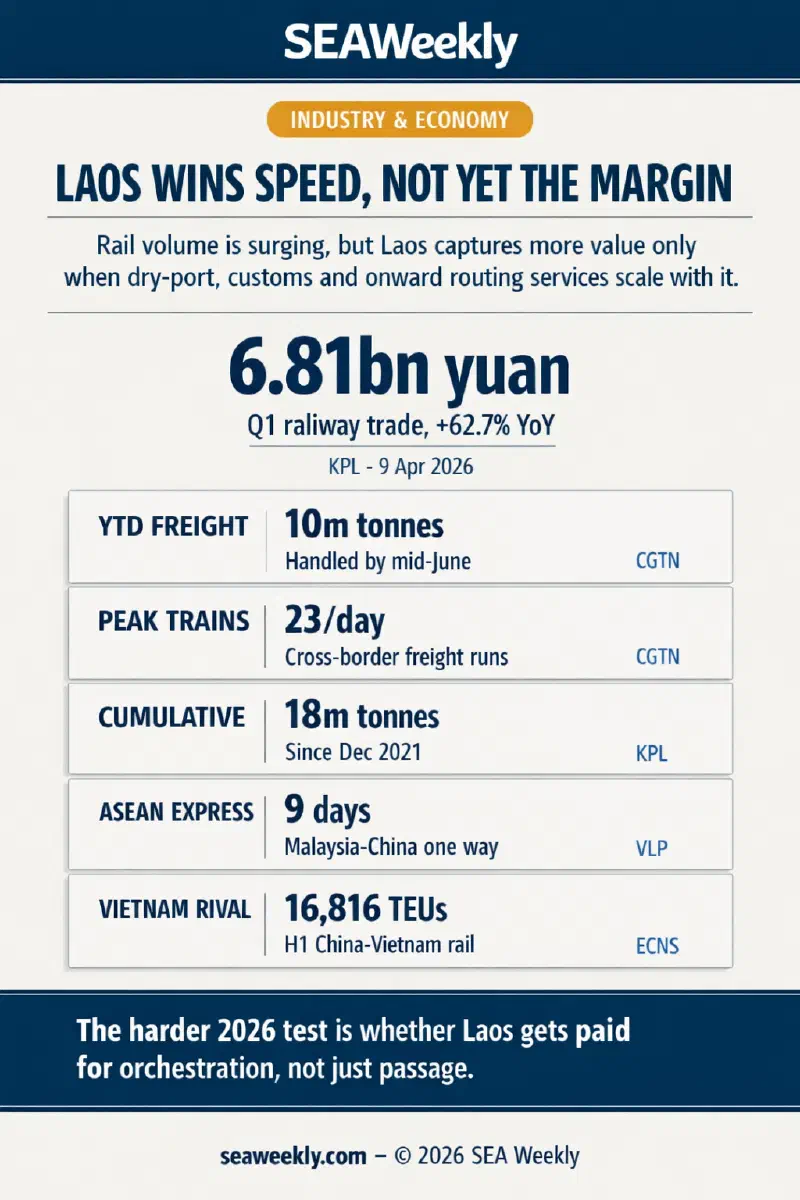
There is no serious case left for treating the Laos-China Railway as a symbolic Belt and Road success that still needs to prove commercial relevance. The traffic is already too large for that. KPL reported in April that trade carried on the line jumped 62.7% year on year in the first quarter to 6.81 billion yuan, or about USD 992 million, and that cumulative trade moved since opening had already exceeded 80 billion yuan across more than 6,000 companies and over 3,800 goods categories (KPL, April 9, 2026).
The June operating data is stronger still. According to CGTN, the railway had already handled more than 10 million tonnes of freight in 2026 by mid-June. Average daily freight volume had passed 67,000 tonnes, cross-border cargo had exceeded 2.5 million tonnes, peak cross-border train frequency had risen from two a day at the start of operations to 23, and hauling capacity per train had increased from 2,000 tonnes to 2,800 tonnes (CGTN, June 14, 2026).
Those are not vanity metrics. They tell you the line is now a live commercial system carrying meaningful trade flows rather than a prestige route awaiting volume. KPL’s March update made the same point from a longer horizon: cumulative cross-border cargo since the December 2021 launch had already topped 18 million tonnes, 2025 cross-border volume reached 5.46 million tonnes, up 14% year on year, and the network had broadened to 31 provincial-level regions in China and 19 partner countries, including Thailand and Vietnam (KPL, March 12, 2026).
That is why the easy part of the railway story is over. The route works. The harder part starts now: once the line is proven, where does the next layer of value sit?
The real freight economics sit at Thanaleng, not only on the track #
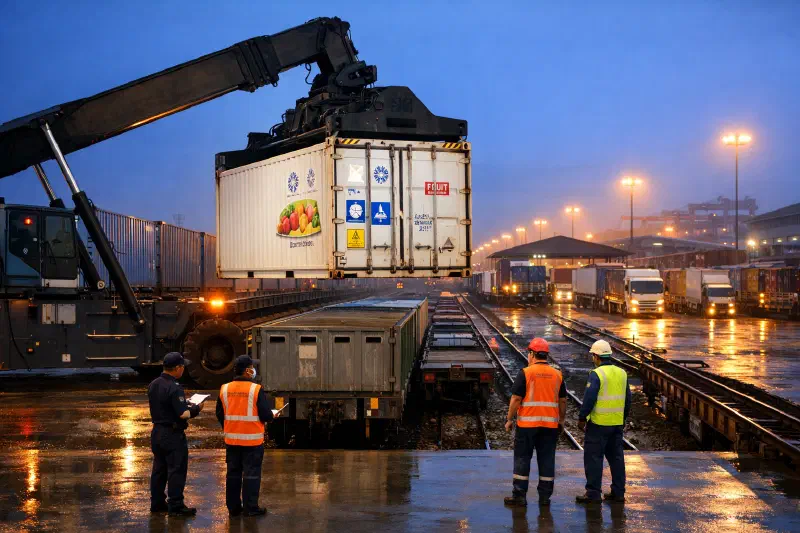
The cleanest clue comes from the kind of cargo that benefits first. Vientiane Times described the railway in February as an economic lifeline because it has reduced transport time, stabilized freight charges, and made it easier for agricultural exporters to reach Chinese buyers with less spoilage and less uncertainty. Its example was not abstract: an 85.5-tonne shipment of Lao bananas traveled from Vientiane to Chongqing in five 40-foot containers as the first fully dedicated end-to-end rail shipment of Lao bananas to China (Vientiane Times, February 26, 2026).
That matters because it identifies the railway’s current economic sweet spot. The biggest gain is not simply that goods move north faster. It is that time-sensitive cargo now has a more predictable inland route and a more stable cost profile than it often gets on volatile sea lanes. For fruit, food, selected intermediate goods, and any shipment where shrinkage or delay eats the margin, the railway changes the economics immediately.
But Vientiane Times also pointed to the limit. The paper said Laos still needs more logistics hubs, cargo distribution centers, and modern sorting and packaging systems if it wants to convert rising throughput into deeper competitiveness. That caveat is the real story. Once a train arrives, the economic rent shifts toward the node that clears the goods, consolidates them, holds them, inspects them, and routes them onward.
That is exactly what Thanaleng Dry Port and the broader Vientiane Logistics Park are built to do. The operator’s official materials say the project is designed to reduce Laos’ logistics costs, provide single-window facilitation, expand Less than Container Load services, diversify value-added logistics functions, and improve revenue collection on cross-border and transit movement under a 50-year PPP framework with regional partners including Kerry Logistics, COSCO Shipping, PLG Integrated Logistics, and Nippon Express (Vientiane Logistics Park, accessed July 21, 2026).
The most concrete operating description of that logic remains a Vientiane Logistics Park feature from late 2024. It said Thanaleng provides single-window customs clearance for rail transport and contains a container yard where the standard-gauge Laos-China Railway and the one-metre-gauge Laos-Thailand railway run in parallel, making direct transfer possible. It also said the ASEAN Express route linking Malaysia, Thailand, Laos and Chongqing cut one-way transit to nine days versus 14 to 21 days by sea, with roughly 20% cost savings, while Thanaleng handled 49,183 containers in 2022 and had been growing 30% to 40% a year (Vientiane Logistics Park / Somsanith Chanthaseng, October 30, 2024).
That is the level where the margin story gets interesting. A rail line can generate throughput. A dry port can charge for orchestration.
I made a similar argument in my June 24 analysis of Laos’ hydropower export economics: once an export system matures, the durable value often sits less with the headline asset and more with the corridor manager. Freight is arriving at the same conclusion. The line matters. The interchange matters more.
Competition is intensifying because rival inland corridors are no longer standing still #
This would already matter if the Laos-China Railway were only competing against older, slower sea routes. It matters more because it is not.
China-Vietnam’s inland corridor is compressing time and friction aggressively. China Railway said in April that regularized cross-border freight operations had raised scheduled weekly trains from three to 14, while same-day departure, same-day arrival, and same-day customs clearance were becoming standard. It claimed station-to-station transit from Nanning to Hanoi could be as fast as 14 hours, and that cross-border express delivery could be completed within 12 hours under a single declaration, single inspection, single release model (China Railway, April 16, 2026).
By mid-July, that service had gone daily. Global Times reported that China-Vietnam freight trains moved 16,816 TEUs of export cargo in the first half of 2026, including 8,940 TEUs in the second quarter alone, up 13.5% from the first quarter. It added that optimized procedures had reduced fresh-cargo processing to about two hours (Global Times, July 14, 2026). ECNS repeated the same 16,816-container H1 total a week later and noted that Pingxiang railway port handled 2,276 containers of imported fruit in the first half, up 50.8% year on year (ECNS, July 21, 2026).
That is the competitive pressure Laos now faces. First-mover advantage is no longer enough. The Laos-China Railway can still be the region’s most consequential frontier-corridor story without being the only inland route that is getting faster, easier, and more customs-efficient.
This is also where some of the earlier Laos coverage needs refining. In my July 7 article on Cambodia versus Laos garment lead times, I argued that buyers were often misreading the railway as a universal export advantage when it was strongest on the input side. The freight story is broader than garments, but the logic is similar. A fast train to Vientiane is not the same thing as a frictionless ASEAN delivery chain. The economic win comes when the transfer after Vientiane is as disciplined as the rail segment before it.
Sea stress makes the railway look better, but it does not settle the argument #
Part of the railway’s current shine comes from what it is competing against. DHL’s July ocean-freight update says effective global capacity remains constrained by port congestion and ongoing Suez detours, while freight rates are still 84% above last year even though fleet capacity is expanding (DHL, July 2026). Portcast’s weekly congestion snapshot still showed waiting times of 4.24 days at Jeddah, 3.54 days at Sohar, 3.48 days at Kota Kinabalu, and 2.94 days at Manila South Harbor in the July 6-12 week, with other ports showing long-tail delay risk that can disrupt specific shipments even when headline averages look manageable (Portcast, July 14, 2026).
That environment makes inland predictability look more valuable. If the sea lane is cheap but erratic, rail does not have to beat it on nominal cost every time. It only has to beat it on the cost of uncertainty for the cargo that cares most about timing.
Still, this is where the story can get overclaimed. The Vientiane Logistics Park material itself says sea shipping is typically cheaper. Rail wins hardest for cargo that benefits from quicker shelf arrival, lower spoilage, or tighter planning windows. It does not replace the maritime system. It reprices which shipments and which logistics services can command a premium while the maritime system remains noisy.
In other words, the railway’s traffic surge should not be mistaken for automatic national capture of the best economics. Some of the value currently created by rail reliability will be taken by Chinese buyers, some by logistics managers, some by the dry port, and some by rival corridors that plug into the same regional trade reconfiguration more efficiently.
What Laos has to capture next #
The railway has already shown that Laos can stop being described only as landlocked and start behaving like a land-linked corridor economy. The next test is narrower and harder: can Laos become the place that handles, clears, stores, inspects, and reroutes cargo well enough to keep more of the logistics income for itself?
That means scaling exactly the things Vientiane Times and Vientiane Logistics Park say are still unfinished: distribution centers, sorting and packaging systems, warehousing, value-added services, transparent revenue collection, and the kind of customs discipline that makes an inland node feel as reliable as the rail line feeding it.
If those layers improve, the Laos-China Railway becomes more than a fast track into China. It becomes a platform from which Laos can sell reliability to the rest of ASEAN. If they do not, the trains will continue to run and the headlines will stay impressive, but a larger share of the best economics will pool elsewhere.
The harder 2026 test is whether Laos gets paid for orchestration, not just passage.
Have a question or a reporting lead on Laos corridor logistics? I’d like to hear from you.
For now, email the editorial desk at editorial@seaweekly.com and mention Nguyen Minh An.
References #
- KPL (April 9, 2026). “Laos-China Railway trade jumps 62.7% in early 2026, reaching record level.” https://kpl.gov.la/EN/detail.aspx?id=97758 (Accessed July 21, 2026)
- CGTN (June 14, 2026). “China-Laos Railway freight volume exceeds 10 mln tonnes in 2026.” https://news.cgtn.com/news/2026-06-14/China-Laos-Railway-freight-volume-exceeds-10-mln-tonnes-in-2026-1NYAQ4xh50A/p.html (Accessed July 21, 2026)
- KPL (March 12, 2026). “China-Laos Railway Handles Over 18 Million Tonnes of Cross-Border Cargo.” https://kpl.gov.la/En/detail.aspx?id=97361 (Accessed July 21, 2026)
- Vientiane Times (February 26, 2026). “Laos-China Railway drives trade, tourism growth in 2026.” https://www.vientianetimes.org.la/freefreenews/freecontent_040_Laos_China_y26.php (Accessed July 21, 2026)
- Vientiane Logistics Park (Accessed July 21, 2026). “About Us.” https://vientianelogisticspark.com/about-us/
- Vientiane Logistics Park / Somsanith Chanthaseng (October 30, 2024). “Laos set to become regional logistics connector, offering ‘great opportunities’.” https://vientianelogisticspark.com/2024-022/ (Accessed July 21, 2026)
- China Railway (April 16, 2026). “China-Vietnam Freight Train Services Become Regularized.” http://wap.china-railway.com.cn/english/news/202604/t20260413_155475.html (Accessed July 21, 2026)
- Global Times (July 14, 2026). “China-Vietnam freight trains shift to daily schedule, driving cross-border trade growth.” https://www.globaltimes.cn/page/202607/1365937.shtml (Accessed July 21, 2026)
- ECNS (July 21, 2026). “China-Vietnam freight trains ship 16,816 containers in H1.” https://www.ecns.cn/cns-wire/2026-07-21/detail-ihfhqwkz8162528.shtml (Accessed July 21, 2026)
- DHL (July 2026). “Ocean Freight Market Update.” https://www.dhl.com/th-en/home/global-forwarding/latest-news-and-webinars/ocean-freight-market-update.html (Accessed July 21, 2026)
- Portcast (July 14, 2026). “Port Congestion Snapshot: Live Vessel Wait Times (Updated Weekly).” https://www.portcast.io/blog/port-congestion-snapshot (Accessed July 21, 2026)
- SEAWeekly / Nguyen Minh An (June 24, 2026). “What’s driving Laos hydropower export economics in ASEAN energy trade?” https://seaweekly.com/posts/2026-06-24-laos-hydropower-export-economics-asean-energy-trade/ (Accessed July 21, 2026)
- SEAWeekly / Nguyen Minh An (July 7, 2026). “How Cambodia vs Laos garment export lead times are diverging as order-book pressure builds in H2.” https://seaweekly.com/posts/2026-07-07-cambodia-laos-garment-export-lead-times-diverging-order-book-h2/ (Accessed July 21, 2026)