
Peak season is supposed to tell you which destination has demand. In Southeast Asian tourism, it more often tells you which destination has a machine.
Thailand and the Philippines are both entering the second-half travel window under higher fuel costs, tighter airline scheduling, and more cautious group bookings. The difference is that Thailand is managing the strain like an operator with pricing power, while the Philippines is still managing it like a market trying to keep a bottleneck from scaring demand away.
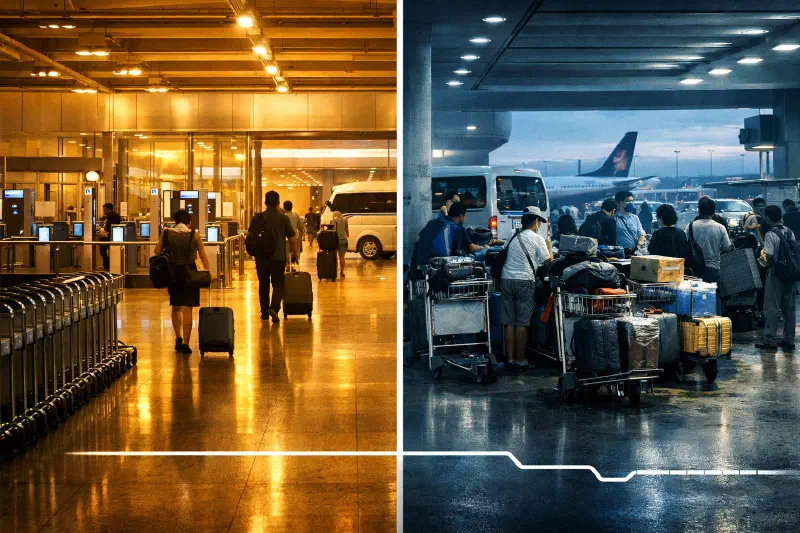
Tourism supply chains are just handoffs: visa, seat, gate, transfer, room night, and sometimes one more domestic flight or ferry. Peak season exposes which handoff can still carry margin when every cost line rises at once.
Thailand is charging for throughput because it trusts the system #
Thailand’s tourism machine is under pressure, but it is still behaving like a system that believes travellers and operators will pay for order. The Ministry of Tourism and Sports reported that the country welcomed 16,210,890 foreign visitors between Jan. 1 and Jul. 4, generating THB 782.57 billion in revenue even as arrivals were down 3.11 percent year on year. A month earlier, at TTM+ 2026 in Pattaya, the Tourism Authority of Thailand said the country had already passed 14 million international visitors and THB 679 billion in revenue as of Jun. 2, while still targeting 33 million arrivals and THB 2.65 trillion in total tourism revenue for the year.
That target only looks believable if you understand that Thailand is not just selling rooms and seats. It is selling a better-instrumented chain. TTM+ 2026 itself generated more than 15,000 business appointments and an expected THB 5.08 billion in tourism revenue, up 12.9 percent from 2025. That matters because buyer confidence is one of the least appreciated inputs in tourism operations. When tour wholesalers, event buyers, airlines, and premium hotel operators keep committing forward, the system can treat peak season as a yield-managed operating problem rather than a scramble for occupancy.
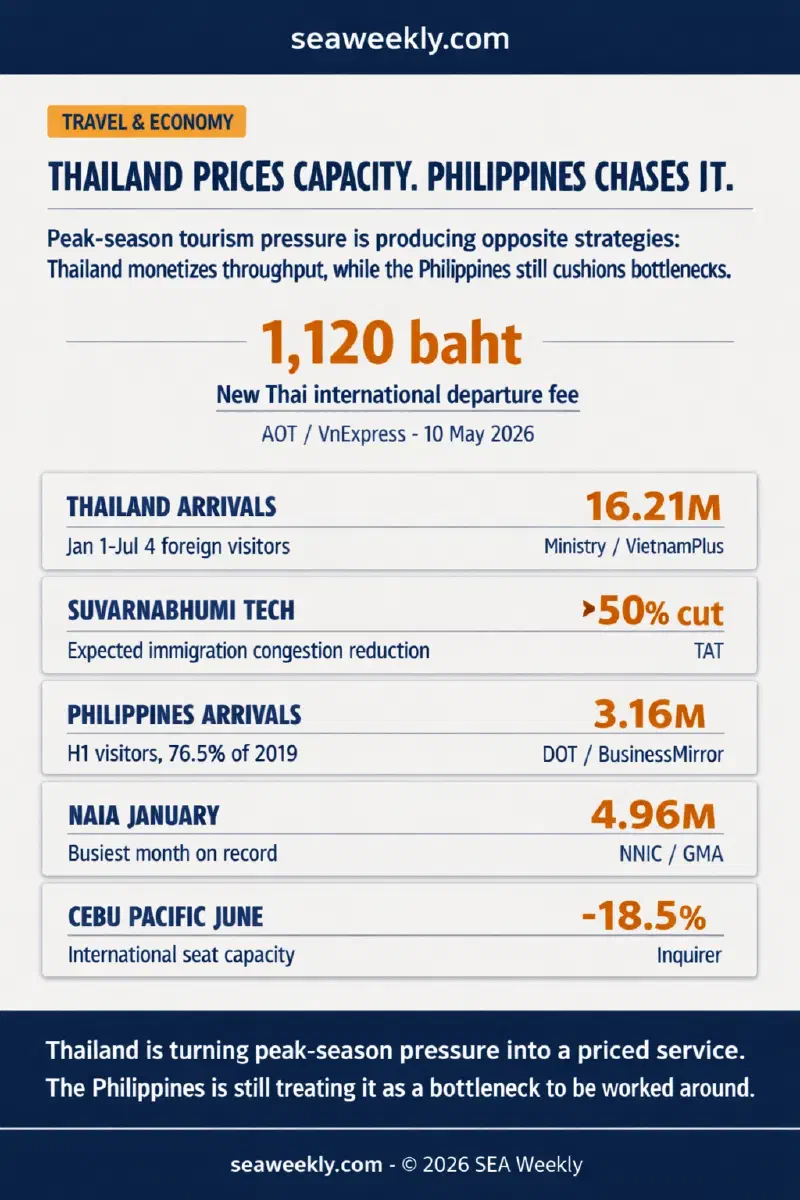
The cleanest signal came from Airports of Thailand. From Jun. 20, the international passenger service charge at six AOT-managed airports rose 50 percent, from 730 baht to 1,120 baht per traveller, while the domestic fee stayed at 130 baht. AOT said the increase would add roughly 10 billion baht in annual revenue for infrastructure and passenger-processing upgrades. A destination that is worried demand will evaporate does not add nearly 400 baht to every international departure in the middle of a difficult year. It does that when it believes the route network, the hotel base, and the traveller mix are strong enough to absorb the premium.
Thailand is also actively smoothing the choke points that justify charging more. On Jul. 17, TAT detailed a multi-agency review at Suvarnabhumi Airport focused on real-time exchange of flight and passenger-volume data, temporary waiting areas, tighter queue management, and wider use of biometric passport channels. The second phase of the automated-channel rollout is scheduled for September, and authorities say the expansion should cut immigration-area congestion by more than 50 percent. That is not tourism marketing. It is throughput engineering.
Even policy is now being tuned around operating quality rather than pure volume. Thailand’s Jul. 16 visa update replaces the old 60-day blanket exemption with a one-country, one-category framework built around 30-day exemptions, 15-day exemptions, or Visa on Arrival, plus tighter TDAC-linked screening. At the same time, Bangkok is still funding future scale: Suvarnabhumi’s East Expansion carries a 12 billion baht price tag to lift annual capacity from 60 million to 70 million passengers by 2029, while Don Mueang’s expansion would bring Bangkok’s two main gateways to roughly 120 million passengers a year. Thailand is not trying to be the cheapest destination in peak season. It is trying to be the most legible one.
That operating logic sits underneath the premium-vs-volume divide I wrote about in June’s Thailand tourism yield analysis and the pricing-power comparison we ran on Jun. 22. The price signal was visible then. What is clearer now is the mechanism that lets Thailand hold that price.
The Philippines is still protecting demand around a fixed ceiling #
The Philippines’ numbers are not weak. They are simply being produced by a much tighter and more defensive chain. Department of Tourism data, reported by BusinessMirror, showed 3.16 million inbound visitors in the first half of 2026, including 2.9 million foreign nationals and 260,717 overseas Filipinos. That is 76.5 percent of the first-half 2019 level, with China arrivals up 64.54 percent year on year and India up 43.03 percent after the 14-day visa-free scheme. The United States remained the top source market.
The problem is not that travellers want to skip the Philippines. It is that too much of the journey still depends on how much inconvenience, surcharge, and uncertainty they are willing to tolerate. NAIA handled a record 4.96 million passengers in January, including 2.42 million international travellers and 2.54 million domestic passengers, with a single-day peak of 180,089 on Jan. 4. The operator says the airport stayed stable thanks to biometric gates and tighter coordination, and that is real progress. But as Lourdes argued in her June analysis of Philippine aviation demand, optimisation under a ceiling is not the same thing as genuine slack.
That distinction became obvious when fuel costs spiked and route economics tightened. In May, the Philippine travel industry described the situation as the biggest tourism shock since COVID: fewer flights, higher fares, later bookings, and Holy Week activity reportedly down by as much as 50 percent in some destinations. Industry estimates cited by ABS-CBN put fuel-related surcharges anywhere from P600 to P19,000 per ticket. BusinessMirror reported that as of Mar. 20, global jet fuel prices had surged to $197 per barrel, prompting a Level-8 surcharge regime that allowed carriers to tack on up to P787 for domestic flights and as much as P6,209 on long-haul routes.
The response inside the Philippine chain was telling. Travel agencies and hotel marketers were not celebrating newfound pricing power. They were talking about shorter booking windows, weaker hotel and tour bookings, canceled corporate and face-to-face ASEAN events, staycation campaigns, and value packages for domestic demand. That is a rational operating response. It is also the opposite of what Thailand is doing. The Philippines absorbs cost pressure by trying to keep the traveller in the chain. Thailand absorbs it by charging more and making the chain more manageable.
Lourdes’s take: The easiest mistake in Philippine tourism is to read every arrival increase as proof that the bottleneck has eased. It has not. The United States remains the top source market partly because balikbayan and Filipino-American traffic tolerate Manila’s inconvenience differently from a first-time discretionary traveller. China and India are growing because 14-day visa-free access lowered the trial cost, not because the airport, airline, and domestic-transfer stack has suddenly become frictionless. Cebu Pacific’s first-half data makes that plain. The airline carried 14.5 million passengers in H1, up 4.3 percent, on 9.7 percent more seat capacity, but the shape of the rebound mattered more than the headline. In June, according to the Inquirer, domestic seat capacity rose 17.7 percent while international capacity was cut 18.5 percent. That is what a carrier does when it trusts short-haul and domestic resilience more than it trusts the economics of forcing more international volume through a volatile cost stack. If hotels are still leaning on flexible packages and airlines are still trimming costly overseas exposure, the Philippines is managing peak season defensively, not monetising scarcity.
The comparison is not arrivals. It is handoff quality. #
This is where the phrase tourism supply chain earns its keep. For Thailand, the relevant question is whether the traveller can move from visa clearance to immigration to transfer to hotel inventory inside a system that is expensive, visible, and increasingly instrumented. For the Philippines, the same journey still carries more hidden friction: a tighter airport ceiling, more sensitivity to fuel surcharges, and, for many destinations, one more domestic flight or ferry connection before the room night begins to earn its margin.
That difference changes how cost pressure shows up on the income statement. Thailand still had enough buyer confidence in June to translate TTM+ into 15,000 appointments and THB 5.08 billion of expected tourism business. In the Philippines, travel groups and hotel operators were already talking in May about deferred meetings, softening MICE demand, and the need to protect occupancy with value-led offers. The more uncomfortable truth is that the more expensive system can be the more resilient one, because its pain is explicit and centralised. A 1,120-baht departure fee, automated border control, and premium hotel rate integrity are visible taxes. Late bookings, trimmed international seats, canceled events, and hotel discounting are invisible taxes paid by operators.
That is the deeper layer beneath the pricing-power divergence we wrote about on Jun. 22. The yield gap was the symptom. The operating-chain gap is the cause.
What the next peak-season test will show #
Thailand’s next risk is obvious: if it keeps tightening screening, shortening stays, and raising throughput charges without delivering the service improvements quickly enough, the premium logic will fray. The Philippines’ next risk is different: if fuel volatility returns or international capacity remains selective, a system still leaning on tolerance, promotions, and domestic cushioning will find it hard to convert arrival growth into durable pricing power.
Both countries still have real demand. That is not the issue. Peak season is not asking which destination is more attractive. It is asking which one can convert an extra traveller into predictable cash while the cost stack is moving.
Thailand is turning peak-season pressure into a priced service. The Philippines is still treating it as a bottleneck to be worked around.
References #
-
Tourism Authority of Thailand (June 10, 2026). “Thailand Tourism Update at TTM+ 2026 reinforces quality-led growth direction.” https://www.tatnews.org/2026/06/thailand-tourism-update-at-ttm-2026-reinforces-quality-led-growth-direction/ (Accessed July 20, 2026)
-
Tourism Authority of Thailand (June 16, 2026). “TTM+ 2026 delivers strong business and measurable sustainability outcomes.” https://www.tatnews.org/2026/06/ttm-2026-delivers-strong-business-and-measurable-sustainability-outcomes/ (Accessed July 20, 2026)
-
VietnamPlus / Vietnam News Agency (July 8, 2026). “Thailand welcomes over 16.21 million foreign visitors in first half of 2026.” https://en.vietnamplus.vn/thailand-welcomes-over-1621-million-foreign-visitors-in-first-half-of-2026-post347939.vnp (Accessed July 20, 2026)
-
Minh Nga, VnExpress International (May 10, 2026). “Thailand to raise airport fees for international travelers by 50% next month.” https://e.vnexpress.net/news/travel/thailand-to-raise-airport-fees-for-international-travelers-by-50-next-month-5072129.html (Accessed July 20, 2026)
-
Tourism Authority of Thailand (July 17, 2026). “Thailand’s Tourism and Sports Ministry accelerates service improvements at Suvarnabhumi Airport.” https://www.tatnews.org/2026/07/thailands-tourism-and-sports-ministry-accelerates-service-improvements-at-suvarnabhumi-airport/ (Accessed July 20, 2026)
-
Tourism Authority of Thailand (July 16, 2026). “Thai Cabinet approves updated visa measures pending Royal Gazette publication.” https://www.tatnews.org/2026/07/thai-cabinet-approves-updated-visa-measures-pending-royal-gazette-publication/ (Accessed July 20, 2026)
-
VNA, VnExpress International (June 16, 2026). “Major expansion planned for Southeast Asia’s second-largest airport to boost tourism.” https://e.vnexpress.net/news/travel/major-expansion-planned-for-southeast-asia-s-second-largest-airport-to-boost-tourism-5086637.html (Accessed July 20, 2026)
-
Ma. Stella F. Arnaldo, BusinessMirror (July 20, 2026). “PHL visitor arrivals near 3.2M in 1H on China, India surge.” https://businessmirror.com.ph/2026/07/20/phl-visitor-arrivals-near-3-2m-in-1h-on-china-india-surge/ (Accessed July 20, 2026)
-
Ted Cordero, GMA Integrated News (February 6, 2026). “Record 4.96M passed through NAIA in January 2026 — NNIC.” https://www.gmanetwork.com/news/money/companies/975617/record-4-96m-passed-through-naia-in-january-2026-nnic/story/ (Accessed July 20, 2026)
-
Raine Musngi, ABS-CBN News (May 7, 2026). “Philippine tourism faces worst shock since COVID as flights cut, costs surge — industry group.” https://www.abs-cbn.com/news/business/2026/5/7/philippine-tourism-faces-worst-shock-since-covid-as-flights-cut-costs-surge-1122 (Accessed July 20, 2026)
-
Jekki Pascual, ABS-CBN News (May 11, 2026). “Fuel price hikes dampen travel bookings, tourism groups say.” https://www.abs-cbn.com/news/business/2026/5/11/fuel-price-hikes-dampen-travel-bookings-tourism-groups-say-1923 (Accessed July 20, 2026)
-
Ma. Stella F. Arnaldo, BusinessMirror (March 29, 2026). “PHL tourism faces headwinds as fuel prices surge, flights cut.” https://businessmirror.com.ph/2026/03/29/phl-tourism-faces-headwinds-as-fuel-prices-surge-flights-cut/ (Accessed July 20, 2026)
-
Ted Cordero, GMA News (July 15, 2026). “Cebu Pacific reports 14.5M passengers flown in H1 2026, up 4.3%.” https://www.gmanetwork.com/news/money/companies/994921/cebu-pacific-passenger-growth/story/ (Accessed July 20, 2026)
-
Logan Kal-El M. Zapanta, Philippine Daily Inquirer (July 16, 2026). “Cebu Pacific rebounds in June; H1 traffic hit 14.5M.” https://business.inquirer.net/600604/cebu-pacific-rebounds-in-june-h1-traffic-hit-14-5m (Accessed July 20, 2026)
-
SEA Weekly (June 4, 2026). “Who Is Winning Thailand Tourism Yield in 2026: Premium Operators vs Volume Players?” https://seaweekly.com/posts/2026-06-04-thailand-tourism-yield-premium-vs-volume/ (Accessed July 20, 2026)
-
SEA Weekly (June 19, 2026). “How Philippines Aviation Demand Is Affecting ASEAN Tourism Yield Competition.” https://seaweekly.com/posts/2026-06-19-philippines-aviation-demand-affecting-asean-tourism-yield/ (Accessed July 20, 2026)
-
SEA Weekly (June 22, 2026). “How Thailand vs Philippines Tourism Yield Is Diverging in Airline-Hotel Pricing Power.” https://seaweekly.com/posts/2026-06-22-thailand-philippines-tourism-yield-airline-hotel-pricing-power/ (Accessed July 20, 2026)