
ASEAN’s port investment wave is no longer mainly about clearing today’s queues. It is about buying a place on tomorrow’s route map.
That is why regional trade route competition has entered a new phase. Two softer weeks in headline freight pricing have not stopped the money. What matters now is whether a port can make itself harder to bypass when a chokepoint flares up, when a shipper diversifies suppliers, or when a factory network starts ranking corridors by recoverability rather than nominal cheapness.
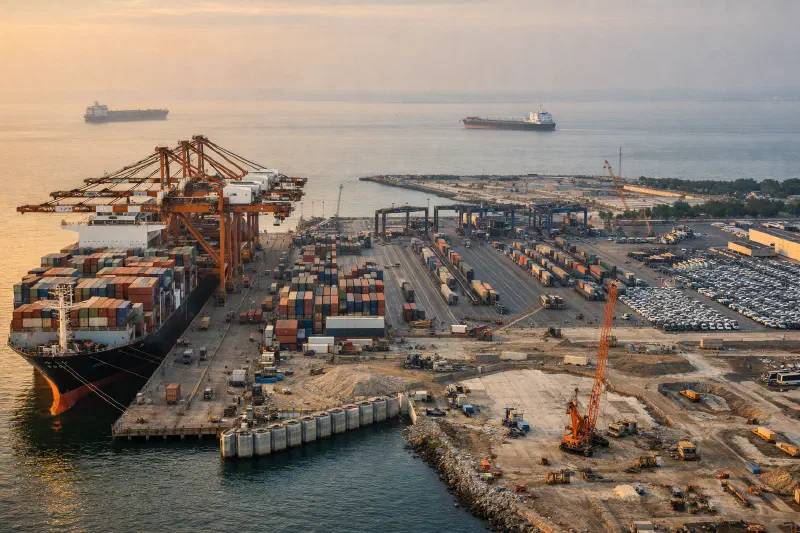
This is not a simple berth race #
The easiest mistake to make is to read the current port capex cycle as a delayed reaction to last month’s congestion or last quarter’s freight spike. That is not sufficient anymore. Drewry’s World Container Index fell another 4 percent on Jul 23 to $4,374 per 40ft container, which would normally support a story about cooling urgency. But Drewry said carriers were simultaneously preparing Emergency Fuel Surcharges for August because Strait of Hormuz concerns were still feeding transport risk into the market (Drewry, Jul 23, 2026).
That is the right starting point for today’s port story. Spot rates can soften for two weeks and the investment logic can still intensify, because the real premium has shifted from sheer box movement to route reliability. In my June 9 port-congestion brief, the key split was between ports with spare physical headroom and ports already running tight. By late July, the harder question is which of those ports are trying to turn that temporary advantage into durable route share.
Thailand’s June discussion around Laem Chabang makes the broader point well. Nation Thailand cited a DP World survey showing that 54 percent of executives still expected trade growth in 2026 to be faster than in 2025, while 53 percent expected high or very high policy uncertainty and 42 percent identified improvements in transport infrastructure and capacity as a top growth driver (Nation Thailand, Jun 14, 2026). In other words, the region is investing not because the world looks calm, but because it does not.
Singapore and Malaysia are defending the Malacca franchise #
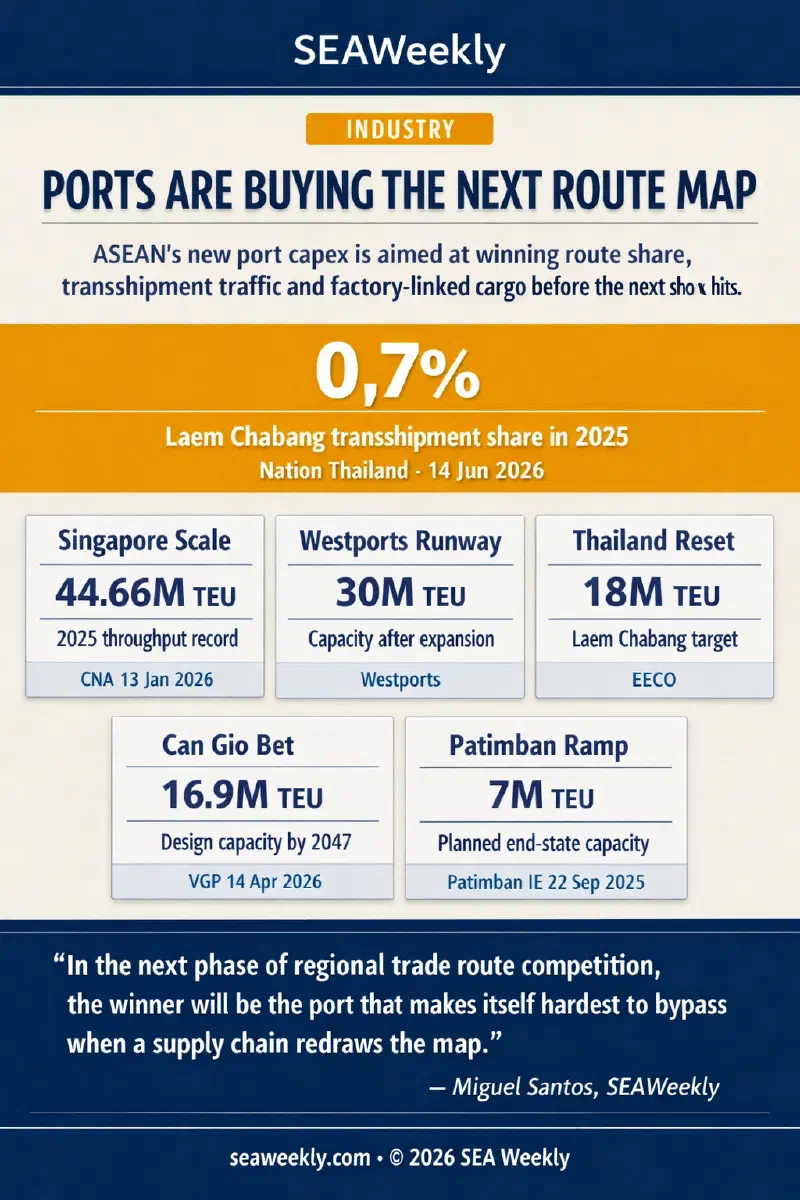
The clearest evidence that route competition has changed is that the leading incumbents are still spending aggressively. Singapore does not need a crisis story to justify port investment, yet it keeps expanding because it wants to remain mandatory regardless of how trade lanes shift. The Port of Singapore handled a record 44.66 million TEUs in 2025, up 8.6 percent year on year, while vessel arrivals hit 3.22 billion gross tonnage and marine fuel sales climbed to 56.77 million tonnes (CNA, Jan 13, 2026).
The more revealing signal is that Singapore is still building well beyond that record. Transport Minister Chee Hong Tat said Tuas already had 11 berths in operation, with one more planned by end-2025, four more in 2026, and another two in 2027. The full end-state remains 65 million TEUs in the 2040s (CNA, May 16, 2025). Singapore is not expanding because it doubts its current role. It is expanding because the value of being the region’s default recovery hub rises when route maps become less stable.
Malaysia’s Westports is making a similar bet from the other side of the same maritime spine. Westports’ own corporate material stresses its location on the Straits of Malacca, its 5.8km quay length, and an expansion pipeline that would take total handling capacity to 30 million TEUs once completed (Westports Holdings). That is not defensive language from a port worried only about local cargo. It is the language of a hub trying to preserve routing centrality.
The operating data supports that reading. The Star reported in February that Westports handled 11.3 million TEUs in FY25, with transshipment volumes up 7.2 percent year on year even as gateway volumes fell 1.9 percent to 4.8 million TEUs. Research houses expected FY26 throughput of 11.9 million TEUs to remain inside a 12 to 12.5 million TEU handling envelope, and noted that Westports was adding 5 percent more yard slots for completion in Q3 2026 (The Star, Feb 4, 2026). That is the critical point. This is not panic expansion after a breakdown. It is pre-emptive investment to keep the Malacca-Singapore corridor too liquid to ignore.
For Malaysia, that means treating Westports and Port Klang as strategic route assets rather than passive beneficiaries of geography. The pitch is not just lower frictions for Malaysian cargo. It is continued relevance for cargo that could otherwise be routed around Malaysia when alliance schedules or supply-chain maps change.
Thailand shows why concrete alone is not enough #
Laem Chabang is the strongest example of why port investment has become a corridor-quality contest rather than a simple capacity race. The Eastern Economic Corridor Office says Phase 3 will raise Laem Chabang’s capacity from 11 million to 18 million TEUs a year, lift vehicle handling from 2 million to 3 million units, and push rail’s share of freight from 7 percent to 30 percent. Total investment stands at 110,924 million baht, with Terminal F1 expected to open in 2027 and F2 in 2031 (EECO).
Those are large numbers, but the more interesting data sits outside the glossy capacity target. Nation Thailand reported that Laem Chabang’s transshipment cargo share fell from 1.0 percent of total volume in 2019 to just 0.7 percent in 2025, even though total container volume grew more than 25 percent. The same report said Phase 3 was 68.89 percent complete overall and that more than 22,000 trucks enter the port each day during peak periods (Nation Thailand, Jun 14, 2026).
That is what the new phase looks like in practice. Thailand is not merely pouring more quay space. It is trying to recover a type of cargo share that legal friction and operating complexity have allowed to slip. The Port Authority of Thailand is now seeking amendments to 17 laws tied to transshipment procedures, while also building buffer areas, smarter truck flow, and new rail infrastructure. The physical build matters. But the decline in transshipment share is the real tell. Route competition is now decided by how well a port combines infrastructure, rules, and inland choreography.
Vietnam and Indonesia are using ports to rewrite industrial geography #
Vietnam’s July decisions show that ports are increasingly being used to lock in industrial geography, not just move cargo faster. The Can Gio International Transshipment Port is the dramatic version of that strategy. The project covers roughly 571 hectares, carries investment of more than VND128,872 billion, and is designed to reach 4.8 million TEUs by 2030 before scaling to 16.9 million TEUs by 2047 (Government News of Vietnam, Apr 14, 2026). That is a direct attempt to win a larger place in the mega-vessel and relay-routing map.
But Vietnam is also making a more immediate, more industrially grounded port bet in the north. PSA Vietnam’s Lach Huyen agreement in Haiphong covers four deep-sea container berths with 4.5 million TEUs of annual handling capacity. The first two berths are due to start construction at end-2026 and complete in 2028, and PSA explicitly tied the project to its inland container depot facilities in Bac Ninh to create an integrated multimodal logistics ecosystem (VIR, Jul 5, 2026). That is not abstract maritime ambition. It is a bid to make North Vietnam’s factory belt harder to route around.
Indonesia’s Patimban shows the same corridor logic from an earlier stage of the build-out. Xinhua reported on Jul 16 that Patimban launched its first international container shipping route with an MSC vessel from Singapore. The current container terminal is still small at 250,000 TEUs a year, but the launch matters because it moves Patimban from plan to live network participation (Xinhua, Jul 16, 2026).
The longer-horizon numbers explain why Indonesia still cares. A Patimban Industrial Estate overview describes a staged ramp from roughly 250,000 TEUs initially to 3.3 million TEUs in 2027, 6.1 million in 2032 and about 7 million in 2042, alongside a dedicated car terminal capable of handling 600,000 vehicles annually. It also links the port to a 37.05km access toll road and a 511-hectare SEZ pitched to electronics, semiconductors, automotive, and petrochemicals (Patimban Industrial Estate, Sep 22, 2025). Read that correctly and Patimban is not a port story alone. It is an export-corridor relocation story.
What is really driving the money #
Put those cases together and the investment logic becomes clearer. Singapore and Westports are defending the region’s most important incumbent spine. Laem Chabang is trying to turn scale into recaptured transshipment share by fixing both hardware and procedure. Vietnam is splitting its bets between a long-horizon transshipment hub and an immediate factory-linked gateway. Indonesia is using Patimban to tilt industrial geography eastward and make a new export lane credible.
That is the fixed-asset version of the line I have been tracing in June 29’s freight-cost piece, July 18’s SEA Weekly on corridor competition, and last week’s inventory brief. Once buyers start paying for recoverability, the port stops being just a place to lift boxes. It becomes the hard asset underneath pricing power.
The uncomfortable truth is that not every announced berth or terminal will win. Ports that add concrete without fixing truck flow, rail share, customs friction, or repeat cargo generation will still struggle to capture durable route share. That is why Laem Chabang’s transshipment decline matters so much, and why Patimban’s first live international service may tell us more than any long-range master plan.
The next winners in ASEAN will not simply move more boxes. They will make the right cargo easier to reroute, easier to clear, and easier to commit to when the straight-line shipping map stops looking reliable. In the next phase of regional trade route competition, the winner will be the port that makes itself hardest to bypass when a supply chain redraws the map.
Have a view on which ASEAN port is actually gaining route share, or a ground-level signal from the quayside? I’d like to hear it.
For now, email the editorial desk at editorial@seaweekly.com and mention Miguel Santos.
References #
- Drewry Supply Chain Advisors (July 23, 2026). “World Container Index - 23 Jul.” https://www.drewry.co.uk/supply-chain-advisors/supply-chain-expertise/world-container-index-assessed-by-drewry (Accessed July 27, 2026)
- Channel News Asia (January 13, 2026). “Singapore sees record port performance in 2025.” https://www.channelnewsasia.com/singapore/singapore-sees-record-port-performance-in-2025-5855836 (Accessed July 27, 2026)
- Channel News Asia (May 16, 2025). “6.1% increase in container throughput in 2025 despite global trade uncertainty: Chee Hong Tat.” https://www.channelnewsasia.com/singapore/trade-war-tariffs-singapore-ports-containers-chee-hong-tat-5134021 (Accessed July 27, 2026)
- Westports Holdings. “About Port.” https://www.westportsholdings.com/our-port/ (Accessed July 27, 2026)
- The Star (February 4, 2026). “Revenue growth forecast for Westports in FY26.” https://www.thestar.com.my/business/business-news/2026/02/04/revenue-growth-forecast-for-westports-in-fy26 (Accessed July 27, 2026)
- Nation Thailand (June 14, 2026). “Laem Chabang upgrade aims to capture global supply-chain shift.” https://www.nationthailand.com/business/trade/40067427 (Accessed July 27, 2026)
- Eastern Economic Corridor Office. “Laem Chabang Port Phase 3.” https://www.eeco.or.th/en/laem-chabang-port-phase-3/ (Accessed July 27, 2026)
- Government News of Vietnam (April 14, 2026). “Investor selected to build Can Gio International Transshipment Port - Viet Nam’s largest port.” https://en.baochinhphu.vn/investor-for-can-gio-international-transshipment-port-selected-11126041415092631.htm (Accessed July 27, 2026)
- Vietnam Investment Review (July 5, 2026). “PSA Vietnam to develop container berths at Lach Huyen Port in Haiphong.” https://vir.com.vn/psa-vietnam-to-develop-container-berths-at-lach-huyen-port-in-haiphong-156058.html (Accessed July 27, 2026)
- Xinhua (July 16, 2026). “Indonesia’s Patimban Port launches international container shipping route.” https://english.news.cn/asiapacific/20260716/f671b91e2f664f5188ff8098744b0974/c.html (Accessed July 27, 2026)
- Patimban Industrial Estate (September 22, 2025). “Patimban Port: Indonesia’s New Export Gateway on the North Coast of Java.” https://patimbanindustrialestate.co.id/patimban-port-indonesias-new-export-gateway-on-the-north-coast-of-java/ (Accessed July 27, 2026)