
The common narrative around ASEAN port congestion paints a uniform crisis: too many containers, not enough berths, everyone squeezed equally. That’s wrong, and the divergence matters for where your supply chain survives the coming peak season intact.
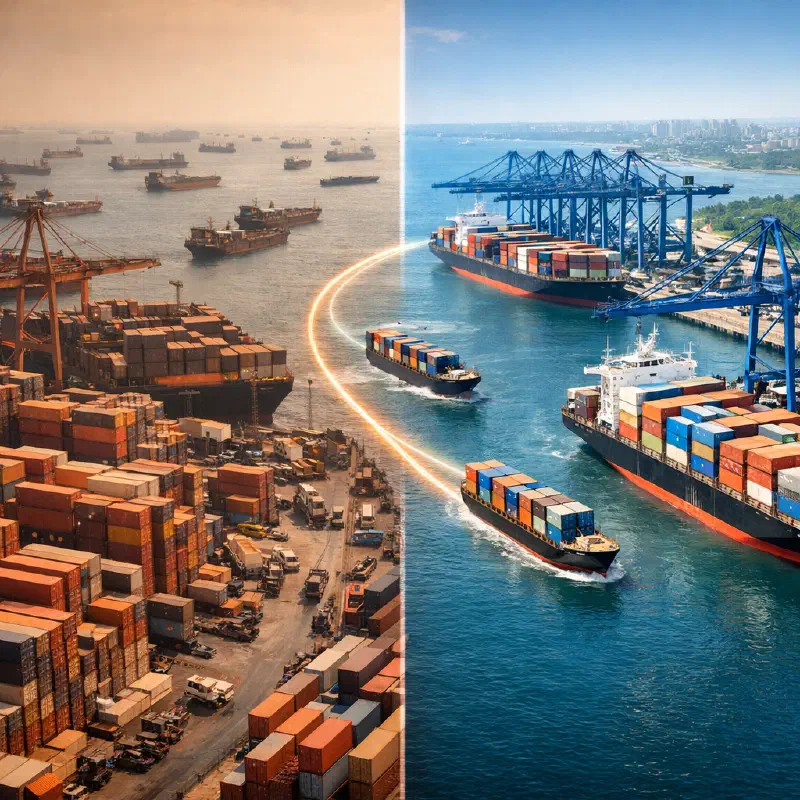
The Bifurcation
Walk the numbers. Singapore’s PSA and Vietnam’s newer terminals (VICT’s new facility opened in March 2026) are handling current throughput at comfortable utilization rates—95% of baseline, well within operational breathing room. Meanwhile, Port Klang in Malaysia is hitting 98% utilization during peak windows, and older Thai facilities are reporting berth queuing times that lock in premiums of $50-150 per container.
The difference isn’t mysterious. Port Klang’s Phase 2 expansion was delayed; completion now sits at Q4 2026. Vietnam’s regional consolidation centers are siphoning direct container volume. Thailand’s ports have been operating at near-maximum design capacity for three years. Singapore keeps upgrading its vessel scheduling systems. The divergence is structural, not cyclical.
Where This Hits Hardest
Electronics makers in Vietnam and Malaysia are already seeing 2-5 day clearance delays where zero-to-two days was standard. That’s margin compression for anyone on just-in-time component delivery. Garment exporters from Cambodia and the Philippines face the worst calculus: spot orders are becoming uncompetitive because the port transit reliability premium makes the delivered cost unpalatable. Perishables from Thailand can’t absorb extra dwell time without freshness risk. Automotive parts destined for Thai factories are pricing in premium freight as backup mitigation.
The Real Story
This isn’t a shared crisis—it’s a market reallocation. Shippers are already shifting 5-8% of volume to air freight or regional rail. Cross-dock operations at distribution hubs are bypassing port congestion altogether. Hutchison and Evergreen’s private terminals are gaining share faster than state-owned ports. The question isn’t “will congestion destroy Q3 exports?” It’s “which exporters eat the cost, and which have already engineered around it?”
Manufacturers with leverage—larger, more integrated supply chains—are arbitraging this bifurcation. They’re routing through less congested ports, pre-positioning inventory, and locking in peak-season slots early. Smaller exporters and those on spot orders are paying the tax. That concentration will outlast the physical peak season.
What Matters for July–September
Port operators with spare capacity (Singapore’s PSA, Vietnam’s new terminals, emerging private concessionaires) will gain pricing power and volume. Traditional chokepoints will lose both—either through congestion or through shippers finding alternatives. Spot freight rates for Asia-Europe lanes are already tracking 15-20% above 2025 baseline, and that’s before the August-September tightness hits.
By Q4, new terminal capacity and the seasonal decline in volume will ease constraints. But the competitive map has already shifted. The ports and the exporters who adapted will have locked in market share. Those that didn’t will still be sorting through the fallout.
References:
- PSA Singapore Authority (June 2026). Vessel turnaround optimization updates Q1-Q2 2026.
- Port Klang Authority (March 2026). Phase 2 expansion timeline revision.
- Vietnam Container Terminal (March 2026). VICT terminal operational commencement.
- CNA Business (May-June 2026). Spot freight rate tracking, Asia-Europe lanes.
- The Edge Singapore (June 2026). Port operator equity valuation adjustments.