
ASEAN electronics is not moving from lean inventory to fat inventory ahead of Q4. It is moving from one inventory rule to two.
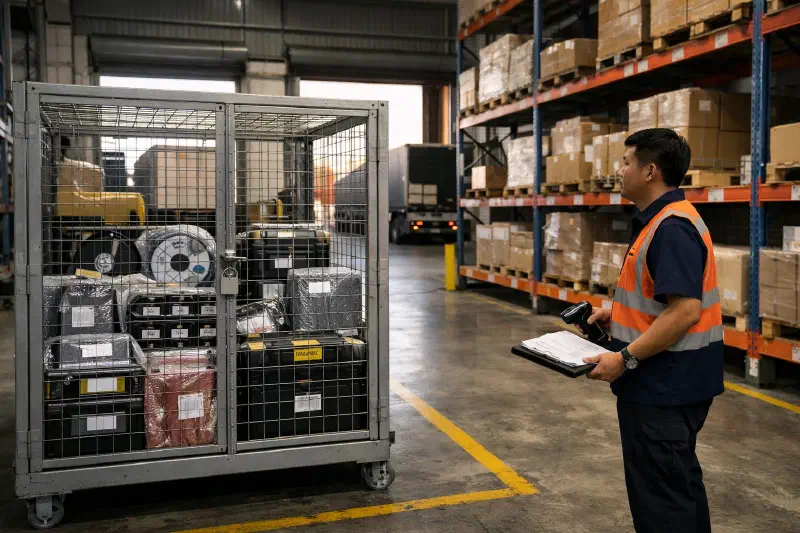
The parts that can stop a line - semiconductors, PCB panels, power modules, specialist connectors, urgent spares - are getting buffered, pre-booked, and in some cases matched with controlled air capacity. Bulkier and lower-margin inputs are not. They remain lean because carrying them at current freight, warehousing, and working-capital costs is too expensive to justify. The Q4 winner will not be the factory holding the most stock. It will be the one that knows which stock deserves a premium and which corridor lets it carry less.
The blunt restocking story is wrong #
The most useful way to read the current ASEAN electronics cycle is to stop talking about restocking as if it were a single regional move. The evidence from Vietnam, still the clearest demand engine in the region’s electronics chain, points to something more selective and more fragile.
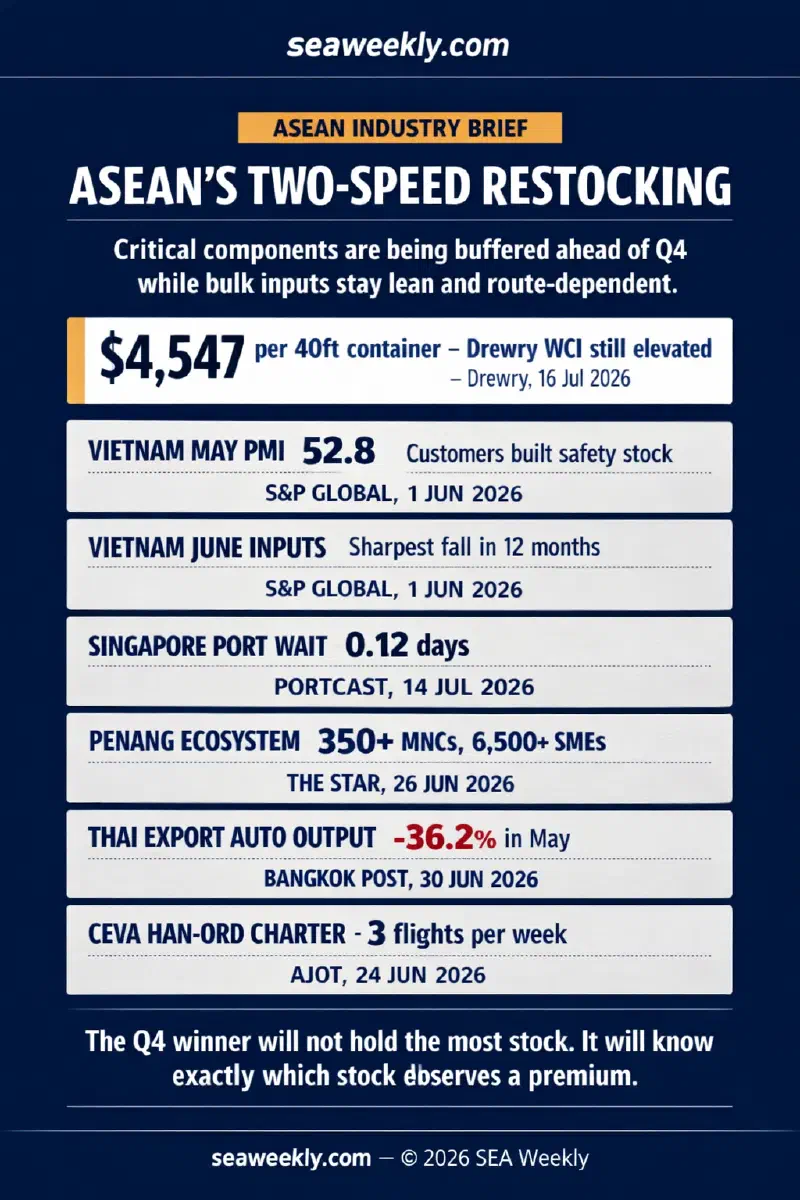
In May, Vietnam’s manufacturing PMI rose to 52.8, and S&P Global said part of the improvement reflected customer safety-stock building amid worries about a prolonged Middle East conflict (VIR, June 1, 2026). That sounds like a classic restocking signal. But the same survey also said stocks of purchases and preproduction inventories kept falling even as purchasing activity picked up. In other words, the system was not becoming comfortably stocked. It was buying defensively while still running lean.
June made the tension harder to ignore. Vietnam’s PMI eased to 51.8, still expansionary, but input stocks fell at the sharpest pace in a year. Firms said they were using inputs to support production growth and were also facing difficulties importing goods, while supplier delivery times lengthened again (VIR, July 1, 2026). That is not the profile of a broad, confident inventory rebuild. It is the profile of manufacturers triaging inventory inside a still-growing system.
That distinction matters because our July 10 industry brief on lead-time volatility already established the diagnosis: concentrated upstream supply and elevated freight costs were stretching delivery times. The next question is behavioural. What do procurement teams do because that diagnosis now looks durable rather than temporary?
Two inventory rules, not one #
The answer is visible in Vietnam’s H1 trade composition. The headline trade deficit of $16.65 billion is easy to misread as weakness. The National Statistics Office said the opposite: stronger imports reflected businesses proactively securing machinery, materials, and manufacturing inputs to expand output and meet future market demand (VIR, July 5, 2026).
But look closer at what that means operationally. Electronics, computers, and components reached $71.16 billion in H1, up 49.1 percent year on year. Vietnam’s trade deficit with China widened to $77.3 billion. The deficit with South Korea surged 81 percent to $26.4 billion. Those are not generic trade numbers. They are a map of where critical inputs still come from, and how concentrated that map remains.
When the critical bill of materials is concentrated, the restocking decision stops being a simple question of volume. A procurement manager does not need to protect every carton of lower-value input equally. The real problem is line stoppage. If a shortage of memory modules, specialist connectors, or power-management components can idle a production line, those SKUs justify higher freight, tighter booking discipline, and more buffer stock. A box of lower-value bulk inputs often does not.
That is why the current inventory strategy is not broad accumulation. It is tiering. The expensive part is not just the freight invoice. It is the working capital tied up in inventory that may not be needed immediately, and the warehousing cost of carrying it while rates are still elevated.
Drewry’s World Container Index still stood at $4,547 per 40ft container on July 16, even after a 2 percent weekly decline, and blank sailings were still scheduled on the Transpacific (Drewry, July 16, 2026). DHL’s July market update said global container demand was up 4 percent year to date, effective capacity remained constrained by congestion and Suez detours, and freight rates were still 84 percent above a year earlier (DHL, July 2026). Dimerco’s July freight report was blunter for operators: pre-book three to four weeks ahead, because blank sailings and congestion at transshipment hubs are tightening effective capacity from mid-July (Dimerco, July 1, 2026).
You do not answer that environment by stockpiling everything. You answer it by deciding which inventory is worth premium protection.
Where the optionality is moving #
This is where the regional hierarchy starts to matter. Vietnam is where the inventory is being consumed fastest. That does not automatically make it the best place to stage the hedge.
Malaysia, especially Penang, is increasingly important because it combines industrial density with logistics optionality. Penang’s electrical and electronics segment contributed RM41.7 billion to state GDP in 2024. The state is supported by more than 350 multinationals and over 6,500 manufacturing-related SMEs, with Penang International Airport and North Butterworth Container Terminal acting as visible logistics anchors (The Star, June 26, 2026). That is the sort of ecosystem where strategic stock can be staged closer to more than one routing choice.
Singapore remains the cleaner recovery node. Portcast’s July 14 snapshot showed Singapore at 0.12 days of median waiting time, versus 2.94 days at Manila South Harbor and 3.48 days at Kota Kinabalu (Portcast, July 14, 2026). Changi handled 517,000 tonnes of airfreight in the first quarter of 2026, up 7.6 percent year on year, even while Middle East passenger traffic collapsed (AsiaOne, April 17, 2026). For a procurement team trying to decide where a critical shipment can still be recovered when one lane fails, those are not background details. They are active inventory inputs.
This extends the logic in our July 8 analysis of Malaysia’s logistics edge and the July 18 SEA Weekly on corridor pricing. ASEAN’s better corridors are not simply moving more cargo. They are selling recoverability. Inventory optionality follows the same rule.
Vietnam still has its own selective hedge. CEVA’s Hanoi-Chicago charter now runs three times a week on a Boeing 777 full freighter, targeting high-tech and industrial customers that need predictable long-haul capacity (AJOT, June 24, 2026). But that is the point: air is being reserved for the inventory that can justify it. The line-stopping parts get protected. The rest of the bill of materials does not automatically come along for the ride.
Thailand is the warning against a regional blanket call #
Thailand is useful here because it weakens any easy claim that all ASEAN manufacturing chains are rebuilding Q4 stock in parallel.
Thailand’s export-oriented car production fell 36.2 percent in May, while exports to the Middle East dropped 66.1 percent. Yet domestic sales still rose 14.1 percent in January-May (Bangkok Post, June 30, 2026). That is not an electronics story directly, but it is an inventory story. It shows how quickly replenishment logic diverges once export visibility weakens in one market while domestic demand stays firmer in another.
The implication is straightforward. ASEAN should not be read as a single Q4 restocking block. Manufacturers tied to cleaner export visibility and more recoverable corridors will protect critical inventory earlier. Manufacturers exposed to weaker export order books will stay lean for longer, even if the broader regional narrative still sounds constructive.
What to watch before Q4 locks in #
The first signal is whether Vietnam’s input stocks stabilise while purchasing activity remains firm. If they do, the selective buffer strategy is starting to work. If inputs keep falling faster than replenishment arrives, the region remains closer to triage than to control.
The second signal is whether the Malaysia-Singapore staging logic keeps strengthening. If Penang continues to look like the easier place to hold high-value stock near multiple routing options, and if Singapore keeps its congestion and air-cargo advantage, more optionality will keep moving there even if the end demand sits elsewhere.
The third is air-freight discipline. If controlled air capacity keeps being added, but only for high-value industrial shipments, that confirms the two-speed model rather than contradicting it. Air is not replacing ocean. It is being reserved for the stock that is too important to leave exposed.
That is the real shift ahead of Q4. ASEAN electronics is not relearning how to carry more inventory. It is relearning how to decide which inventory is worth protecting.
The factories that win this cycle will not be the ones with the fullest warehouse. They will be the ones that know exactly which shelf can afford to be empty.
Have a question or a sourcing signal on Q4 electronics restocking? I’d like to hear from you.
For now, email the editorial desk at editorial@seaweekly.com and mention Miguel Santos.
References #
- Vietnam Investment Review / S&P Global (June 1, 2026). “Vietnamese manufacturers record a rebound in new orders in May.” https://vir.com.vn/vietnamese-manufacturers-record-a-rebound-in-new-orders-in-may-153853.html (Accessed July 22, 2026)
- Vietnam Investment Review / S&P Global (July 1, 2026). “Manufacturing sector ends the first half of 2026 on a positive note.” https://vir.com.vn/manufacturing-sector-ends-the-first-half-of-2026-on-a-positive-note-155872.html (Accessed July 22, 2026)
- Vietnam Investment Review / National Statistics Office (July 5, 2026). “Vietnam posts trade deficit as imports outpace exports in first half.” https://vir.com.vn/vietnam-posts-trade-deficit-as-imports-outpace-exports-in-first-half-156046.html (Accessed July 22, 2026)
- Vietnam Investment Review / National Statistics Office (July 4, 2026). “Manufacturing boosted by FDI, export recovery and public investment.” https://vir.com.vn/manufacturing-boosted-by-fdi-export-recovery-and-public-investment-156056.html (Accessed July 22, 2026)
- The Star (June 26, 2026). “Penang primed to prosper.” https://www.thestar.com.my/business/business-news/2026/06/26/penang-primed-to-prosper (Accessed July 22, 2026)
- Drewry Supply Chain Advisors (July 16, 2026). “World Container Index - 16 Jul.” https://www.drewry.co.uk/supply-chain-advisors/supply-chain-expertise/world-container-index-assessed-by-drewry (Accessed July 22, 2026)
- DHL Global Forwarding (July 2026). “Ocean Freight Market Update.” https://www.dhl.com/th-en/home/global-forwarding/latest-news-and-webinars/ocean-freight-market-update.html (Accessed July 22, 2026)
- Portcast (July 14, 2026). “Port Congestion Snapshot: Live Vessel Wait Times (Updated Weekly).” https://www.portcast.io/blog/port-congestion-snapshot (Accessed July 22, 2026)
- Dimerco (July 1, 2026). “Asia Pac Freight Report: July 2026.” https://dimerco.com/news-press/asia-pac-freight-report-july-2026/ (Accessed July 22, 2026)
- AJOT (June 24, 2026). “CEVA boosts Asia Pacific-U.S. air cargo with two charters connecting Vietnam, China to U.S.” https://www.ajot.com/news/ceva-boosts-asia-pacific-u.s-air-cargo-with-two-charters-connecting-vietnam-china-to-u.s (Accessed July 22, 2026)
- AsiaOne (April 17, 2026). “Changi Airport handled 17.6 million passengers in Q1 amid strong demand for North Asia, Europe.” https://www.asiaone.com/singapore/changi-airport-q1-2026-passenger-cargo-demand (Accessed July 22, 2026)
- Bangkok Post (June 30, 2026). “Automotive sector posts downturn in first 5 months.” https://www.bangkokpost.com/business/motoring/3278539/automotive-sector-posts-downturn-in-first-5-months (Accessed July 22, 2026)