
The most important AI purchase in ASEAN manufacturing this quarter is not a humanoid robot, a generative copilot on the shop floor, or a glossy proof of concept for board slides. It is the coordination layer that tells a procurement team which shipment is about to miss a handoff, which supplier delay will spill into a production schedule, and whether paying for one airfreight uplift now is cheaper than missing a customer delivery promise next week.
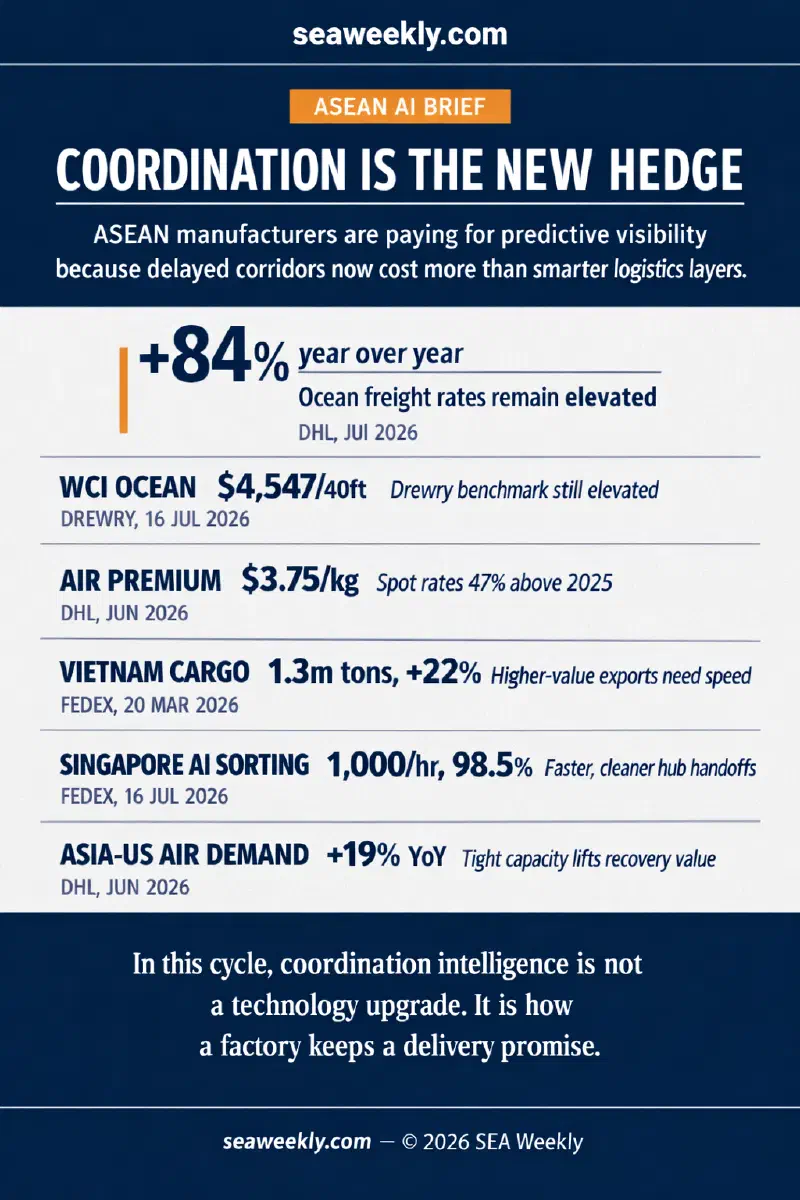
That is a less theatrical AI story than the region’s conference circuit prefers, but it is the one factories are actually underwriting. With Drewry’s World Container Index at $4,547 per 40ft on Jul 16 and DHL still reporting freight rates 84 per cent above last year, demand up 4 per cent year to date, and effective ocean capacity constrained by congestion and Suez detours, Q3 2026 is not a normal freight cycle. It is an exception-management cycle. Once that changes, AI stops looking like a speculative innovation budget and starts looking like production insurance.

Q3 has turned routing noise into production risk #
The rate level still matters, but it is no longer the whole story. Drewry’s Jul 16 assessment made clear that blank sailings, early peak-season activity and geopolitical shipping risk are still propping up container pricing even after a weekly dip. Nikkei Asia’s Jun 25 report on Hormuz traffic showed that the recovery in tanker flows was only partial, while its Jun 28 Caixin report on Seacon Shipping put the more operational point bluntly: unpredictability is now a scheduling problem in its own right.
That distinction matters for manufacturers more than for almost anyone else. A freight forwarder can reprice a lane. A factory with timed component inflows, export deadlines, and customer penalties has to absorb the knock-on effects across inventory, labor sequencing, and working capital. That is why our recent reporting on Vietnam’s selective airfreight hedge, Thailand versus Indonesia routing predictability, and ASEAN corridor recoverability all point to the same conclusion: buyers are increasingly paying for the route that fails more gracefully, not merely the route that looks cheapest on the first quote.
For a Vietnamese electronics exporter, a Thai auto-parts supplier, an Indonesian industrial-input producer, or a Cambodian garment factory shipping on tight buyer windows, the Q3 problem is not just that freight is expensive. It is that one late handoff now triggers a broader chain of decisions: whether to resequence production, whether to split the shipment, whether to trigger air on the highest-value components, whether to pre-alert a customer, and whether to redraw the next week’s procurement plan. That is precisely the class of decision problem AI coordination tools are built to compress.
The AI spend is moving from tracking to intervention #
This is the part many public discussions still get wrong. The most commercially relevant AI shift in manufacturing logistics is not from humans to machines. It is from passive visibility to active intervention.
Gartner’s March 2025 supply-chain technology outlook organized the field around connectivity plus intelligence: low-cost sensors and tags for end-to-end visibility, decision intelligence to improve or automate operating choices, intelligent simulation to test outcomes before they become losses, and agentic systems that can execute bounded decisions in real time. That sounds abstract until you put it next to the actual language shippers and exporters are now using.
FedEx’s Jul 16 supply-chain trends update describes visibility shifting from tracking to intervention: predictive delay alerts, weather advisories, near-real-time sensor monitoring, and digital customs tools that reduce documentation errors before they become border delays. Its earlier Supply Chain 5.0 essay from May 2024 put the strategic version even more clearly: AI changes logistics when it moves the business from reactive to predictive.
That is exactly why manufacturers are accelerating spend. In a stable corridor, a dashboard is nice to have. In a corridor where a missed sailing, a customs mismatch, a weather event, or a Gulf-related delay can force expensive resequencing, a predictive layer becomes a cost-control tool. The same July 16 FedEx piece notes that an AI-powered robotic sorting arm at its Singapore hub can handle up to 1,000 packages per hour with barcode accuracy above 98.5 per cent. The number is useful not because every ASEAN factory wants a robot arm in a parcel hub. It is useful because it shows where the value is being monetized: faster, cleaner, less error-prone handoffs in networks that serve time-sensitive cargo.
Why manufacturers, not just logistics operators, are buying into the layer #
My Jul 5 brief on AI logistics tools argued that enterprise-grade freight prediction and control-tower tools were already giving larger operators a structural advantage. My Jul 11 trade-finance brief made the same point in finance: AI works fastest where the data infrastructure is already clean.
The manufacturing story now sits between those two. Factories are not buying AI because they want to become logistics companies. They are buying it because the line between factory execution, shipment timing and financing pressure has narrowed sharply.
FedEx’s Mar 20 analysis of Vietnam’s air-cargo growth is revealing on this point. Vietnam handled about 1.3 million metric tons of air cargo in 2025, up 22 per cent from the prior year, while electronics accounted for more than one-third of its exports. That is not just a transport story. It is a signal about product mix. Higher-value electronics, advanced machinery and precision components make logistics reliability more important because the cost of lateness rises with value density and customer sensitivity.
The same FedEx analysis says digital logistics tools now let exporters manage documentation and cross-border shipping from a single interface, while selected service tiers use AI-powered analytics for predictive insights and proactive intervention. Read against Vietnam’s export mix, that is the real acceleration story. The investment case is no longer “can AI make shipping more interesting?” It is “can predictive coordination protect margin on high-value shipments when sea and air both remain stressed?”
Even network decisions now read differently through that lens. FedEx’s Sep 25, 2025 Northern Vietnam service enhancement promised one-day faster transit to Asia and Europe and greater reliability to North America. In a calmer freight year, that is a competitive perk. In Q3 2026, it becomes part of a factory’s contingency architecture.
Coordination is becoming the real manufacturing moat #
This is also why the acceleration is bigger than any one country. Vietnam’s exporters need it because their value chain is climbing. Thailand’s manufacturers need it because predictability increasingly beats nominal cheapness in regional routing. Indonesia’s producers need it because cost stress and weaker order flow make every avoidable delay more expensive. Singapore benefits because it is already monetizing the network quality and intervention density that others are still building.
There is a second-order effect too. Nikkei Asia’s Jul 5 report on MinebeaMitsumi showed a 58 billion yen, or $360 million, Southeast Asian expansion in bearings used for AI data centers. That matters here because it underlines how AI-led manufacturing demand is spreading beyond chips into broader component chains. As more ASEAN factories serve higher-value, timing-sensitive end markets, the cost of coordination failure rises. So does the willingness to fund tools that reduce it.
The obvious caveat is that this acceleration will not be evenly distributed. A large electronics exporter with structured shipment data and meaningful customer penalties can justify control towers, predictive alerts and intervention support much more easily than a low-margin exporter operating with fragmented documentation and thinner balance-sheet room. Q3 is therefore likely to widen the coordination gap even as it speeds up adoption among firms that can pay for resilience.
That is the uncomfortable truth beneath the upbeat AI narrative. ASEAN manufacturers are accelerating AI investment, yes. But the spend is concentrating in the part of the market where a delay is expensive enough, the cargo valuable enough, and the data clean enough to make coordination intelligence pay.
The factories that win this cycle will not be the ones with the flashiest AI story. They will be the ones that can tell a buyer, before a delay becomes a miss, what failed, what the fallback route is, what inventory gets reprioritized, and when the order will still arrive. In this cycle, coordination intelligence is not a technology upgrade. It is how a factory keeps a delivery promise.
References:
- Drewry (July 16, 2026). “World Container Index - 16 Jul.” https://www.drewry.co.uk/supply-chain-advisors/supply-chain-expertise/world-container-index-assessed-by-drewry (Accessed July 19, 2026)
- DHL Global Forwarding (July 2026). “Ocean Freight Market Update.” https://www.dhl.com/th-en/home/global-forwarding/latest-news-and-webinars/ocean-freight-market-update.html (Accessed July 19, 2026)
- DHL Global Forwarding (June 2026). “Air Freight Market Update.” https://www.dhl.com/vn-en/home/global-forwarding/latest-news-and-webinars/air-freight-market-update.html (Accessed July 19, 2026)
- Nikkei Asia (June 25, 2026). “Hormuz tanker traffic climbs to 25% of prewar level.” https://asia.nikkei.com/spotlight/iran-tensions/iran-war/hormuz-tanker-traffic-climbs-to-25-of-prewar-level (Accessed July 19, 2026)
- Nikkei Asia / Caixin (June 28, 2026). “How China’s ship managers help fleets navigate a changing Strait of Hormuz.” https://asia.nikkei.com/spotlight/caixin/how-china-s-ship-managers-help-fleets-navigate-a-changing-strait-of-hormuz (Accessed July 19, 2026)
- Gartner (March 18, 2025). “Gartner Identifies Top Supply Chain Technology Trends for 2025.” https://www.gartner.com/en/newsroom/press-releases/2025-03-18-gartner-identifies-top-supply-chain-technology-trends-for-2025 (Accessed July 19, 2026)
- FedEx Business Insights (March 20, 2026). “Vietnam’s Air Cargo Growth: Opportunities For Exporters And Manufacturers.” https://www.fedex.com/en-sg/business-insights/tech-innovation/vietnam-air-cargo-growth-opportunities.html (Accessed July 19, 2026)
- FedEx Business Insights (July 16, 2026). “Supply Chain Trends: How Smarter Logistics Is Helping Businesses Move Faster.” https://www.fedex.com/en-sg/business-insights/tech-innovation/5-logistics-trends-driving-a-smarter-supply-chain.html (Accessed July 19, 2026)
- FedEx Business Insights (May 7, 2024). “Supply Chain 5.0: The Transformative Power Of AI.” https://www.fedex.com/en-sg/business-insights/tech-innovation/supply-chain-5-0-the-transformative-power-of-ai.html (Accessed July 19, 2026)
- FedEx Newsroom (September 25, 2025). “FedEx Enhances Network from Northern Vietnam to Asia and Europe.” https://newsroom.fedex.com/newsroom/asia-english/fedex-enhances-network-from-northern-vietnam-to-asia-and-europe (Accessed July 19, 2026)
- Nikkei Asia (July 5, 2026). “Japan’s MinebeaMitsumi to boost bearings output for AI data centers.” https://asia.nikkei.com/business/electronics/japan-s-minebeamitsumi-to-boost-bearings-output-for-ai-data-centers (Accessed July 19, 2026)
- SEA Weekly (July 5, 2026). “ASEAN AI Brief: How AI-powered logistics tools are being deployed to manage ASEAN freight cost volatility as Q3 shipping rates climb.” https://seaweekly.com/posts/2026-07-05-asean-ai-brief-ai-logistics-tools-asean-freight-cost-volatility/ (Accessed July 19, 2026)
- SEA Weekly (July 11, 2026). “ASEAN AI Brief: What’s driving AI adoption in ASEAN trade finance as working capital stress tests traditional banking models in Q3.” https://seaweekly.com/posts/2026-07-11-asean-ai-brief-ai-adoption-asean-trade-finance-working-capital/ (Accessed July 19, 2026)
- SEA Weekly (July 15, 2026). “Why Vietnam air freight capacity is becoming a strategic hedge against sea route congestion in H2 2026.” https://seaweekly.com/posts/2026-07-15-vietnam-air-freight-capacity-strategic-hedge-sea-route-congestion-h2-2026/ (Accessed July 19, 2026)
- SEA Weekly (July 18, 2026). “SEA Weekly: How ASEAN corridor competition is redrawing the Q3 supply chain cost map.” https://seaweekly.com/posts/2026-07-18-sea-weekly-asean-corridor-competition-redrawing-q3-supply-chain-cost-map/ (Accessed July 19, 2026)