
The question Blue Yonder’s Gabriel Werner asked on a recent supply chain podcast should be the one every logistics technology vendor is being asked right now in ASEAN: is AI solving the right problems? Werner’s answer was deliberately uncomfortable: stop chasing AI for AI’s sake; focus on real, measurable supply chain problems. In Q3 2026, ASEAN’s most measurable supply chain problem is a freight rate spike that hit a 22-month high on June 25. The AI tools being deployed to manage it are reaching exactly the operators who need them least.
What the tools do in a rate spike #
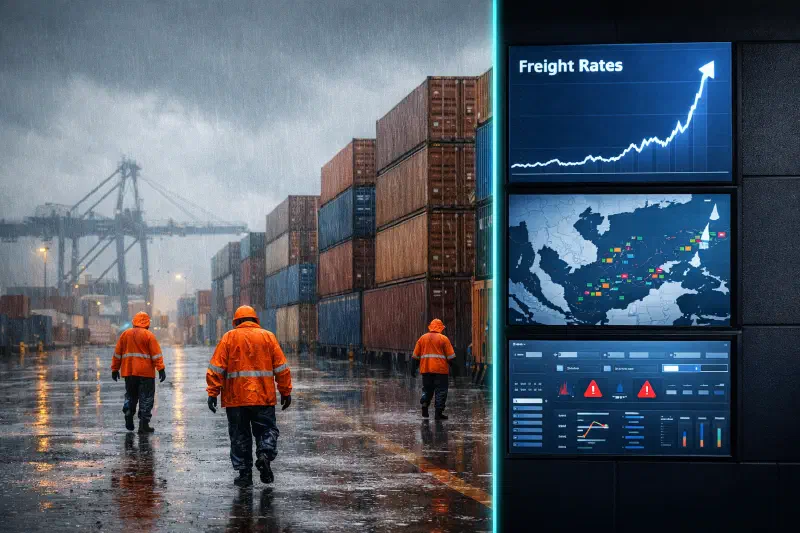
When the Drewry World Container Index posted $4,166 per 40-foot container on June 25 — up 5% in a single week, with Shanghai–Los Angeles at $5,750 and Shanghai–New York at $7,149 — the operators who had AI-powered freight rate models running already knew the direction. As SEA Weekly reported on June 29, DHL’s June ocean-freight update was showing global demand running 4% above year-ago levels against fleet capacity growth of just 3%, with Suez Canal detours still constraining effective slot availability. Add the Strait of Hormuz disruption — tanker traffic reached only 25% of prewar levels as of late June, according to Nikkei Asia’s June 26 report — and the Q3 rate environment was legible to anyone reading the structural signals.
AI logistics tools translate those signals into operational decisions. The principal applications being deployed across ASEAN’s major logistics corridors fall into three categories. Rate prediction models — machine learning pipelines trained on historical container rate data, port congestion signals, and oil price inputs — generate probabilistic forecasts four to twelve weeks ahead. These feed into dynamic carrier selection tools that automatically route freight to the cheapest qualified carrier at the optimal booking window. Above both layers sit supply chain control towers: software platforms that aggregate real-time visibility across multi-modal supply chains, surface disruption alerts, and provide scenario modelling when a port congestion event or weather disruption requires rerouting. Blue Yonder’s control tower architecture, currently competing directly against ERP incumbents for enterprise supply chain mandates, is among the most widely deployed platforms in Singapore-based logistics operations and among the multinational manufacturers running regional distribution hubs out of Thailand and Malaysia.
The practical effect of these tools in a Q3 rate environment: operators who had AI-generated rate forecasts available in May and June were able to pre-book Q3 capacity before the June 25 spike. Those who didn’t are booking at spot rates.
The access gap is the story #
The operators who have these tools are not the operators who are most exposed to Q3 freight cost volatility. PSA International, DHL Asia Pacific, Kuehne+Nagel, Maersk’s Asian operations, and the logistics arms of regional e-commerce platforms — Shopee, Sea Group, Lazada — all have enterprise-grade AI supply chain infrastructure. They entered Q3 2026 with forward capacity pre-booked, inventory buffers pre-positioned, and disruption alerts calibrated to Hormuz and monsoon triggers. Their Q3 freight cost is largely locked.
The operators absorbing Q3 volatility at spot prices are the ones who could benefit most from AI but have the least capacity to deploy it. Vietnamese garment and electronics SME exporters, booking week-to-week through freight agents, are absorbing the full June 25 rate spike because they had no forecasting model and no forward contracts. Philippine inter-island logistics operators, already under fuel cost pressure from the Luzon–Mindanao shipping routes that carry the country’s food supply, lack the EDI integrations and historical data warehouses that any ML rate model requires to function. Indonesian manufacturers, whose input price inflation just hit the highest level since September 2013 according to Indonesia’s June PMI data, are managing cost pressures with spreadsheets.
Thailand’s port congestion risk and the freight-to-CPI pass-through dynamics now running across the region make this access gap more consequential, not less. The operators who are price-setting downstream costs in food distribution, garment manufacturing, and industrial inputs are precisely the tier of ASEAN logistics that is running without AI.
The mechanism that makes this worse #
There is a systems-level effect in this asymmetry that is not getting enough attention. When Tier 1 operators use AI-powered rate prediction to pre-book Q3 container capacity in April and May, they are not only hedging their own exposure — they are reducing the pool of available spot capacity for every operator who couldn’t or didn’t pre-book. AI becomes a capacity-concentrating mechanism in a tight freight market. The operators who lock capacity early tighten conditions for those booking late; the operators booking late are disproportionately ASEAN’s smaller exporters and regional manufacturers.
This is not a critique of the tools. Supply chain control towers genuinely work: Seacon Shipping’s June 28 account of navigating the Hormuz disruption illustrates how combining AI-driven scheduling with experienced logistics judgment produces real operational advantage. The insight is a systems one: when hedging technology becomes standard only among the top tier, it changes the market structure in ways that amplify the exposure of those without access. Werner’s self-critical question — is AI solving the right problems — points directly at this gap. A rate prediction model optimised for a Singapore freight desk is not solving the problem faced by a Cebu-based inter-island logistics operator trying to keep rice distribution costs from tipping into a consumer price crisis.
The 2027 battleground is data, not models #
The AI adoption asymmetry in ASEAN logistics is not primarily a model problem. Blue Yonder, o9 Solutions, Kinaxis, and dozens of more specialised freight-tech platforms offer accessible and often cloud-based tools. The barrier to using them in Vietnam’s SME export sector or across Indonesia’s non-nickel logistics chains is not the quality of the AI model — it is the absence of the underlying data infrastructure those models require. Rate prediction needs three to five years of clean, structured freight data. Carrier selection AI requires EDI integrations that most ASEAN SME logistics operators do not have. Control tower platforms need real-time data feeds from carriers, ports, and customs systems that are not yet standardised across the region.
The Bloomberg observation that AI’s boom is carving a K-shape into Asian economies — diverging fortunes between AI infrastructure beneficiaries and those outside the data-center investment perimeter — applies at the logistics tier level just as it does at the country level. MinebeaMitsumi’s $360 million AI data center investment in Southeast Asia, announced July 5, is a marker of where AI infrastructure investment is landing: inside the production and distribution ecosystems of large manufacturers with the capital to build it, not in the SME export corridors that carry ASEAN’s most freight-cost-sensitive trade flows.
The Q3 freight spike will not last. Rates will normalize, Hormuz will stabilise, the monsoon window will close. But the data infrastructure gap between ASEAN’s large logistics operators and its SME exporters will not normalize with the rate cycle. When AI rate prediction becomes standard among ASEAN’s Tier 1 operators — which is a 12-to-18-month process, not a multi-year one — the next competitive divide will be entirely about whose AI has clean, structured, multi-year freight data to train on. Operators who spent the 2025-2026 cycle building that infrastructure will have a durable advantage. Operators who deployed AI dashboards without addressing their underlying data pipelines will be paying enterprise software fees to read outputs they could have found in a Drewry weekly update.
The right question for the ASEAN logistics sector is not whether AI can manage Q3 freight cost volatility. It demonstrably can, for the operators who have built the data foundation to run it. The right question is who built that foundation, and who is still trying to.
References:
- Supply Chain Digital / Blue Yonder (2026). “Ep.10 | Gabriel Werner: Is AI Solving the Right Problems?” https://supplychaindigital.com/podcasts/ep-10-gabriel-werner-is-ai-solving-the-right-problems (Accessed July 5, 2026)
- Supply Chain Digital / Blue Yonder (2026). “Supply Chain Stability as Strait of Hormuz Set to Reopen?” https://supplychaindigital.com/news/supply-chain-stability-as-strait-of-hormuz-set-to-reopen (Accessed July 5, 2026)
- Supply Chain Digital / Blue Yonder (2026). “Blue Yonder vs. ERP Giants: The Battle for the Network.” https://supplychaindigital.com/news/blue-yonder-vs-erp-giants-the-battle-for-the-network (Accessed July 5, 2026)
- Drewry (June 25, 2026). “World Container Index Assessed by Drewry.” https://www.drewry.co.uk/supply-chain-advisors/supply-chain-expertise/world-container-index-assessed-by-drewry (Accessed June 29, 2026)
- Nikkei Asia (June 26, 2026). “Hormuz tanker traffic climbs to 25% of prewar level.” https://asia.nikkei.com/spotlight/iran-tensions/iran-war/hormuz-tanker-traffic-climbs-to-25-of-prewar-level (Accessed July 5, 2026)
- The Jakarta Post (July 1, 2026). “RI factories slide into contraction in June amid soaring costs, weak demand.” https://www.thejakartapost.com/business/2026/07/01/ri-factories-slide-into-contraction-in-june-amid-soaring-costs-weak-demand (Accessed July 5, 2026)
- Nikkei Asia (June 28, 2026). “How China’s ship managers help fleets navigate a changing Strait of Hormuz.” https://asia.nikkei.com/spotlight/caixin/how-china-s-ship-managers-help-fleets-navigate-a-changing-strait-of-hormuz (Accessed July 5, 2026)
- Bloomberg (July 3, 2026). “How the AI Boom Is Carving a K-Shape Into Asian Economies.” https://www.bloomberg.com/news/newsletters/2026-07-03/how-the-ai-boom-is-carving-a-k-shape-into-asian-economies (Accessed July 5, 2026)
- Nikkei Asia (July 5, 2026). “Japan’s MinebeaMitsumi to boost bearings output for AI data centers.” https://asia.nikkei.com/business/electronics/japan-s-minebeamitsumi-to-boost-bearings-output-for-ai-data-centers (Accessed July 5, 2026)
- DHL (June 2026). “Ocean Freight Market Update.” https://www.dhl.com/th-en/home/global-forwarding/latest-news-and-webinars/ocean-freight-market-update.html (Accessed June 29, 2026)
- SEA Weekly (June 29, 2026). “How ASEAN freight costs are squeezing supply chain margins as Q3 shipping rates climb.” https://seaweekly.com/posts/2026-06-29-asean-freight-costs-squeezing-supply-chain-margins/ (Accessed July 5, 2026)
- SEA Weekly (July 1, 2026). “What’s driving Thailand port congestion risk ahead of peak monsoon shipping season?” https://seaweekly.com/posts/2026-07-01-thailand-port-congestion-monsoon-shipping-season/ (Accessed July 5, 2026)
- SEA Weekly (July 2, 2026). “ASEAN Economy Brief: What’s Driving Freight Cost Pass-Through to ASEAN Consumer Prices in Q3?” https://seaweekly.com/posts/2026-07-02-asean-economy-brief-freight-cost-pass-through-consumer-prices/ (Accessed July 5, 2026)