
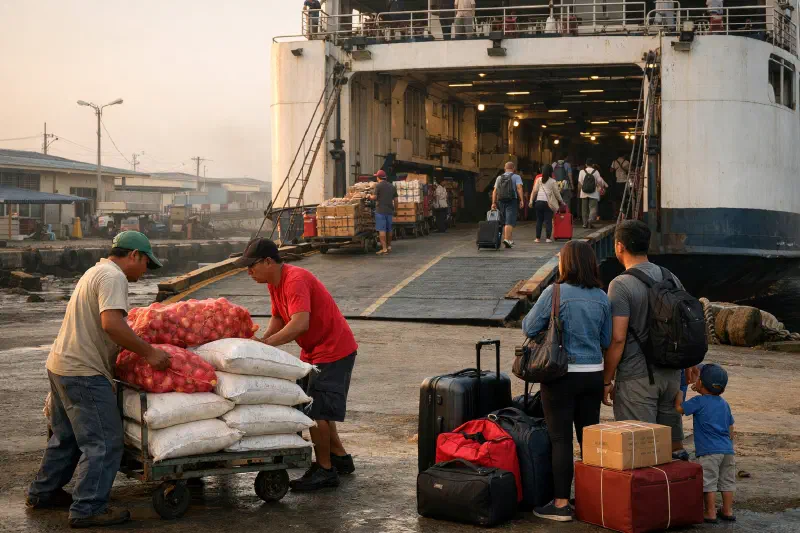
In the Philippines, connectivity is never just a transport story. The same short-haul flight or roll-on roll-off ferry that carries a family to Cebu for a three-day break also carries onions, rice, sugar, and fuel costs from one island economy to another. That is why inter-island connectivity may be one of the clearest Philippine signals for H2 2026: it can keep domestic travel moving at the same time that it keeps food inflation uncomfortably sticky.
What looks like a contradiction is really the same mechanism seen from two budgets. Airlines are adding domestic seats, hotels and the Department of Tourism are discounting through the lean season, and domestic travelers still spent far more than foreign visitors last year. But every extra domestic leg in an archipelago is also a price pass-through point. In the Philippines, the network that supports leisure demand is the same network that taxes household consumption.
The archipelago discount is still an inflation tax #
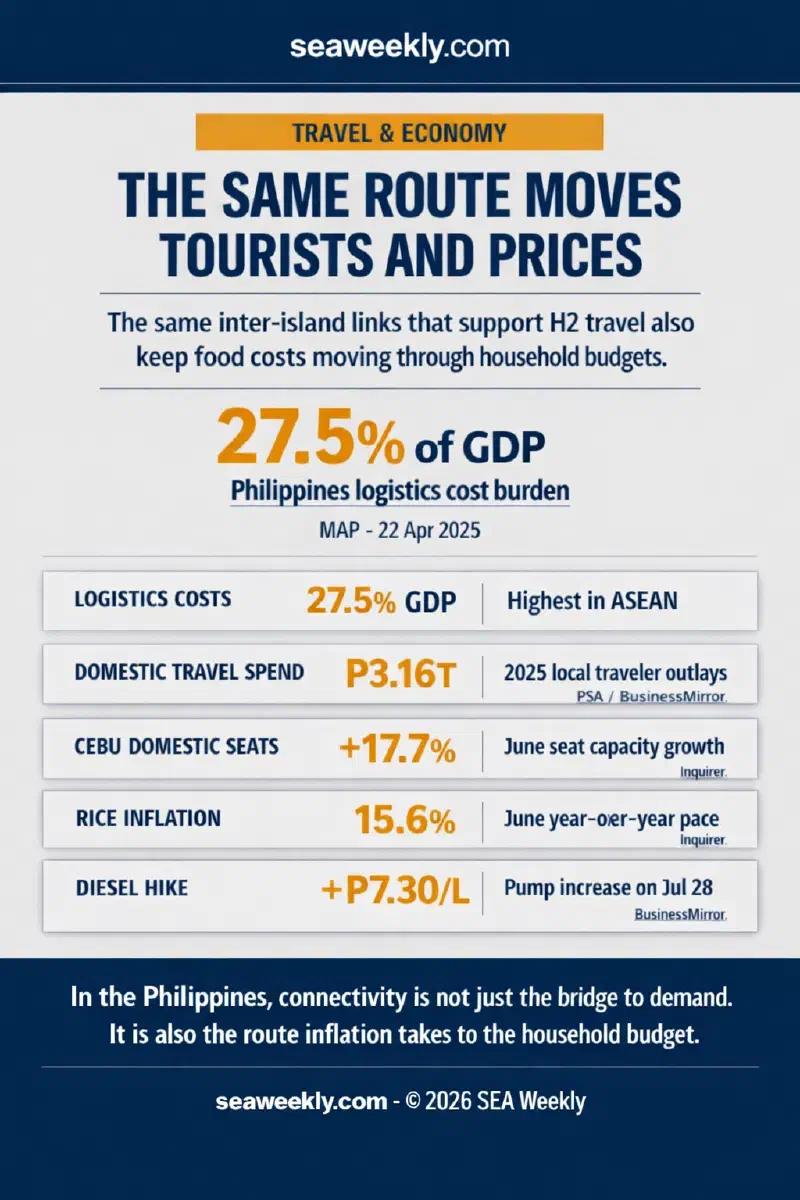
On paper, June brought relief. Headline inflation eased to 6.4 percent from 6.8 percent in May, while transport inflation slowed to 12.8 percent from 16.2 percent, food inflation moderated to 5.2 percent, and rice inflation edged down to 15.6 percent. If you read only that release, the obvious conclusion is that the worst of the cost shock is passing.
That is too generous a reading of where households are actually headed. Before families had any time to feel June’s softer print, oil firms announced a new July 28 pump-price hike of P7.30 per liter for diesel, P6.80 for gasoline, and P4.20 for kerosene. On the same day, AMRO warned that the Philippines remains one of the region’s more energy-exposed economies and that oil volatility can still bleed into food prices through transport and fertilizer channels (BusinessMirror, July 27).
The deeper problem is structural, not monthly. The Management Association of the Philippines says logistics costs consume 27.5 percent of Philippine GDP, the highest in ASEAN, and that domestic maritime transport rates often rival or exceed international freight charges. Metro Manila’s ports handle 70 percent of national container volume while operating above designed capacity. Mindanao farmers, in some cases, face higher domestic transport costs than export costs. That is not a minor efficiency issue. It is the reason a cheaper barrel of crude does not translate cleanly into cheaper living.
As I argued in my July 2 analysis of Philippine food import inflation, the country does not absorb freight shock once. It absorbs it twice: first when imported food lands, and again when that food crosses an inter-island network that is expensive, fuel-sensitive, and still bottlenecked around Manila. Connectivity matters because the cost of moving anything in the Philippines is still a household story long after it starts as a transport story.
Why domestic travel still has more life than the household budget #
The tourism side of the equation initially looks stronger. According to the Philippine Statistics Authority, cited by BusinessMirror, domestic travelers spent P3.16 trillion in 2025, compared with P698.46 billion spent by foreign visitors. That is the real scale base of Philippine tourism. It explains why the Department of Tourism’s “Discover More to Love” campaign is aimed less at a sudden boom than at preserving local movement through the July-to-November lean season.
The mechanics of that defense are revealing. Hotels are offering 50 percent to 70 percent discounts. Cebu Pacific has aligned that campaign with its own domestic push, highlighting direct inter-island connectivity from Manila, Cebu, Clark, Iloilo, and Davao, and marketing one-way seats from Cebu to Boracay or Palawan for as low as P299. The message is clear: if the traveler can skip one transfer, one extra ferry, or one more expensive handoff, the trip can still work.
Airline capacity decisions make the same point more bluntly. Cebu Pacific flew 14.5 million passengers in the first half of 2026, with domestic passengers accounting for 10.9 million of them. In June, its domestic passengers rose 6.2 percent on 17.7 percent more seat capacity, while international traffic fell 8.6 percent and international seats were cut 18.5 percent. Even after fuel surcharge relief to Level 8 in the second half of July, airlines can still collect P253 to P787 on domestic tickets.
This is not what a broad-based travel boom looks like. It is what a risk-managed domestic defense looks like. Airlines are not saying the Philippine consumer is flush. They are saying the most reliable remaining demand is on shorter, more direct domestic routes, where travelers can still be persuaded with timing, convenience, and tactical discounts.
The problem is not desire. It is the cost of one more handoff. #
That distinction matters because the industry itself is already describing H2 in the language of constraint. BusinessMirror reported on July 9 that 6.4 percent inflation is expected to slow domestic travel, even if the government’s campaign helps smooth the trough. Alfred Lay of Leechiu Property Consultants was precise: the campaign is well timed, but it is more likely to keep the floor from dropping out than to trigger a genuine demand spike.
Travel behavior earlier this year already pointed in that direction. In March, as fuel prices surged and airlines adjusted routes, BusinessMirror reported that Filipinos were not giving up on travel altogether. They were shifting toward nearby Asian destinations and local trips, with interest concentrating around places that were either close to Metro Manila or reachable through cleaner hub connections such as Clark, Boracay, Cebu, and Batangas. The desire to travel survived. The tolerance for friction did not.
That is the central economic role of inter-island connectivity in H2. It does not simply determine whether a route exists. It determines whether the route still makes financial sense after the airfare, the domestic surcharge, the ferry leg, the transfer, and the food bill at the destination are all counted together.
Tourism leaders have started saying this out loud. On July 21, the Tourism Congress of the Philippines argued that air connectivity remains the single biggest structural constraint to Philippine tourism and that the country needs more direct services into Cebu, Boracay, and Palawan. That is not just an inbound-tourism argument. It is also a domestic-demand argument. Every direct route removes one expensive handoff from the traveler’s budget.
The irony is that the same logic applies to food. Every extra transfer, feeder vessel, and domestic trucking link also adds cost to rice, onions, sugar, and packaged goods. Better connectivity can support demand. But in a system where logistics remain this expensive, incomplete connectivity functions like a tax.
H2 resilience will be narrower than the headline #
This is where the household-finance lens matters. In my June 8 piece on remittance quality, I argued that Philippine household resilience is uneven because not all remittance corridors produce the same income cushion. The same is true here. The urban household with stable salary income, credit access, and a direct hub route to Cebu or Boracay is living a different H2 from the provincial household whose grocery basket is already absorbing food and transport pressure.
That is why tourism headlines and household sentiment can diverge so sharply. The Philippines welcomed 3.16 million visitors in the first half of 2026, up 5.4 percent from a year earlier, but that is still only 76.5 percent of the first-half 2019 level. International recovery is real, yet incomplete. Domestic travel remains the industry’s bigger support base, but even that base is being preserved through discounts, route choices, and shorter booking horizons rather than broad spending power.
Metro Manila hotels, for example, still managed a modest lift in average daily rates and occupancy in the first five months of the year. But that is partly because corporate and MICE demand is less exposed to the household squeeze than budget leisure travel is. The domestic traveler the industry most needs in H2 is also the one most likely to ask whether one more trip is worth it after diesel, rice, and electricity all moved higher in the same month.
What to watch by October #
Nomura cut its 2026 Philippine inflation forecast to 5.1 percent in mid-July, arguing that lower oil prices improve the trajectory. But the same report warned that core inflation accelerated to 4.4 percent in June and that second-round effects are still building. That is the right way to think about Philippine connectivity in H2. Headline relief may arrive earlier than real household relief does.
If fuel prices stabilize and domestic capacity remains concentrated on direct hub routes, Philippine domestic travel can still hold up better than many feared. But the travel that survives will likely be shorter-haul, more promotional, and more concentrated around destinations that require fewer costly handoffs. If oil volatility returns, the same network that currently keeps domestic leisure moving will transmit higher food and transport costs fast enough to crowd that leisure out again.
The easiest mistake in H2 is to celebrate connectivity whenever a route is added or a seat sale lands. In an archipelago economy, connectivity is only bullish when the household can afford both the ticket and the groceries at the other end.
Have a question or a ground report from your province on how transport costs and travel choices are changing? I would like to hear from you.
Email me at editorial@seaweekly.com
References #
- Management Association of the Philippines / Alfredo E. Pascual (April 22, 2025). “The Philippines’ Logistics Challenge: Charting Pathways Forward.” https://map.org.ph/the-philippines-logistics-challenge-charting-pathways-forward/ (Accessed July 28, 2026)
- Philippine Daily Inquirer / Nyah Genelle C. De Leon (July 7, 2026). “Inflation eases to 6.4% in June.” https://business.inquirer.net/599245/inflation-eases-to-6-4-in-june (Accessed July 28, 2026)
- Philippine Daily Inquirer / Ian Nicolas P. Cigaral and Nyah Genelle C. De Leon (July 8, 2026). “Inflation eased to 6.4% in June on cheaper oil.” https://business.inquirer.net/599354/inflation-eased-to-6-4-in-june-on-cheaper-oil (Accessed July 28, 2026)
- BusinessMirror / Lenie Lectura (July 27, 2026). “Pump prices rise anew amid Mideast supply disruptions.” https://businessmirror.com.ph/2026/07/27/pump-prices-rise-anew-amid-mideast-supply-disruptions/ (Accessed July 28, 2026)
- BusinessMirror / Andrea E. San Juan (July 27, 2026). “AMRO: Continued oil prices volatility to fuel inflation.” https://businessmirror.com.ph/2026/07/27/amro-continued-oil-prices-volatility-to-fuel-inflation/ (Accessed July 28, 2026)
- BusinessMirror / Ma. Stella F. Arnaldo (June 24, 2026). “PHL hotels, carriers, DMCs offer discounts to boost local travel.” https://businessmirror.com.ph/2026/06/24/phl-hotels-carriers-dmcs-offer-discounts-to-boost-local-travel/ (Accessed July 28, 2026)
- BusinessMirror / Ma. Stella F. Arnaldo (July 9, 2026). “High inflation, airfares seen slowing domestic travel in the PHL.” https://businessmirror.com.ph/2026/07/09/high-inflation-airfares-seen-slowing-domestic-travel-in-the-phl/ (Accessed July 28, 2026)
- GMA News / Ted Cordero (July 15, 2026). “Cebu Pacific reports 14.5M passengers flown in H1 2026, up 4.3%.” https://www.gmanetwork.com/news/money/companies/994921/cebu-pacific-passenger-growth/story/ (Accessed July 28, 2026)
- Philippine Daily Inquirer / Logan Kal-El M. Zapanta (July 16, 2026). “Cebu Pacific rebounds in June; H1 traffic hit 14.5M.” https://business.inquirer.net/600604/cebu-pacific-rebounds-in-june-h1-traffic-hit-14-5m (Accessed July 28, 2026)
- BusinessMirror / Ma. Stella F. Arnaldo (March 29, 2026). “PHL tourism faces headwinds as fuel prices surge, flights cut.” https://businessmirror.com.ph/2026/03/29/phl-tourism-faces-headwinds-as-fuel-prices-surge-flights-cut/ (Accessed July 28, 2026)
- BusinessMirror / Ma. Stella F. Arnaldo (July 20, 2026). “PHL visitor arrivals near 3.2M in 1H on China, India surge.” https://businessmirror.com.ph/2026/07/20/phl-visitor-arrivals-near-3-2m-in-1h-on-china-india-surge/ (Accessed July 28, 2026)
- BusinessMirror / Ma. Stella F. Arnaldo (July 21, 2026). “Tourism leaders want more flights, expanded marketing overseas.” https://businessmirror.com.ph/2026/07/21/tourism-leaders-want-more-flights-expanded-marketing-overseas/ (Accessed July 28, 2026)
- Philippine Daily Inquirer / Nyah Genelle C. De Leon (July 13, 2026). “PH 2026 inflation forecast cut to 5.1%.” https://business.inquirer.net/600135/ph-2026-inflation-forecast-cut-to-5-1 (Accessed July 28, 2026)
- SEA Weekly / Maria Lourdes Reyes (June 8, 2026). “Why Philippines Consumption Outlook 2026 Depends on Remittance Quality, Not Just Volume.” https://seaweekly.com/posts/2026-06-08-philippines-consumption-outlook-2026-remittance-quality/ (Accessed July 28, 2026)
- SEA Weekly / Maria Lourdes Reyes (July 2, 2026). “How Philippines food import inflation is challenging household spending resilience in H2 2026.” https://seaweekly.com/posts/2026-07-02-philippines-food-import-inflation-household-spending-h2-2026/ (Accessed July 28, 2026)
- SEA Weekly / Pichayya P’Chai Srisuk and Maria Lourdes Reyes (July 20, 2026). “How Thailand vs Philippines tourism supply chains are managing cost and capacity pressures in peak season.” https://seaweekly.com/posts/2026-07-20-thailand-philippines-tourism-supply-chains-cost-capacity-peak-season/ (Accessed July 28, 2026)