
The number circulating in most coverage of Philippine household spending in 2026 is $36.6 billion — the Bangko Sentral ng Pilipinas’ forecast for full-year cash remittances from overseas Filipino workers. It is a record projection, built on a record 2025 baseline of $35.63 billion. On its face, it tells a story of resilience.
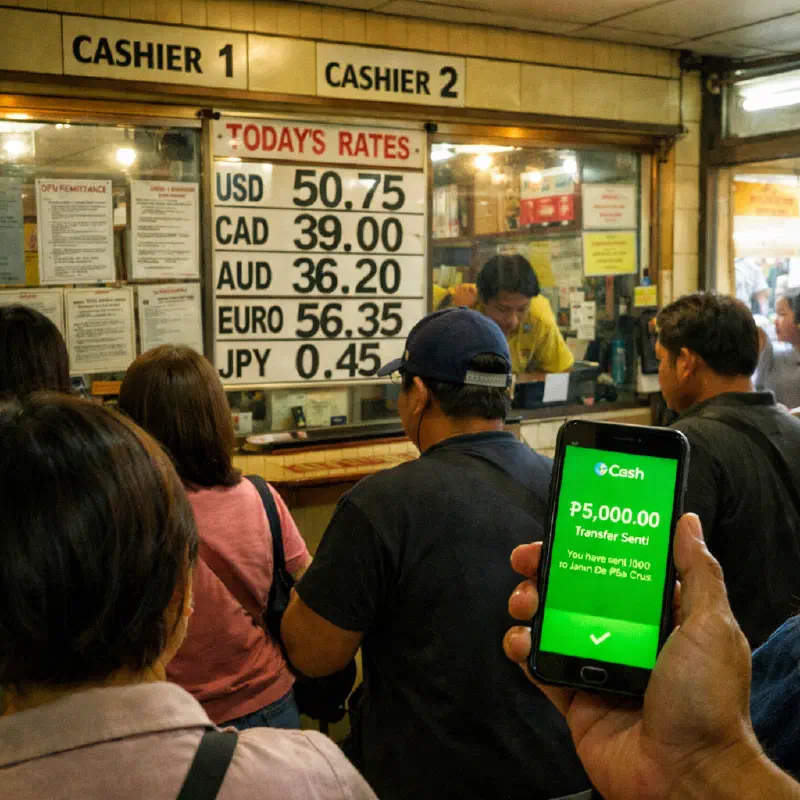
But the aggregate hides more than it reveals. Growth is slowing: Q1 2026 cash remittances grew by just 2.8% year-on-year, and March’s 2.3% expansion was the weakest monthly growth rate since June 2023. The deceleration is not a crisis — but it is a signal that the volume story has reached a ceiling, and that what happens to Philippine household consumption in 2026 will be shaped more by the composition of those inflows than by their headline size.
The Middle East ratio that changes the calculus #
There is a figure embedded in BSP data that most commentary skips over. According to BPI president TG Limcaoco and BPI lead economist Emilio Neri, the Middle East hosts roughly 40% of all OFWs — but generates less than 20% of total remittance inflows.
Read that twice. Nearly half of all overseas Filipinos are working in the Gulf region, but their collective share of total remittances is less than half what their headcount would suggest. In Q1 2026, Saudi Arabia contributed 6.3% of cash remittances and the UAE 4.7%, with the broader Middle East corridor accounting for roughly 17% of total inflows. The US, by contrast, accounts for just under 40% of the Philippines’ more than 4.4 million diaspora — yet generates roughly 40% of all remittances.
The arithmetic tells a story about occupational structure. Middle East OFWs are disproportionately domestic workers, construction labourers, and low-to-mid-skilled service workers — categories where earnings are constrained by host-country wage structures and where a larger share of income is consumed locally in higher cost-of-living environments. US, Singapore, and UK OFWs skew heavily toward healthcare, maritime, and professional services — sectors with higher earnings, more predictable deployment, and a wider margin to remit.
This matters enormously for consumption. The Philippines’ household spending base is not underpinned by a uniform remittance flow. It is anchored by a comparatively small cohort of high-earning, stably employed OFWs in advanced economies, layered over a much larger but lower-income-per-head OFW population in the Gulf. When analysts say the remittances are “resilient,” they are describing the performance of the first cohort. The vulnerabilities lie in the second.
What the US remittance tax actually changes #
The US “One Big Beautiful Bill,” signed by President Trump on July 4, 2025 and effective January 1, 2026, introduced a 1% excise tax on cash-based remittance transfers — covering payments made via cash, money orders, and cashier’s checks. Bank-to-bank electronic transfers and US-issued debit or credit cards are explicitly exempt.
At the macro level, the impact is modest. The Philippine Department of Finance estimated that only about 20% of the 4.4 million Filipinos in the US use affected channels — approximately 880,000 people — and that the resulting reduction in annual inflows would be around $100 million against a projected $36.5 billion total. RCBC chief economist Michael Ricafort confirmed to BusinessWorld that 3% growth remains achievable for the year even with the tax factored in.
But aggregate figures obscure household-level effects. The families most exposed to the US remittance tax are not the same as those sending via bank transfer. According to the Asian Journal’s reporting on the law, the tax applies specifically to cash-based methods disproportionately used by lower-income senders — migrants in informal employment, undocumented workers, and older members of the diaspora who never migrated to digital transfer channels. For these families’ recipients, a $10 deduction on every $1,000 sent is not negligible when that money pays rent or school fees.
The tax is also accelerating a behavioural shift that was already underway. More than 55% of remittance inflows to the Philippines are now processed through digital channels, with GCash and Maya together handling the majority of wallet-level disbursements. BSP’s Digital Payments Transformation Roadmap has pushed retail digital transaction volume past its 50% target. The US levy is nudging the remaining cash-channel users toward digital platforms — which have lower fees and higher transparency, but also require smartphone access and financial literacy to use effectively.
The unresolved question is what fraction of affected senders switch to regulated digital alternatives versus informal channels. Development economists, including the Overseas Development Institute in a June policy bulletin, warned explicitly that remittance taxes of any kind risk pushing flows into unregulated corridors — weakening financial transparency and consumer protection for the families on the receiving end.
What households are actually doing with the money #
Understanding what remittances fund is as important as understanding how much arrives. Philippine household surveys consistently show remittance spending concentrated in three tiers: daily consumption needs (food, utilities, transport), education (tuition, school materials), and healthcare and housing.
The consumption story for 2026 sits on top of this. Private consumption grew 4.6% in 2025, and Fitch BMI projects 4.5% for 2026 — stable, but not accelerating. Inflation is running at 2.8%–3.1%, within BSP’s target band but still elevated enough to squeeze the purchasing power of families whose peso income is buffered by dollar inflows converted at a peso that averaged P58.85 in December 2025.
BSP’s Consumer Expectations Survey for Q1 2026 recorded a confidence index of -15.8% — negative, but an improvement from the -22.2% in Q4 2025. Households are cautiously optimistic, not buoyant. BSP rate cuts — the policy rate has come down from its peak, with analysts expecting it to approach 4.5% by year-end — are providing some monetary easing. But the spending story is still primarily a remittance story, not a wage story, in the provinces where OFW households are most concentrated.
The back-to-school season in June typically creates a predictable spike in remittance demand. June and July are when parents in remittance-dependent households draw on savings and request additional transfers for tuition deposits. That seasonal pattern has been consistent for decades. What is changing is the margin available to absorb it: with remittance growth in the low single digits, families are dealing with flat or modestly higher real inflows against higher peso prices for food and education.
The longer reframe #
Jonathan Ravelas, senior adviser at Reyes Tacandong & Co., put it cleanly in May: “Remittances remain a critical anchor for Philippine consumption — but they’re no longer a high-growth driver. If we want faster economic expansion, the heavy lifting will have to come from investment and stronger domestic demand.”
That reframing matters for how policymakers and analysts read the 2026 consumption outlook. The $36.6 billion headline forecast is almost certainly going to hold — the underlying deployment of Filipino workers across healthcare, maritime, and professional services is robust, global demand for these skills is durable, and the BSP’s official 3% growth target is conservative enough to absorb moderate Middle East disruption or US tax effects.
What the headline cannot tell you is whether that $36.6 billion generates the same household consumption multiplier as it did in previous cycles. The evidence suggests it is doing somewhat less: more of it is being absorbed by inflation, more is flowing through digital channels that reduce fee leakage but also compress informal small business income that used to live in the remittance transfer ecosystem, and less of it is landing in households positioned to convert remittance receipts into productive investment or durable consumption.
The Philippines is not facing a remittance crisis. It is facing a more subtle transition: from a model in which remittance volume growth reliably translated into consumption growth, to one in which the relationship between the two depends increasingly on the occupational composition of the OFW base, the channel mix, and the household’s capacity to manage the real purchasing power of what arrives. That is a harder story to tell from the aggregate data — but it is the story that explains why 2026 consumption will likely disappoint those who read the $36.6 billion as a straightforward positive.
References #
-
Manila Bulletin (May 15, 2026). “Overseas remittances rebound even as Mideast tension escalates.” https://mb.com.ph/2026/05/15/overseas-remittances-rebound-in-march-even-as-mideast-tension-escalates (Accessed 8 Jun 2026)
-
Philippine Star (May 16, 2026). “OFW remittances continue to climb.” https://www.philstar.com/business/2026/05/16/2528196/ofw-remittances-continue-climb (Accessed 8 Jun 2026)
-
Philippine Tribune (March 16, 2026). “OFW remittances rise to $3.02B in January — BSP.” https://tribune.net.ph/2026/03/16/ofw-remittances-rise-to-302b-in-january-bsp (Accessed 8 Jun 2026)
-
BusinessWorld (February 17, 2026). “OFW remittances hit record $35.6B.” https://www.bworldonline.com/top-stories/2026/02/17/730931/ofw-remittances-hit-record-35-6b/ (Accessed 8 Jun 2026)
-
Fintech News Philippines (May 2026). “Overseas Filipino Remittances Surge to A Record High of US$35.6 Billion in 2025.” https://fintechnews.ph/70114/remittance/record-philippine-cash-remittances-2025-bsp-data-economic-impact/ (Accessed 8 Jun 2026)
-
Asian Journal (2026). “Overseas Filipinos face new 1% remittance tax under U.S. law.” https://asianjournal.com/world/asia/overseas-filipinos-face-new-1-remittance-tax-under-u-s-law/ (Accessed 8 Jun 2026)
-
Metrobank Wealth Insights / BusinessWorld (2026). “Philippine remittances seen to keep momentum despite new US tax.” https://wealthinsights.metrobank.com.ph/news/philippine-remittances-seen-to-keep-momentum-despite-new-us-tax (Accessed 8 Jun 2026)
-
ABS-CBN News (February 13, 2026). “Philippine consumer spending to see stable growth in 2026, says Fitch unit.” https://www.abs-cbn.com/news/business/2026/2/13/philippine-consumer-spending-to-see-stable-growth-in-2026-says-fitch-unit-1442 (Accessed 8 Jun 2026)
-
BSP Consumer Expectations Survey Q1 2026. https://www.bsp.gov.ph/Lists/Consumer%20Expectation%20Report/Attachments/25/CES_1qtr2026.pdf (Accessed 8 Jun 2026)