
The World Bank reclassified the Philippines as an upper-middle income country this week. At almost the exact same moment, the Bangko Sentral ng Pilipinas estimated that June inflation ran between 6 and 7 percent — above its 2–4 percent target band for the fourth consecutive month — and a credit data study showed that the P5,000–P10,000 digital loan bracket carries a 42 percent delinquency rate. These three facts belong to the same story, and the story is not the one the income reclassification headline tells.
The double freight problem #
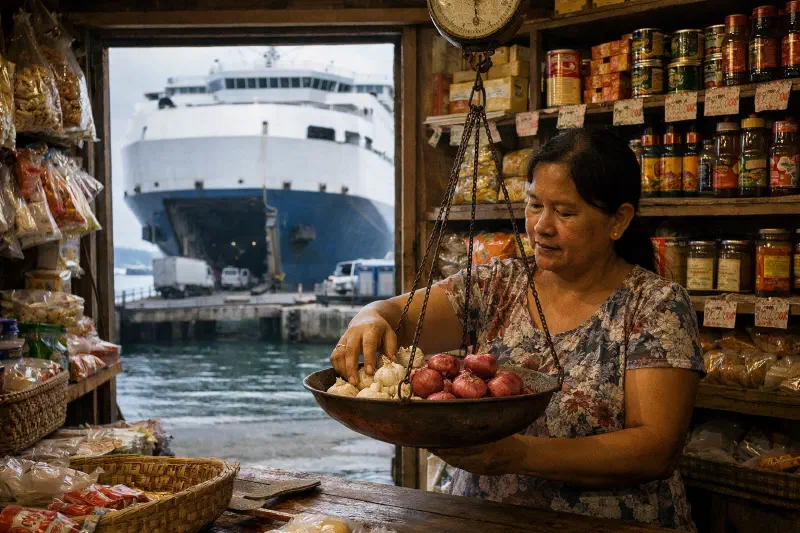
The Philippines faces a food import inflation mechanism that most countries do not. In Vietnam or Thailand, a spike in container shipping rates raises the landed cost of imported goods once, at the port. In the Philippines, the same container rate spike raises costs twice — once at the international arrival point, and again as those goods distribute across an inter-island network of roll-on roll-off ferries, small cargo vessels, and coastal trucking routes that connects the national food supply across 7,641 islands.
Inter-island freight costs are directly tied to bunker fuel prices. When marine fuel rises — as it has alongside oil prices that surged after the Strait of Hormuz closure — the cost of moving rice from surplus provinces in Mindanao and the Visayas to Metro Manila’s wet markets rises within two to three weeks. That lag is meaningfully shorter than the four-to-eight weeks it takes container rate increases to clear through the import cost channel. Households in Cebu, Davao, and Iloilo feel the price change before analysts with their lag-adjusted CPI models expect it.
The country’s core food import basket — garlic and onions predominantly sourced from China, cooking oil from Malaysia and Indonesia, processed foods from the region — faces the full force of the import cost channel simultaneously. The Drewry World Container Index hit a 22-month high of $4,166 per 40-foot container on June 25, with the Shanghai–Los Angeles route up 12 percent to $5,750 and global demand running 4 percent above year-ago levels against fleet capacity growth of only 3 percent (Drewry, June 25, 2026). Rice imports, made more accessible to volume by the EO 62 tariff reduction to 15 percent in 2024, now flow through a pricing channel that is directly exposed to every container rate move.
That combined exposure — international container rates feeding import costs, bunker fuel feeding domestic distribution costs — is why food inflation in the Philippines is structurally more persistent than headline comparisons with regional peers suggest. Even when global container rates soften, the inter-island network responds to its own fuel economics on its own schedule.
The remittance buffer is thinner than it looks #
In prior years, the standard analytical frame for Philippine household spending resilience was the OFW remittance total. The number is large, it is relatively stable, and it insulates consumption from shocks that would otherwise compress demand more sharply. That frame remains partially correct — and increasingly misleading.
As I argued in June, the aggregate remittance figure masks a quality divergence that matters more than the volume. The US, UK, and Singapore corridors generate the high-income, stable-sending flows that anchor the headline total. The Middle East corridors — home to roughly 40 percent of all overseas Filipinos — generate less than 20 percent of total inflows while employing a much larger, lower-wage cohort of domestic workers, construction laborers, and service employees.
Those Gulf corridors are now under stress. April 2026 inflows fell to approximately $2.7 billion — an 11-month low — with year-on-year growth decelerating to about 2 percent, according to ING Bank’s regional research team (Philippine Daily Inquirer, July 1, 2026). The cause is direct: Middle East economic disruption following the Strait of Hormuz closure has reduced the earning capacity and sending frequency of the cohort that, precisely because of its size, amplifies any slowdown in household income across the provinces.
ING economist Deepali Bhargava was direct: the slowdown could exert “a more persistent drag on inward remittances as conditions in the Middle East region take time to stabilize.” For families whose food budget is funded primarily by Gulf remittances — and whose only source of real-income uplift in an inflationary environment is the peso value of those transfers — the combination of a weakening peso (P61.29 per dollar on July 1) and slower inflows is not an abstract macro story. It is a monthly shortfall.
What the micro-loan data actually tells us #
The most revealing signal in this week’s Philippine data did not come from a central bank release. It came from LenderLink, a credit data platform whose latest figures showed that P867 billion in digital loans were disbursed across 619,000 borrowers as of Q4 2025, with the average loan size at P5,468 — and with the P5,000–P10,000 bracket carrying a 42 percent delinquency rate (Philippine Daily Inquirer, July 2, 2026).
Forty-one percent of these borrowers are aged 25–34. Metro Manila accounts for the largest share of loan records at 20 percent, which means the remaining 80 percent are distributed across provincial centers and smaller cities — exactly the geography where OFW-dependent households are most concentrated and where food import inflation is most directly felt.
This is the operational definition of debt-funded resilience. When the remittance cushion thins and food costs remain elevated, the behavioral response is not to reduce spending — particularly when the spending involves children’s food and school preparation costs during the June-to-July back-to-school period. The behavioral response is to borrow. The fact that a significant share of those borrowers cannot repay on time suggests the cushion created by the loan is not adequate to bridge the underlying gap.
The BSP’s rate increase to 4.75 percent in June — the second in the current tightening cycle — is designed to slow that borrowing. As a mechanism against aggregate demand-driven inflation, this is textbook. As a mechanism against supply-driven food price increases caused by freight costs and peso depreciation, it is blunter. Higher rates reduce the affordability of the very micro-credit that households are using to absorb the shock.
The minimum wage arithmetic #
The 12 percent minimum wage increase approved for Metro Manila workers — the largest in years, to be disbursed in two tranches starting this month — is the government’s most visible acknowledgment that the cost-of-living pressure is structural (VnExpress International, July 2, 2026).
The arithmetic is straightforward: if June inflation settles at the midpoint of the BSP estimate — around 6.5 percent — then a 12 percent nominal wage increase for covered workers yields a real wage improvement of approximately 5 percent. For a Metro Manila minimum-wage worker in the formal sector, that is meaningful.
The coverage gap is equally straightforward. The families most exposed to food import inflation are not primarily Metro Manila formal sector workers. They are remittance-dependent households in Calabarzon, Central Luzon, Region 6, and Mindanao — families whose income comes not from wages subject to the RTWPB order but from OFW transfers that are decelerating in both volume and purchasing power simultaneously. The 12 percent wage increase does not reach them. Neither does it reach the market vendors, domestic workers, and informal sector employees who sit in the highest-delinquency brackets of the digital lending data.
What H2 resilience actually requires #
The conventional framing of Philippine household spending resilience treats the first quarter GDP print — 2.8 percent, the weakest since the pandemic recovery began — as the baseline risk and the full-year remittance forecast as the floor. Both framings are optimistic about the wrong things.
The Drewry WCI spike from late June will begin reaching Philippine retail shelves in approximately late August, based on typical import-to-retail lag structures. The full pass-through lands in September and October — which is the same window in which the BSP will be assessing whether the tightening cycle has done enough. As this publication’s July 2 economy brief noted, the Q3 inflation data that central banks are preparing to read as stabilisation evidence will be pricing in April and May freight conditions, not June’s (SEA Weekly Economy Brief, July 2, 2026).
For Philippine household spending, that timing mismatch has a specific implication: the 12 percent wage increase that takes effect this month, the partial recovery in remittance flows, and any demand compression from BSP rate hikes all need to work their way through the economy before Q4 freight costs arrive in food prices. Whether the sequence holds depends on whether the three buffers — wages, remittances, and accessible credit — are simultaneously available when the next cost wave lands.
The World Bank’s income reclassification measures the national income average. What it does not measure is whether the households below that average, facing compounding food import costs, a slowing remittance cushion, and BSP-constrained credit, can hold purchasing power through the second half of 2026. That test has not been passed. It is only just beginning.
References:
- Philippine Daily Inquirer / Ian Nicolas P. Cigaral (July 1, 2026). “BSP: Inflation likely eased in June to 6-7%.” https://business.inquirer.net/598120/bsp-inflation-likely-eased-in-june-to-6-7 (Accessed July 2, 2026)
- Philippine Daily Inquirer / Ian Nicolas P. Cigaral (July 1, 2026). “ING: PH trails Asia in consumer recovery.” https://business.inquirer.net/598126/ing-ph-trails-asia-in-consumer-recovery (Accessed July 2, 2026)
- Philippine Daily Inquirer / Logan Kal-El M. Zapanta (July 2, 2026). “Filipinos taking smaller, more frequent loans–study.” https://business.inquirer.net/598264/filipinos-taking-smaller-more-frequent-loans-study (Accessed July 2, 2026)
- Philippine Daily Inquirer (July 1–2, 2026). “Philippines reaches upper-middle income status, World Bank says.” https://business.inquirer.net/598325/philippines-reaches-upper-middle-income-status-world-bank-says (Accessed July 2, 2026)
- VnExpress International (July 2, 2026). “Philippines approves record 12% minimum wage hike for Manila workers.” https://e.vnexpress.net/news/business/economy/philippines-approves-record-12-minimum-wage-hike-for-manila-workers-5092134.html (Accessed July 2, 2026)
- Drewry (June 25, 2026). “World Container Index Assessed by Drewry.” https://www.drewry.co.uk/supply-chain-advisors/supply-chain-expertise/world-container-index-assessed-by-drewry (Accessed June 29, 2026)
- SEA Weekly / Maria Lourdes Reyes (June 8, 2026). “Why Philippines Consumption Outlook 2026 Depends on Remittance Quality, Not Just Volume.” https://seaweekly.com/posts/2026-06-08-philippines-consumption-outlook-2026-remittance-quality/ (Accessed July 2, 2026)
- SEA Weekly / Chloe Tan (July 2, 2026). “ASEAN Economy Brief: What’s Driving Freight Cost Pass-Through to ASEAN Consumer Prices in Q3?” https://seaweekly.com/posts/2026-07-02-asean-economy-brief-freight-cost-pass-through-consumer-prices/ (Accessed July 2, 2026)