
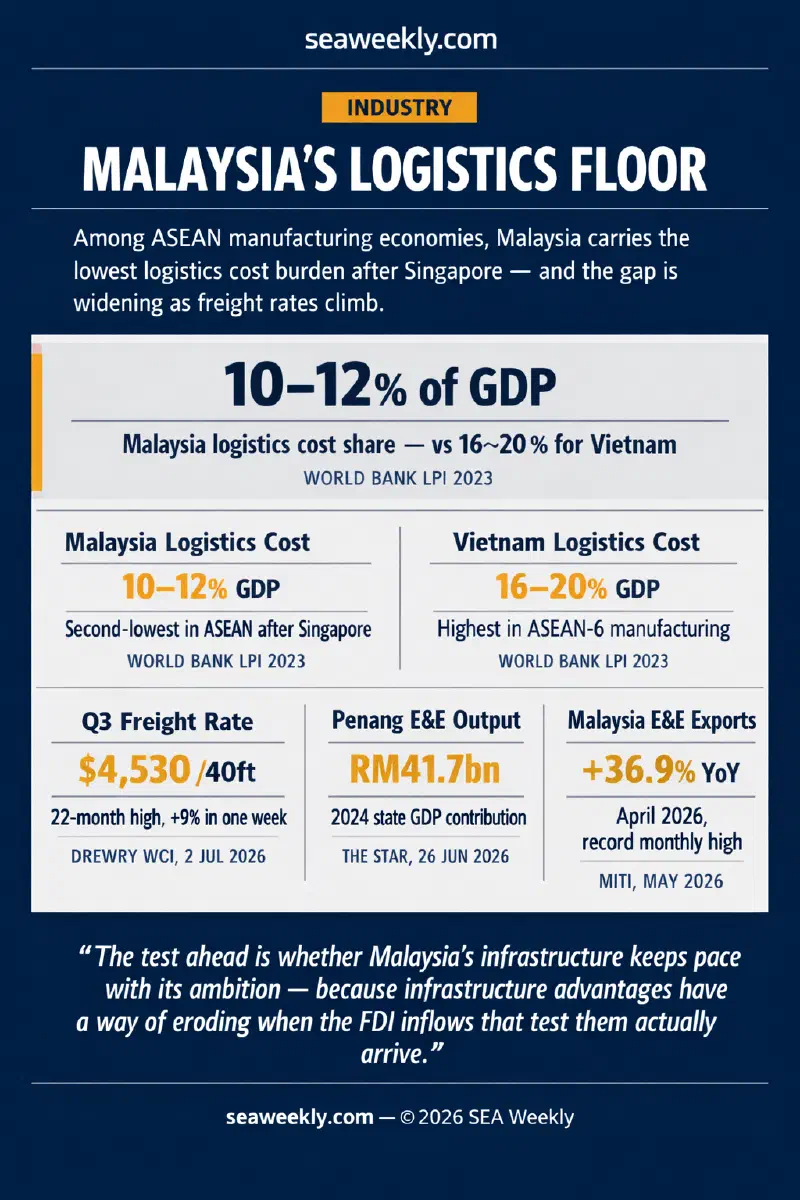
The procurement managers currently reassessing ASEAN electronics supply chain routing are not looking at factory tours. They are looking at spreadsheets. Specifically, they are looking at the gap between a freight rate that just hit $4,530 per 40ft container on July 2 — up 9% in a single week, according to Drewry — and what that rate does to the delivered cost of their product depending on where it was manufactured.
That gap is where Malaysia’s logistics efficiency advantage lives. And in a Q3 2026 where that Drewry World Container Index has now reached levels not seen since September 2024, the advantage is no longer theoretical.
The logistics cost gap that most ASEAN analysis skips #
The most revealing number in the current ASEAN freight cycle is not the container rate itself. It is the ratio of logistics costs to GDP across manufacturing economies — because that ratio determines how hard each economy’s exporters feel the same freight-rate move.
World Bank logistics benchmarking puts Vietnam’s logistics costs at roughly 16–20% of GDP, the highest in ASEAN-6. Indonesia runs 14–16%, weighed down by archipelago inter-island economics. Thailand comes in at 12–14%. Malaysia sits at approximately 10–12% — second only to Singapore’s 8–10% among manufacturing economies in the region.
That gap is not accidental. It reflects more than 40 years of deliberate infrastructure investment anchored on two logistics nodes: Penang in the north, for the electronics and semiconductor cluster, and Port Klang in the centre, for the sea freight gateway. The combination of a mature deep-water container port with one of ASEAN’s most connected industrial air freight networks creates an efficiency floor that competitors have not matched.
In practice, this means a Malaysian electronics exporter feels every 10% move in global container rates roughly 30–50% less severely than a Vietnamese counterpart exporting a product of equivalent dollar value, all else equal. When the Drewry index rose 5% to $4,166 per 40ft on June 25 alone — a 22-month high at the time — that asymmetry began showing up in delivered-cost comparisons that procurement teams were already running for their Q4 order allocation decisions (Drewry, 25 Jun 2026).
Why Penang’s logistics infrastructure compound the advantage #
The deeper story is that Malaysia’s logistics advantage is not a single data point. It is a compound effect of geography, infrastructure density, and manufacturing mix — and it is most visible in Penang.
Penang contributed RM41.7 billion to its own state GDP through electrical and electronics output in 2024, anchoring a manufacturing sector that represents 46.1% of state output. The state hosts more than 350 multinationals and 6,500 manufacturing-related SMEs. Approved FDI reached RM15.2 billion in the first nine months of 2025, driven by E&E, machinery and equipment, and chemicals, with the US as the largest capital source, followed by China and the Cayman Islands (The Star, 26 Jun 2026).
What that ecosystem density creates is logistics efficiency through consolidation. When enough multinationals and tier-one suppliers operate within the same corridor, they can co-load cargo, negotiate block contracts with carriers, and absorb freight rate volatility across diversified shipment schedules in a way that a single factory in a greenfield industrial park in Vietnam or Indonesia cannot.
Penang International Airport handles a significant share of Malaysia’s electronics air cargo — the mode of choice for high-value semiconductors, advanced packaged chips, and precision components where freight cost is a small fraction of product value. The North Butterworth Container Terminal complements this with sea freight capacity for less time-sensitive, higher-volume electronics assembly. Two modes, one ecosystem.
Port Klang and the sea freight gateway #
For Malaysia’s broader electronics supply chain, Port Klang carries the sea freight load that does not route through the north. As Southeast Asia’s second-busiest container port after Singapore, Port Klang offers the infrastructure reliability — vessel scheduling depth, berth availability, customs integration — that electronics supply chains require for precision inventory management.
The contrast with Thailand’s position at Laem Chabang is instructive. Thailand’s main gateway already ran berth queuing premiums of $50–150 per container at its older facilities before the Q3 monsoon window even opened — charges accumulating before the first seasonal disruption, not because of it (SEAWeekly, 9 Jun 2026). Thailand’s automotive sector compound the pressure: Thai car production fell 17.94% year on year in May 2026, creating a paradox where production declines did not immediately reduce inbound cargo pressure, since long-lead supply contracts keep inventory moving after output has already fallen (Bangkok Post, 29 Jun 2026).
None of this means Malaysia’s ports are immune to congestion. Daniel Lim’s July 6 analysis of Singapore’s trade finance positioning noted specifically that Vietnamese electronics manufacturers were needing to reroute shipments “around a congested Port Klang” — a reminder that the advantage is structural and relative, not absolute. Malaysia’s infrastructure edge over most ASEAN competitors exists in degree, not kind.
The product-type multiplier #
The argument for Malaysia’s logistics efficiency advantage is sharpest when it engages with the type of goods moving through it.
Vietnam’s logistics exposure is disproportionately concentrated in high-import, thin-margin manufacturing. Electronics component imports surged 52.3% year on year to $65.3 billion in the first four months of 2026 — the raw material of an export model that is efficient but structurally thin (Vietnam Investment Review, 14 May 2026). When freight rates for air cargo from Vietnam to Europe nearly doubled to $6.27 per kilogram on the back of Hormuz disruption, as Reuters documented in April, the hit fell on products where that additional cost represented a meaningful share of total delivered value (Reuters, 10 Apr 2026).
Malaysia’s trajectory is different. SkyeChip Bhd — the only pure-play semiconductor IP company listed in Southeast Asia and the only commercialised HBM3/HBM3E memory interface IP company in the region — generated RM425,000 in revenue per engineer in FY2026, with the US accounting for 23.1% of revenue and a projected core earnings CAGR of 48% through FY2029 (The Star, 26 Jun 2026). A product at that revenue-per-unit intensity is essentially immune to a $50 increase in ocean freight per container. It changes the logistics cost calculation entirely.
That is the deeper logic of Malaysia’s National Semiconductor Strategy, launched in 2024: moving toward chip design, advanced manufacturing, and compound materials does not just increase export value. It also reduces the freight-cost-to-product-value ratio, making logistics volatility less damaging to margins.
Malaysia’s April 2026 exports reached a record RM182.74 billion, up 36.9% year on year, with E&E continuing to lead on AI-linked demand, automotive electronics, and machinery (MITI, 20 May 2026). That headline is partly a volume story. Increasingly, it is also a mix story.
The caveat: the SME logistics tail #
Malaysia’s logistics efficiency advantage is real — but it is not evenly distributed. The 6,500 manufacturing SMEs in Penang alone sit on the other side of a capability divide from the 350+ multinationals. Smaller suppliers often lack the volume to consolidate cargo, the balance sheet to absorb elevated freight costs across a quarter, or the commercial leverage to pass through rate increases to their multinational customers.
The Penang Economic Forum 2026 was explicit about this tension: panellists acknowledged that moving beyond the “traditional low-cost manufacturing model” is essential, but that SMEs still dominate the numerical count — and their viability in a sustained freight-rate upswing is more fragile. This is where Malaysia’s logistics cost advantage thins out. The aggregate 10–12% logistics-cost-to-GDP ratio masks a distribution in which the large-firm tier performs better than that figure implies, and the SME tail performs worse.
What this means for H2 investment decisions #
The freight rate backdrop is not easing. Drewry’s July 2 reading of $4,530 per 40ft, and carrier signals of further general rate increases through Q3, suggest that the sorting pressure on ASEAN electronics supply chains will continue for at least the next two months. In that environment, the logistics cost structure comparison is not a background variable — it is an active input into where global electronics companies are placing their H2 order allocation and their medium-term capex.
Malaysia will not win every decision. Its cost of living, currency dynamics, and the premium embedded in Penang’s ecosystem density all limit how competitive it can be on pure price. But in a cycle where freight-rate volatility is exposing the structural weaknesses of thin-margin, high-input supply chains, the 10–12% logistics cost floor is becoming one of the clearest arguments Malaysia can make to a procurement team that has already read this week’s Drewry report.
The test ahead is whether Malaysia’s infrastructure keeps pace with its ambition. As the National Semiconductor Strategy raises the export mix toward higher-value activities, Port Klang and Penang’s logistics nodes will need to scale accordingly — without repeating the congestion dynamics that already affect rival gateways. That infrastructure race is, for now, one Malaysia is winning. But infrastructure advantages have a way of eroding when the FDI inflows that test them actually arrive.
References #
- Drewry (25 Jun 2026). “World Container Index — Assessed by Drewry.” https://www.drewry.co.uk/supply-chain-advisors/supply-chain-expertise/world-container-index-assessed-by-drewry (Accessed 8 Jul 2026)
- The Star (26 Jun 2026). “Penang primed to prosper.” https://www.thestar.com.my/business/business-news/2026/06/26/penang-primed-to-prosper (Accessed 8 Jul 2026)
- The Star (26 Jun 2026). “SkyeChip profit forecast to grow at 48% CAGR from FY26 to FY29.” https://www.thestar.com.my/business/business-news/2026/06/26/skyechip-profit-forecast-to-grow-at-48-cagr-from-fy26-to-fy29 (Accessed 8 Jul 2026)
- Ministry of Investment, Trade and Industry Malaysia (20 May 2026). “Trade Performance April 2026.” https://www.miti.gov.my/miti/resources/Media%20Release/Press_Release_Trade_Performance_Apr_2026.pdf (Accessed 8 Jul 2026)
- Vietnam Investment Review (14 May 2026). “Vietnam enters manufacturing and investment-led growth phase.” https://vir.com.vn/vietnam-enters-manufacturing-and-investment-led-growth-phase-152649.html (Accessed 8 Jul 2026)
- Reuters (10 Apr 2026). “Shippers weigh unusual routes as high air cargo rates and ocean gridlock persist.” https://www.reuters.com/business/energy/shippers-weigh-unusual-routes-high-air-cargo-rates-ocean-gridlock-persist-2026-04-10/ (Accessed 8 Jul 2026)
- Bangkok Post (29 Jun 2026). “Automotive sector posts downturn in first 5 months.” https://www.bangkokpost.com/business/motoring/3278539/automotive-sector-posts-downturn-in-first-5-months (Accessed 8 Jul 2026)
- SEAWeekly (9 Jun 2026). “ASEAN Industry Brief: How ASEAN port congestion patterns are evolving before Q3 peak shipping season.” https://seaweekly.com/posts/2026-06-09-asean-port-congestion-brief/ (Accessed 8 Jul 2026)
- World Bank Logistics Performance Index 2023. https://lpi.worldbank.org/international/global (Accessed 8 Jul 2026) — ASEAN logistics cost benchmarking referenced in SEAWeekly (17 Jun 2026), “Why Vietnam logistics costs are still the key variable in ASEAN export recovery.”