
The industrial pitch showing up at Penang’s investment promotion offices and Vietnam’s northern economic zone authorities carries the same logos in mid-2026. Same multinational technology companies. Same electronics supply chain upgrade budget. Same questions about labour cost, logistics reliability, and the durability of industrial policy. The obvious read is that Malaysia and Vietnam are locked in zero-sum competition for the same prize.
The more useful read is structural: they are not primarily fighting over the same investment category. The competition is real but it is narrower than the headline version — and it is concentrated in a specific upgrade layer where both countries’ ambitions genuinely overlap.
Malaysia’s upgrade thesis starts in Penang, but it doesn’t end there #
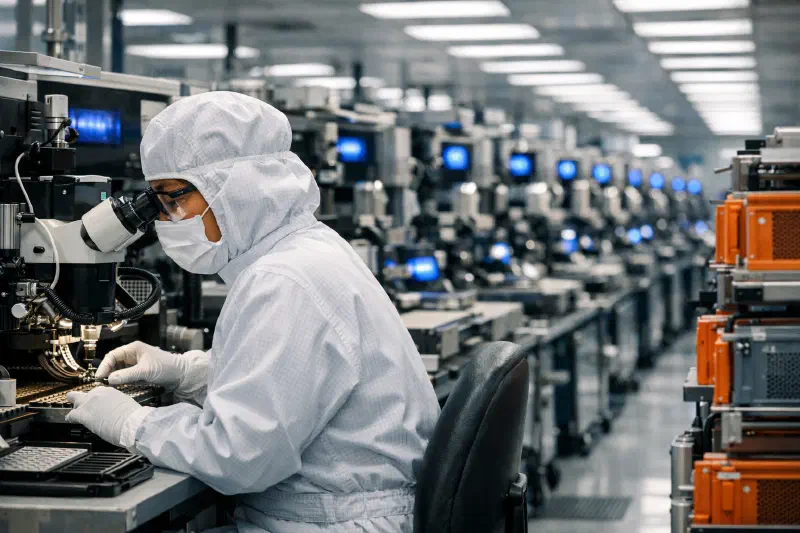
Penang’s claim on Southeast Asia’s semiconductor and electronics manufacturing landscape is not in dispute. The state contributed RM41.7 billion to Malaysia’s GDP through its electrical and electronics segment in 2024, anchoring a manufacturing sector that accounts for 46.1% of state output. Approved foreign direct investment in Penang reached RM15.2 billion in the first nine months of 2025, driven primarily by E&E, machinery, and chemicals, with the United States remaining the largest capital source, followed by China and the Cayman Islands. Supported by more than 350 multinationals and 6,500 manufacturing-related SMEs, Penang has built the densest industrial supplier ecosystem in Southeast Asia outside Singapore for semiconductor and electronics work (The Star, “Penang primed to prosper”, June 26, 2026).
The more revealing signal in 2026 is not the volume of FDI but the direction of the ambition. The Penang Economic Forum held this week explicitly called for the state to move beyond its traditional low-cost manufacturing model toward higher-value activities anchored in the “4T’s”: talent, technology, product innovation, and intellectual property. That is a clear-eyed acknowledgement that the model which built Penang’s ecosystem over four decades needs to evolve if it is to hold against challengers who can match its current cost structure.
The clearest embodiment of Malaysia’s intended direction is SkyeChip Bhd — the only pure-play semiconductor intellectual property company listed in the region and the only commercialised HBM3/HBM3E memory interface IP company in Southeast Asia. Revenue per engineer has reached RM425,000 in FY2026, and the US now accounts for 23.1% of the company’s revenue — its entry to Samsung Foundry Connect in February 2026 opened the South Korean market simultaneously. Core earnings are projected at a 48% CAGR from FY2026 to FY2029, with gross margin expanding from 45% toward 51% on the IP licensing flywheel (The Star, “SkyeChip profit forecast to grow at 48% CAGR from FY26 to FY29”, June 26, 2026).
SkyeChip is proof of concept for where Malaysia’s National Semiconductor Strategy — launched in 2024 — wants to take the country: from back-end outsourced assembly and test operations toward chip design, advanced manufacturing, and compound materials. That shift, if multiplied beyond one benchmark company, would move Malaysia’s value capture in the semiconductor chain by several meaningful steps.
Vietnam’s upgrade push is backed by volume and a new accountability framework #
The challenge for Malaysia’s positioning is that Vietnam is not standing still. The country registered US$18.2 billion in new and expanded foreign direct investment in the first four months of 2026, up 32% year-on-year, with manufacturing accounting for approximately 69% of newly registered capital and industrial output growing 10% year-on-year in April (Vietnam Investment Review, “Vietnam enters manufacturing and investment-led growth phase”, May 14, 2026). That is not simply assembly-plant capital. The June 2026 investment announcements tell a more specific story.
Coherent Corporation — the US-listed photonics and advanced materials technology group with a market capitalisation of US$74 to 82 billion, backed by a US$2 billion equity investment from Nvidia — signed a lease for 30,000 square metres of industrial space at KTG Industrial Nhon Trach 2 in Dong Nai for its second plant in the province, following a US$127 million facility opened there in July 2025. Coherent manufactures thermoelectric coolers, technical ceramics, semiconductor wafers, and advanced optics — materials embedded deep in the semiconductor value chain, not at the commodity end. Its growing presence in Dong Nai strengthens Vietnam’s southern manufacturing base as a credible complement to the northern Bac Ninh–Hanoi electronics cluster (VIR, “US giant Coherent expands business in Vietnam”, June 25, 2026).
In the same week, South Korea’s Interflex invested a further US$18 million in Korea Circuit Vina, its PCB manufacturing subsidiary in Vinh Phuc Province, raising its ownership to 89.32%. With combined investments of approximately US$46 million into the Vietnamese subsidiary over 2025 and 2026, Interflex is committing serious capital to Vietnam’s electronics depth — and its Flexible PCB business sits squarely in the category that Malaysia’s NIMP 2030 also targets (VIR, “South Korea’s Interflex to expand PCB manufacturing in Vietnam”, June 17, 2026).
The investment backdrop would mean less without a policy framework to sustain it. Resolution 10, issued by the Politburo on June 8, 2026, marks Vietnam’s most explicit shift in foreign investment strategy in years. Rather than measuring success by capital volume, the resolution ties government support to project performance, technology transfer verification, and localisation achievement. Its targets are specific: localisation rates in key manufacturing industries reaching 45 to 50% by 2030; 10,000 Vietnamese companies entering multinational supply chains; and US$200 to US$300 billion in registered FDI over 2026–2030, with 75% from developed economies. Semiconductors are listed explicitly as a priority sector alongside AI, advanced energy, and new materials (VIR, “Resolution 10 marks new chapter in Vietnam’s foreign investment strategy”, June 18, 2026).
Where the strategies genuinely collide #
The inconvenient truth for clean competitive narratives is that Malaysia and Vietnam are not primarily fighting over the same category in 2026. Malaysia is securing IP-intensive, design-led semiconductor business. Vietnam is building manufacturing depth and reducing import dependency in electronics components. Those are different problems.
But the space between them — advanced PCB manufacturing, compound semiconductor subassembly, high-precision electronics components — is where both strategies compete for the same pool of global FDI. Japanese electronics manufacturer Meiko Electronics breaking ground on a US$500 million electronic circuit factory in Phu Tho, Vietnam is the kind of investment that could plausibly have been evaluated for Malaysia. Interflex’s PCB expansion carries the same logic. These are not commodity assembly plays. They represent precisely the mid-tier electronics upgrade that Malaysia’s NIMP 2030 targets and that Vietnam’s Resolution 10 now explicitly claims.
The constraint is that the global supply chain upgrade budget for this tier is not unlimited. As we argued in the June 2 deep dive on Indonesia versus Vietnam manufacturing competitiveness, supply chain managers are increasingly assigning countries distinct roles rather than picking a single winner. The same dynamic applies here — but only if both countries can hold their respective upgrade lanes. If Vietnam closes its localisation gap faster than expected, the overlap with Malaysia’s mid-tier ambitions expands. If Malaysia multiplies its semiconductor IP and design ecosystem into a movement rather than a single benchmark company, it moves further out of Vietnam’s competitive reach.
Siti Aishah’s take: Malaysia’s structural edge is coherence, not just history #
Malaysia’s most durable competitive argument in this contest is not its semiconductor history — every country in the region is building a version of that story. It is the institutional coherence that history has generated. Bank Negara Malaysia has maintained the Overnight Policy Rate at 2.75% with inflation running at 1.9% in April 2026 — a policy environment unusually hospitable to the long-cycle capital expenditure that high-value electronics manufacturing requires. The ringgit’s appreciation of more than 10% through 2025 directly reduces the cost of importing precision capital equipment — bonding machines, advanced CNC systems, photolithography tools — that companies committing to semiconductor upgrade investments must deploy. As I examined in the June 3 piece on Malaysia’s domestic demand resilience, this monetary stability is an undervalued tool for industrial upgrading.
What concerns me about the Malaysia story is the gap between ambition and execution speed on talent. The Penang Economic Forum’s 4T framework correctly identifies talent as the first pillar — but Malaysia continues to lose STEM engineers to Singapore’s significantly better-compensated semiconductor sector. The alternative financing channels discussion at the Forum signals the ecosystem recognises it needs more capital pathways to grow the next generation of IP companies, but Malaysia’s deep tech venture and growth capital base remains thin. SkyeChip is one company, not a structural shift. The industrial policy coherence that protects Malaysia’s base does not by itself generate the next ten SkyeChips.
Nguyen Minh An’s take: Vietnam’s urgency is creating accountability Malaysia doesn’t have #
What shouldn’t be missed about Resolution 10 is its accountability structure. By attaching specific, public, measurable targets — localisation rate percentages by 2030, a named count of Vietnamese companies as MNC suppliers, a defined share of FDI from developed economies — Vietnam has created a benchmark against which its industrial upgrade will be evaluated. That is politically costly to announce. It is also strategically clarifying for global supply chain decision-makers evaluating both countries on parallel timelines.
The FDI momentum backing the resolution is genuine. Disbursed foreign direct investment reached US$7.4 billion in the first four months of 2026, up 9.8% year-on-year and the highest four-month level in five years. Vietnam’s manufacturing PMI recovered to 52.8 in May after a softer April, indicating renewed order flow (VIR, June 1, 2026).
Vietnam’s honest challenge is its import dependency. Electronics and computer component imports rose 52.3% year-on-year to US$65.3 billion in January–April 2026 — nearly matching the export surge in volume terms (VIR, May 14, 2026). As the June 17 analysis of Vietnam logistics costs showed, margin resilience depends on more than gross export volumes when inputs are rising as fast as outputs. The localisation target of 45–50% by 2030 would require roughly doubling domestic content share from its current level in under five years. Ambitious is the right word for it. But the speed of Resolution 10’s issuance — less than three months after the tariff disruptions of early 2026 — signals a government that understands the urgency and is willing to deploy accountability mechanisms in response.
The scenario that defines the next three years #
If Vietnam executes on its localisation targets and converts FDI momentum into a deeper domestic supplier base, the overlap with Malaysia’s mid-tier upgrade ambitions becomes direct. The companies placing PCB and advanced component investments in Vietnam today are the same companies evaluating Malaysia for their next round of decisions.
If Malaysia accelerates its semiconductor IP and design ecosystem — multiplying SkyeChip-equivalents and attracting integrated device manufacturers rather than remaining anchored in outsourced assembly — it moves into a tier that Vietnam’s current capability base cannot plausibly reach in a three-to-five year horizon.
The scenario that should concern both governments is neither of these outcomes, but the middle path: both countries stuck in their respective upgrade lanes, neither closing the capability gap fast enough, while Taiwan and South Korea hold the semiconductor intelligence tier and China continues to absorb volume electronics capacity being relocated from its own system. That outcome means Malaysia and Vietnam are competing loudly — but neither wins the prize they set out to claim. The supply chain upgrade happens, just not to either country’s full strategic benefit.
How quickly each government can close its own gap — Malaysia on the IP talent pipeline, Vietnam on the localisation rate — will determine which scenario actually materialises. The industrial pitch decks landing in Penang and Hanoi this month will begin to reveal the answer.