
The Thai Meteorological Department’s advisory on June 30 was not subtle about what was coming. A monsoon trough lying across the upper North and Northeast. The southwest monsoon strengthening over the Andaman Sea. Waves of 2-3 metres in the upper Andaman, rising above 3 metres in storm areas. The Department of Disaster Prevention and Mitigation had already dispatched Cell Broadcast alerts to Chiang Khong, Chiang Rai, warning of flash floods, forest run-off and landslides. Small boats in the upper Andaman ordered to stay ashore. (The Nation, 30 Jun 2026)
For logistics operators routing cargo through Thailand’s deep-sea gateways, this advisory marked the formal opening of the Q3 disruption window. The question is not whether the monsoon will create port pressure this year. It does every year. The question is the starting position from which Thailand enters it — and that starting position has rarely been worse.
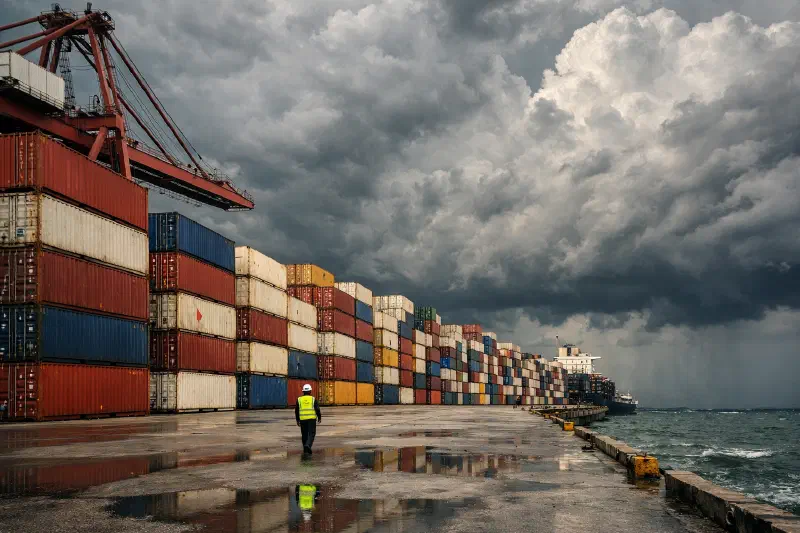
Laem Chabang is running hot before the season starts #
Laem Chabang handles approximately 70% of Thailand’s total container throughput and is one of Southeast Asia’s most capacity-constrained major gateways. Its Phase 3 expansion — targeting an additional 4 million TEU of annual capacity — has been in development since 2022 with full operation expected in the 2026-2027 window. Infrastructure timelines, however, provide no relief for a port already generating queue costs in the current cycle.
A SEAWeekly briefing from June 9 documented Thailand’s older port facilities reporting berth queuing premiums of $50-150 per container — charges accumulating before the first monsoon squall, not because of it. That same analysis noted that Thailand’s ports had been operating at near-maximum design capacity for three years and that perishables from Thailand could not absorb extra dwell time without freshness risk, with automotive parts already pricing in premium freight as backup mitigation.
The monsoon compounds this in specific, predictable ways. The Gulf of Thailand and the upper Andaman corridors that feed Laem Chabang experience weather degradation from July through September that slows vessel arrivals, extends anchorage wait times, and compresses ground-handling throughput on heavy-rain days. None of this is seasonal surprise. What is unusual is that Thailand’s port infrastructure enters this window with its buffers already consumed.
Rates at a 22-month high, and carriers expect more #
The rate backdrop is the second factor that makes this July particularly dangerous for supply chain operators routing through Thailand. Drewry’s World Container Index hit $4,166 per 40ft container on June 25 — a 22-month high, up 5% in a single week. Shanghai-to-Los Angeles rose 12% to $5,750. Shanghai-to-New York climbed 6% to $7,149. Drewry flagged further increases in the coming weeks as carriers implement general rate increases, peak-season surcharges and bunker-related adjustments in July. (Drewry, 25 Jun 2026)
Maersk’s full-year guidance revision this week made the rate trajectory explicit from another direction. The world’s second-largest container carrier lifted its EBITDA forecast to $8-10 billion from $4.5-7 billion, citing strong Far East demand and sustained spot rate increases as the drivers. (FreightWaves, 30 Jun 2026) What that guidance confirms for Thailand is that carriers are capturing the margin upside from this rate environment. Thai exporters paying $50-150 in queuing premiums at the port gate are on the wrong end of that distribution.
For shippers routing cargo through Laem Chabang, the compounding problem is that the berth queue cost and the lane rate are both still moving upward simultaneously. There is no rate plateau in sight as July begins.
As SEAWeekly’s June 29 analysis of ASEAN freight costs documented, the Q3 freight squeeze tends to hit margins before it hits volumes — exporters keep shipping while absorbing the pain through thinner gross returns rather than cancelling orders. Thailand’s deep-sea exposure means that structural squeeze lands here first and hardest.
The automotive supply chain adds pressure where relief was expected #
Thailand’s manufacturing sector adds a counterintuitive wrinkle. Bangkok Post reported that Thai car production fell 17.94% year on year in May 2026, with the automotive sector posting a consistent downturn across the first five months of the year. (Bangkok Post, 29 Jun 2026)
A production drop of that magnitude should, in theory, reduce inbound logistics pressure — fewer components needed, less inbound cargo. In practice, automotive supply chains do not unwind that cleanly. Production lines at Thailand’s Eastern Seaboard vehicle plants run on long-lead component supply schedules. Steel coils, electronic subassemblies, precision brake components, and powertrain parts were ordered and shipped weeks before output numbers were revised downward. Manufacturers carry buffer stock and draw down inventory before cutting inbound orders. The effect during a production contraction is typically a period of elevated inbound cargo relative to falling output — congestion pressure from the wrong direction, sustained longer than the production decline would imply.
The household financial backdrop deepens the difficulty. Thailand’s National Credit Bureau reported this week that the country’s 13.6 trillion baht household debt stock carries non-performing loans at 9.3% and debt restructuring rates above 10%. (Nation Thailand, 30 Jun 2026) Auto loans in particular are becoming harder to obtain as the credit environment tightens — a signal that directly connects to the production decline and to the consumer-side demand that would normally sustain outbound cargo flows. The macro cushion is thin on both sides: the industrial operator absorbing queue premiums, and the consumer who eventually absorbs cost pass-through.
The intra-Asia peak waning is not the relief it sounds #
Seatrade Maritime reported on June 30 that the intra-Asia mini-peak — a surge in regional container shipping that had driven rates on shorter routes — is waning, citing Drewry’s early indications. (Seatrade Maritime, 30 Jun 2026)
That might read as good news for a congested Laem Chabang. It is not straightforward. The intra-Asia mini-peak runs on feeder vessels and regional services that use different berths, crane configurations, and scheduling windows than the deep-sea traffic competing for Laem Chabang’s main-lane capacity on Transpacific and Asia-Europe lanes. When intra-Asia regional cargo normalises, it does not free up the deep-sea berths where ultra-large container vessels are queuing.
What the waning mini-peak more likely represents is a consolidation of overall cargo into fewer, larger trans-ocean shipments — which concentrates berth demand at Thailand’s main gateway precisely when the monsoon window begins to restrict the vessel scheduling flexibility that port operators rely on to manage peak load. The structure of the congestion changes; the congestion itself does not.
The window is narrow #
Thailand’s Q3 port congestion risk this year is the product of compounding rather than a single cause. Laem Chabang is entering the monsoon window with berth queuing premiums already active. Global container rates are at a 22-month high with carriers signalling further increases in July. Thailand’s most strategically significant manufacturing sector is contracting in a way that sustains inbound logistics pressure even as outbound production falls. And the macro context — elevated household debt, NPLs approaching 10%, tightening consumer credit — provides little domestic buffer for cost pass-through.
Shippers routing through Thailand in the July-August window have a short horizon before these factors fully intersect. Carriers are implementing GRIs effective July 1. The meteorological department’s monsoon advisory is already live. Those who have secured forward slots are still exposed to queuing costs that were running before the season started. Those who have not are now managing all three simultaneously.
The Laem Chabang Phase 3 capacity story plays out in 2027. The Q3 2026 story is happening right now, and it started before anyone expected.
References:
- The Nation Thailand (30 Jun 2026). “DDPM warns Chiang Khong of flash floods as heavy rain hits Thailand.” https://www.nationthailand.com/news/general/40068064 (Accessed 1 Jul 2026)
- Drewry Supply Chain Advisors (25 Jun 2026). “World Container Index – 25 Jun.” https://www.drewry.co.uk/supply-chain-advisors/supply-chain-expertise/world-container-index-assessed-by-drewry (Accessed 1 Jul 2026)
- SEAWeekly (9 Jun 2026). “ASEAN Port Congestion: The Bifurcated Peak Season Story.” https://seaweekly.com/posts/2026-06-09-asean-port-congestion-brief/ (Accessed 1 Jul 2026)
- FreightWaves (30 Jun 2026). “Wartime economy: Maersk lifts full-year guidance on strong demand.” https://www.freightwaves.com/news/wartime-economy-maersk-lifts-full-year-guidance-on-strong-demand (Accessed 1 Jul 2026)
- Bangkok Post (29 Jun 2026). “Automotive sector posts downturn in first 5 months.” https://www.bangkokpost.com/business/motoring/3278539/automotive-sector-posts-downturn-in-first-5-months (Accessed 1 Jul 2026)
- Nation Thailand (30 Jun 2026). “Thailand’s 13.6tn-baht debt problem moves into small loans.” https://www.nationthailand.com/business/trade/40068050 (Accessed 1 Jul 2026)
- Seatrade Maritime News (30 Jun 2026). “Container shipping’s intra-Asia mini-peak is waning.” https://www.seatrade-maritime.com/containers/container-shipping-s-intra-asia-mini-peak-is-waning (Accessed 1 Jul 2026)