
The most revealing data point from Indonesia’s June manufacturing report is not the headline number. It is the phrase buried in the S&P Global commentary: “input price inflation accelerated to its most pronounced level since September 2013.” That is nearly thirteen years of industrial cost history being reset in a single month. For Indonesia’s nickel downstream processors, that reset is not an abstraction. It is landing directly on their operating statements as Q3 begins.
Indonesia’s broader manufacturing PMI collapsed to 46.9 in June — the sharpest contraction in a year, with new export orders posting their steepest decline since August 2021 and Indonesia contracting more sharply than every one of its ASEAN peers (Jakarta Post, July 1, 2026). The regional manufacturing PMI held above 50. Indonesia did not. The reason matters: this is not a story of weak demand alone. It is a cost-push story, and the nickel downstream chain is where that cost push lands hardest.
The Three Layers of Cost Stacking #
To understand why the nickel downstream faces specific pressure in H2 — rather than just shared ASEAN freight pain — you need to trace the supply chain from Sulawesi to Shanghai and count the friction points.
The first layer is the global freight shock that everyone in ASEAN is absorbing. Drewry’s World Container Index reached $4,166 per 40ft container on June 25, up 5% in a single week and the highest level since September 2024, with Shanghai-New York up 6% to $7,149 and Shanghai-Los Angeles up 12% to $5,750. Drewry expects further increases through July as general rate increases, peak-season surcharges, and bunker adjustments take effect. The US-Israel war on Iran has added persistent upward pressure: the Indonesian Employers Association told the Quarantine Agency last week that logistics costs have risen 103 to 109 percent from geopolitical shocks alone (Jakarta Post, July 2, 2026). That cost is denominated in US dollars. It is paid by every Indonesian exporter. But nickel downstream processors face it on top of two more layers that most ASEAN exporters do not.
The second layer is the physical geography of Indonesia’s nickel industrial corridor. Morowali Industrial Park in Central Sulawesi — home to Tsingshan’s PT ITSS, Huayou’s PT Huaneng, Virtue Dragon, and the bulk of Indonesia’s nickel pig iron and mixed hydroxide precipitate capacity — sits more than 1,500 kilometres from Surabaya, the main Java export hub. Weda Bay Industrial Estate in North Maluku, which hosts the battery precursor and HPAL investments that will define Indonesia’s Capex 2.0 downstream phase, is further still. Processed nickel products — ferronickel, NPI, MHP, nickel matte — do not leave Indonesia on a single vessel. They first move on coastal or feeder vessels from Sulawesi and Maluku ports to Surabaya or Makassar, then transfer to main ocean carriers for the run to Qingdao, Busan, or Tianjin.
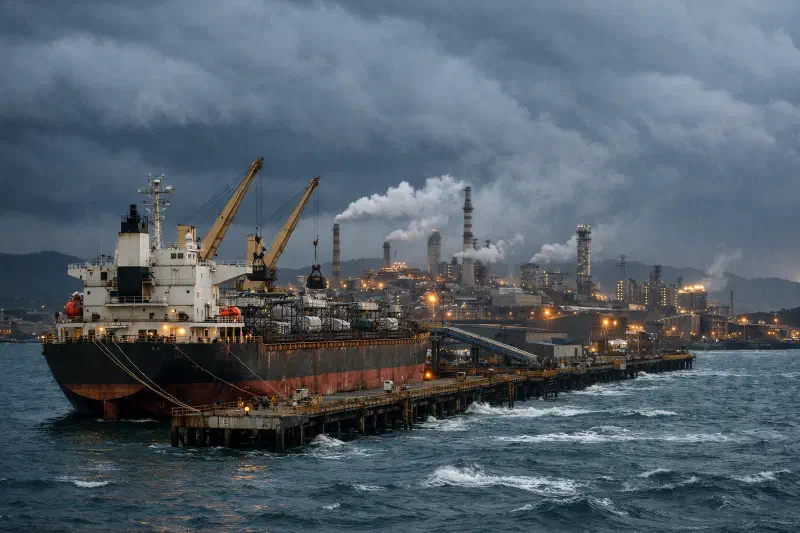
In July, that first leg becomes a weather event. The Banda Sea, Molucca Sea, and Flores Sea — the inter-island shipping lanes that connect the industrial parks to the export hubs — are in peak monsoon conditions. High swells and squalls push schedules, delay loading windows, and force port authorities at smaller jetties to restrict berthing. The July monsoon has always been a friction cost for this corridor. At current global freight rates and with surcharges being applied aggressively, it is now a margin event.
The third layer is the one with the most policy complexity: the Indonesian government’s own production and pricing architecture. The Work Plan and Budget mechanism — RKAB — controls the annual volume allocation that each smelter operator is permitted to process. The Energy Ministry describes RKAB as “not merely an administrative instrument, but also a production control instrument” (Antara, June 17, 2026). That description is accurate. It is also a source of feedstock allocation uncertainty for the midstream processors trying to manage inventory and throughput heading into Q3. When Chinese investors pushed back on RKAB restrictions in June, Bahlil responded by saying collaboration and solutions were being found — but the mechanism itself was not changed.
Layered onto RKAB is the Harga Patokan Mineral (HPM), the government benchmark price that President Prabowo instructed Bahlil to raise in March. The HPM increase was a state revenue play: higher benchmark × more ore throughput = higher royalties, corporate taxes, and non-tax state revenue. Indonesia booked Rp56 trillion ($3.1 billion) in non-tax mineral and coal revenue through late May, and the government needs the line to keep growing to cover rising subsidy bills and a rupiah that continues to weaken. The logic is sound for the state. For processors who pay royalties and input taxes calculated against an HPM that has been deliberately moved upward, it is a structural operating cost increase that cannot be offset by productivity gains.
When the Costs Stack Up on Downstream #
The distinction between upstream and downstream exposure matters here. A mining concession operator — at the very top of the supply chain — benefits from the HPM increase through higher selling prices. The royalty it pays is a smaller percentage of a larger number. The midstream smelter, which buys ore at HPM-linked prices, processes it at energy cost, and ships the output against global freight rates, is exposed on two sides simultaneously: higher input costs from the HPM and higher delivery costs from the freight shock.
This is the friction point that the Chinese Chamber of Commerce and the Chinese Embassy flagged formally in May and June — not as a negotiating tactic but as an operational reality. The Chinese operators at Morowali and Weda Bay are not going to shut down. The installed base — Tsingshan alone has invested billions across its Indonesian operations — makes that inconceivable. What they will do is compress margins, defer discretionary maintenance, and think harder before committing to the next phase of investment: the battery precursor, cathode active material, and recycling facilities that represent Indonesia’s Capex 2.0 downstream ambition.
That is the H2 risk that matters most, and it is largely invisible in the aggregate trade numbers.
The Policy Response and Its Timing Problem #
Jakarta is not unaware of the logistics cost problem. Danantara’s decision this week to merge seven state-owned logistics enterprises into a more efficient structure is an explicit response to the cost burden that Indonesia’s fragmented, state-owned logistics sector places on exporters (Antara, July 1, 2026). The government is also developing a carbon incentive framework for green port certification under the NEK scheme — a long-term play to lower port operating costs and attract shipping calls to Indonesian hubs (Antara, July 1, 2026).
Both moves are the right structural direction. Neither is operational in time for Q3.
The SOE logistics merger will take quarters, not weeks, to produce efficiency gains at the dock gate. The green port NEK scheme requires a Measurement, Reporting, and Verification methodology that does not yet exist. The Quarantine Agency’s push to simplify 22 regulations and implement single-submission inspection — which would directly reduce port delays for exporters — is still being coordinated across multiple ministries. Indonesia’s first trade deficit in six years, reported this week for May, was driven by the oil import surge, not by a nickel export collapse. But the trajectory of the non-oil manufacturing sector, with input prices at a 13-year high and export order decline at the worst level in nearly five years, is the canary that the nickel downstream should be reading carefully.
What H2 Demands the Logistics Chain Cannot Yet Deliver #
Prabowo broke ground on thirteen downstream projects in late April — HPAL facilities, battery material plants, and processing upgrades worth Rp116 trillion combined (Tempo, April 29, 2026). The investment ambition is genuine. The economics of those projects depend on processing spreads — the difference between the cost of ore input and the value of the finished downstream product — that can justify the capital commitment.
In my analysis of Indonesia’s nickel value chain last month, the question was who is winning the value-capture contest. The July answer is that the logistics cost stack is compressing the answer for everyone except the state. The state is collecting more royalties, more HPM-based taxes, more non-tax revenue — and it is also, through RKAB rigidity, export policy uncertainty, and logistics SOEs that have operated below efficiency for years, creating the conditions under which the next-generation investors must weigh their return calculations.
The Indonesian nickel story for H2 2026 is not that the downstream is failing. It is that the cost environment entering Q3 — freight inflation, monsoon-season inter-island delays, and policy-generated feedstock uncertainty — is arriving simultaneously rather than in sequence. Midstream operators with deep pockets and long investment horizons can absorb that. The question is whether they will absorb it while committing new capital, or absorb it while watching their competitors in Chinese domestic processing maintain cost advantages that the Indonesian corridor cannot yet match.
The Danantara logistics merger is the most concrete sign that Jakarta understands the problem. The policy architecture that created part of the problem — HPM maximisation conflicting with downstream investment return requirements — has not yet been examined with the same urgency. Until it is, the logistics cost discussion will keep returning to the same answer: the state is the one layer of the nickel supply chain that is not getting squeezed in H2.