
Laos is selling more electricity into ASEAN than at any point in its history. Thailand bought more than USD 2.34 billion worth of Lao power in 2025. Vietnam imported 2.92 billion kilowatt-hours from Laos in the first quarter of 2026 alone. Singapore’s multilateral import scheme has doubled to 200 megawatts, and Cambodia is now formally studying a dedicated interconnection with Laos under the ASEAN Power Grid.
That looks, at first glance, like the cleanest growth story in frontier ASEAN. It is not.
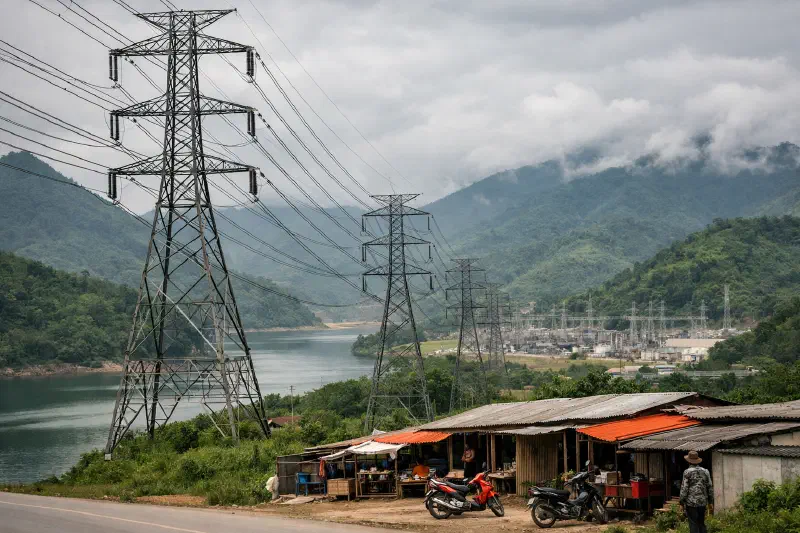
The harder question is no longer whether Laos can export more power. It clearly can. The harder question is who captures the economics once those electrons move through independent power producers, foreign-currency debt, cross-border transmission ventures, and dry-season balancing costs. Laos is becoming more strategically valuable to ASEAN’s energy system, but the public balance sheet still captures less of that value than the export headline suggests.
Export growth is real, but it is still a buyer’s market #
There is no serious doubt that Laos has become one of the region’s most important cross-border electricity suppliers. According to the KPL report on Lao-Thai energy cooperation published on May 5, 2026, Laos exported more than USD 2.34 billion worth of electricity to Thailand in 2025. Thailand remains the principal off-taker, and that matters because it means Laos is still heavily exposed to a single customer’s pricing power even as the export map broadens.
The scale-up is visible beyond Thailand. Water Power Magazine’s February 26, 2026 analysis of Laos’ power outlook says electricity exports reached 40.8 terawatt-hours in 2025, up from 11.6 TWh in 2015. The same report notes that Laos now has 17 interconnection lines with Thailand, two with Vietnam, and one with Cambodia, with more links planned toward China and Myanmar. That is not a frontier outlier anymore. That is an export platform.
Vietnam is the clearest sign that Laos’ customer base is widening, but widening does not automatically mean pricing freedom. Tuoi Tre News reported on April 21, 2026 that Vietnam imported 2.92 billion kWh from Laos in the first quarter, a year-on-year increase of nearly 120 percent, and that Hanoi had approved imports from 47 Lao projects totaling 8,260 MW. That sounds like a dream market until you read further: Vietnam’s Ministry of Industry and Trade also set ceiling prices of 6.95 US cents per kWh for imported hydropower, 6.95 cents for wind, and 7.02 cents for coal. Vietnam is buying more, but it is buying on terms that still keep the upper hand with the importer.
Singapore’s role is even more revealing. Channel News Asia reported on September 20, 2024 that the Lao PDR-Thailand-Malaysia-Singapore Power Integration Project, or LTMS-PIP, doubled from 100 MW to 200 MW. That is small next to Thai or Vietnamese volumes, but strategically it matters because Singapore is not just an off-taker. It is proof that Lao electricity can move through a multilateral, multidirectional trading structure instead of a single bilateral contract. The export map looks more diversified; the bargaining table does not.
The battery is profitable; the utility is not #
The easiest mistake in reading Laos’ export numbers is to assume that more export revenue means a healthier public balance sheet. The AMRO analysis from December 13, 2023 explains why that is too simple.
AMRO splits Laos’ electricity economy into two very different businesses. Roughly a quarter of total power is consumed domestically through Electricite du Laos, which buys power in US dollars but sells it in kip, often below cost-recovery levels. The remaining roughly three-quarters is generated by export-oriented independent power producers whose revenues are largely denominated in dollars under long-term power purchase agreements. Those export IPPs are financially more stable than the domestic utility. In other words, the battery is profitable; the utility is not.
That distinction is the center of the story. ADB’s April 2026 country chapter on Laos is blunt that EDL remains the country’s most significant source of systemic SOE risk because of foreign-currency borrowings, opaque legacy PPAs, take-or-pay obligations, and non-cost-reflective tariffs. The export machine can keep generating hard currency while the state utility continues to weaken the sovereign balance sheet.
That is also why the June 24 question is different from the June 10 question. Earlier this month, in SEA Weekly’s Laos inflation analysis, I argued that the country’s import-side energy dependence keeps pushing cost back onto households. The export side tells the same story from the opposite direction. The dollars arrive, but they do not land neatly where the state most needs them.
Tax structure matters too. AMRO notes that export-oriented IPPs often enjoy generous tax holidays during the early years of operation. Under BOT structures, the Laotian state may eventually inherit the assets and a larger revenue take, but “eventually” is doing a lot of work in a country where the macro-fiscal pressure is immediate. Laos’ export story therefore looks strongest on a project cash-flow basis precisely when its sovereign capture can be weakest.
Transmission is becoming the real rent-extraction asset #
The next phase of Lao power economics will be decided less by how many dams get built than by who controls the transmission corridors and market mechanisms that carry their output.
The clearest example is the China-Laos 500 kV interconnection. According to China Southern Power Grid’s April 20, 2026 project release, the line increased bidirectional exchange capacity from 50 MW to 1,500 MW and can deliver about 3 billion kWh of clean electricity annually. The Lao section is managed by Electricite du Laos Transmission, while the Chinese side is operated by China Southern Power Grid. More important than the engineering detail is the market detail: CSG says northern Lao power can now have its delivery schedules determined through trading in China’s southern regional power market.
That is a meaningful shift. A dam is an asset. A tradable transmission corridor is an economic system. Once power can be routed, scheduled, and settled through a wider market, the highest-value position is not always the generating plant itself. It is often the corridor owner, the dispatcher, or the operator who controls market access.
The same pattern is emerging inside ASEAN. The Laotian Times report on May 26, 2026 says Laos and Cambodia signed a joint framework agreement to study a dedicated cross-border interconnection, while the ASEAN Centre for Energy’s release the same day makes clear that the work includes economic and commercial analysis, not just engineering feasibility. That phrasing matters. ASEAN is not simply laying wires; it is building rules for who gets paid, on what terms, and with what degree of regional leverage.
ADB’s warning that the separation of EDL Transmission added governance complexity should be read in that context. Laos understands that transmission is becoming the strategic chokepoint. The risk is that it enters that next phase with more corridor importance but less transparency over how the associated cash flows are governed.
Dry-season physics still tax the export model #
There is a final reason the export economics are harder than they look: hydrology has not stopped mattering simply because the region wants more renewable power.
The US Trade Administration’s Laos energy guide published on January 15, 2026 notes that Laos earned more than USD 2.6 billion from electricity exports in 2024 but still spent more than USD 177 million on seasonal electricity imports because of weak transmission and distribution cohesion. That single number should end any easy reading of the export narrative. A country can be regionally indispensable and still domestically unbalanced.
AMRO makes the same point more structurally: because Laos depends so heavily on hydropower, it remains exposed to seasonal inflow risk and often has to import more expensive power during the dry season, mainly from Thailand, to stabilize domestic supply. Water Power Magazine adds another operational drag, reporting transmission losses of 10-13 percent and no significant storage assets to buffer variability. Laos is not just selling generation. It is also paying to manage intermittency, grid weakness, and reliability.
That matters because regional buyers are not paying Laos to be picturesque. They are paying for firm delivery. Vietnam’s industrial users, Singapore’s import planners, and future Cambodian grid operators care about dispatchable reliability, not monsoon abundance. If Laos must keep layering coal backup, seasonal imports, and grid reinforcement onto its export platform in order to meet those expectations, then the marginal economics of each additional export deal become less obvious than the headline capacity numbers imply.
Laos is not short of demand. The evidence from Thailand, Vietnam, Singapore, China, and now Cambodia says the region wants Lao electrons. What is driving the economics now is whether Laos can move from being a project host to being a corridor owner and disciplined market participant. That means tighter PPA disclosure, better fiscal capture after tax holidays expire, domestic grid investment so seasonal imports stop eating into export gains, and a cleaner division between EDL’s social obligations and its commercial role.
If those reforms land, hydropower can become more than a foreign-exchange story. It can become one of the few genuine leverage stories in ASEAN energy trade. If they do not, Laos will remain essential to the regional grid while much of the best economics pools elsewhere.
References #
- Asian Development Bank (April 2026). “Economic forecasts for the Lao PDR.” https://www.adb.org/countries/lao-pdr/economy (Accessed 24 June 2026)
- AMRO (December 13, 2023). “Lao PDR’s Electricity Sector: Risk or Opportunity?” https://amro-asia.org/lao-pdrs-electricity-sector-risk-or-opportunity/ (Accessed 24 June 2026)
- International Trade Administration (January 15, 2026). “Laos Energy Sector.” https://www.trade.gov/country-commercial-guides/laos-energy-sector (Accessed 24 June 2026)
- KPL (May 5, 2026). “Laos, Thailand Pledge to Bolster Energy Security Amid Global Uncertainty.” https://kpl.gov.la/EN/detail.aspx?id=100029 (Accessed 24 June 2026)
- Water Power Magazine (February 26, 2026). “Hydropower anchors Laos’ power expansion as exports surge and diversification gathers pace.” https://www.waterpowermagazine.com/analysis/hydropower-anchors-laos-power-expansion-as-exports-surge-and-diversification-gathers-pace/ (Accessed 24 June 2026)
- Tuoi Tre News (April 21, 2026). “Power imports from Laos surge as renewable projects come online.” https://news.tuoitre.vn/power-imports-from-laos-surge-as-renewable-projects-come-online-103260421152542366.htm (Accessed 24 June 2026)
- Laotian Times (April 23, 2026). “Laos-China 500 kV Power Transmission Line Now Operational.” https://laotiantimes.com/2026/04/23/laos-china-500-kv-power-transmission-line-now-operational/ (Accessed 24 June 2026)
- Laotian Times (April 27, 2026). “Lao Electricity Exports to Vietnam Hit Record High on Renewable Boom.” https://laotiantimes.com/2026/04/27/lao-electricity-exports-to-vietnam-hit-record-high-on-renewable-boom/ (Accessed 24 June 2026)
- Laotian Times (May 7, 2026). “Lao Electricity Exports to Vietnam Surge as Regional Energy Trade Expands.” https://laotiantimes.com/2026/05/07/lao-electricity-exports-to-vietnam-surge-as-regional-energy-trade-expands/ (Accessed 24 June 2026)
- Laotian Times (May 9, 2026). “ASEAN Pushes Shared Fuel Reserve as Laos Emerges Central to Regional Energy Plans.” https://laotiantimes.com/2026/05/09/asean-pushes-shared-fuel-reserve-as-laos-emerges-central-to-regional-energy-plans/ (Accessed 24 June 2026)
- Laotian Times (May 26, 2026). “Laos, Cambodia Advance ASEAN Power Grid.” https://laotiantimes.com/2026/05/26/laos-cambodia-advance-asean-power-grid/ (Accessed 24 June 2026)
- ASEAN Centre for Energy (May 26, 2026). “ASEAN Centre for Energy, Electricite du Cambodge, and Electricite du Laos Sign Joint Study Framework to Advance Cambodia-Lao PDR Power Interconnection.” https://aseanenergy.org/press-release/asean-centre-for-energy-electricite-du-cambodge-and-electricite-du-laos-sign-joint-study-framework-to-advance-cambodia-lao-pdr-power-interconnection (Accessed 24 June 2026)
- Channel News Asia (September 20, 2024). “Singapore doubles renewable electricity imports through regional power project, with added supply from Malaysia.” https://www.channelnewsasia.com/singapore/singapore-electricity-imports-double-capacity-laos-malaysia-power-asean-prower-project-4620571 (Accessed 24 June 2026)
- China Southern Power Grid (April 20, 2026). “China-Laos 500 kV interconnection project goes into operation.” https://eng.csg.cn/Press_release/News_2026/202604/t20260420_354685.html (Accessed 24 June 2026)