
Singapore is not insulating ASEAN from Q3 supply-chain stress. It is monetising the parts of that stress other hubs still struggle to absorb.
When freight rates stay elevated and critical sea lanes look politically fragile, cargo owners stop paying only for movement. They pay for optionality: a port that can take the box, a yard that can turn it quickly, an airport that can rescue the high-value shipment, and a balance sheet that can finance the extra days of delay. In Southeast Asia, those layers still sit closer together in Singapore than anywhere else.
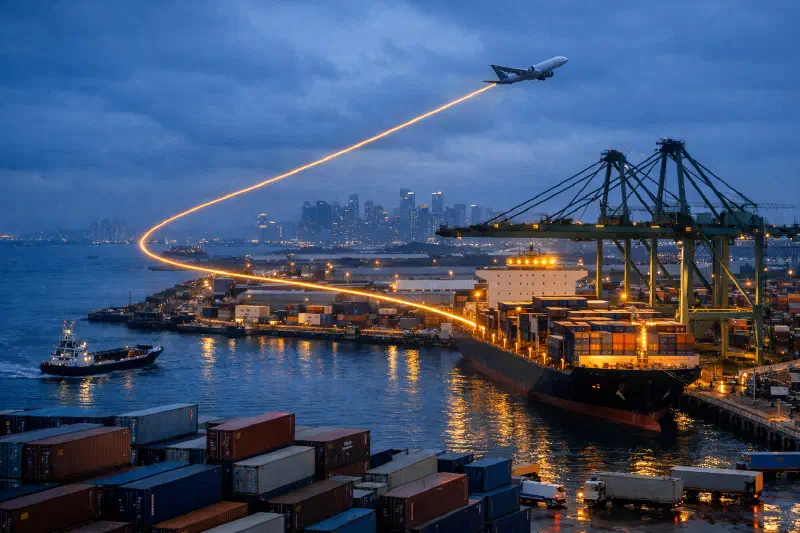
Volatility is making Singapore more valuable, not less #
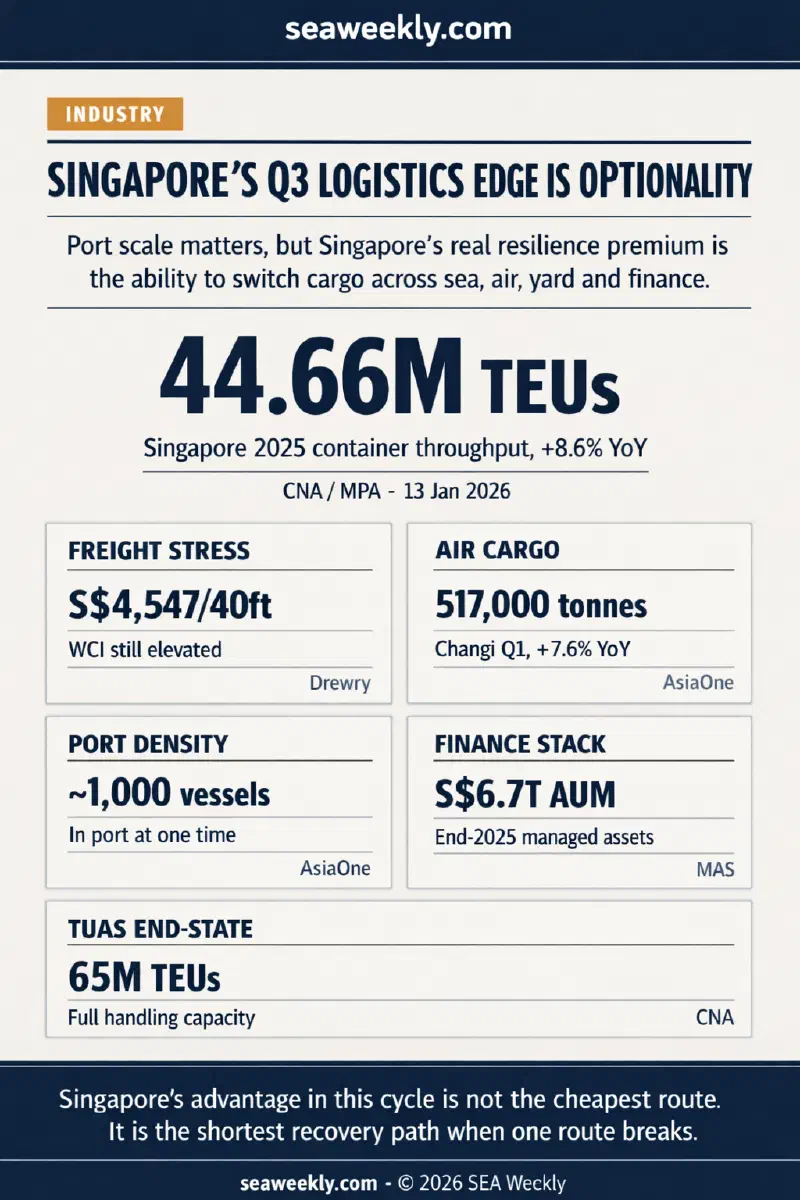
Drewry’s World Container Index stood at $4,547 per 40ft on Jul 16, down 2 per cent on the week but still at a level the firm said was being supported by blank sailings, early peak-season activity and geopolitical shipping risk around Bab el-Mandeb and potential security charges for Strait of Hormuz transits (Drewry, Jul 16, 2026). The point is not whether rates are up or down in a single week. The point is that the market is still paying a disruption premium.
Prime Minister Lawrence Wong framed the strategic version of the same problem at the ASEAN Summit in Cebu in May. Supply-chain resilience depends on connectivity, he argued, and connectivity depends on unimpeded passage through critical straits. His office pointed specifically to the Malacca-Singapore lane as part of the world’s busiest crude and petroleum chokepoint pair since 2020, while another summit intervention pushed ASEAN to ratify the upgraded ASEAN Trade in Goods Agreement because the new environment will mean more shocks, more volatility, and more demand for trade facilitation (AsiaOne, May 8, 2026, AsiaOne, May 8, 2026).
Reuters’ Jul 16 poll on Hormuz disruption captured why this matters commercially. The issue is not just oil price. It is the physical ability to move hydrocarbons, goods, and people through one of the world’s most important chokepoints, with higher freight costs, higher insurance charges, delayed shipments and a more permanent geopolitical risk premium already feeding into regional forecasts (Reuters, Jul 16, 2026).
That is the first non-obvious point about Singapore’s role in this cycle. The city-state’s resilience premium does not require calm seas. It widens when the seas are not calm.
Port scale is only the first layer #
The Port of Singapore handled 44.66 million TEUs in 2025, up 8.6 per cent year on year, while vessel arrivals hit a record 3.22 billion gross tonnage. Marine fuel sales reached 56.77 million tonnes, including 1.95 million tonnes of alternative marine fuels, up from 1.35 million tonnes in 2024 (CNA, Jan 13, 2026). Those are scale numbers, but they are also reliability numbers. Shippers do not keep routing volume through Singapore as a ceremonial gesture. They do it because the hub keeps clearing volume in stressed conditions.
The deeper signal is that the system has been compounding, not merely holding its ground. PSA Singapore broke the 40 million TEU mark for the first time in 2024 with 40.9 million TEUs, up from 38.8 million in 2023. More tellingly, PSA’s group chief executive used the record to emphasize “the synergies between our port operations and port-adjacent services” rather than throughput alone (CNA, Dec 27, 2024). That is the integration story in one sentence: quayside capacity matters, but the value is in the connections around the quay.
Even before the current Q3 stress cycle, Chee Hong Tat was already arguing that Singapore had to stay relevant no matter how customers changed origin points, destinations, or transport modes. His May 2025 update showed 14.18 million TEUs handled in the first four months of that year, up 6.1 per cent, with some of the strength driven by tariff-related front-loading (CNA, May 16, 2025). That is exactly the sort of cargo behaviour Singapore is built to capture: shipment patterns change quickly, and the hub monetises the change rather than being stranded by it.
The integration bet is happening behind the quay #
This is where Tuas matters. In September 2025, a Cosco Shipping joint venture signed an MOU with PSA Port Ecosystem and partners on a possible warehouse project called PSA Supply Chain Hub @ Tuas. The stated goal was not generic storage. It was a regional distribution centre in Singapore serving Southeast Asia and wider Asia, with bulk volume aimed at regional transshipment (Yahoo Finance, Sep 5, 2025). That is Singapore’s operating model in miniature: pull cargo in, hold it briefly, reconfigure it fast, and push it back out across the region.
The Tuas story is also still a build-out story. Chee said last year that the full Tuas end-state targets 65 million TEUs of handling capacity in the 2040s (CNA, May 16, 2025). That matters because Singapore’s resilience argument is not simply about inherited scale. It is about still adding capacity and flexibility while competitors are still deciding where their next bottleneck sits.
The automation push points the same way. In April, MPA and PSA sought proposals for autonomous inter-gateway feeder vessels to move containers between Tuas and Pasir Panjang, supported by a remote operations centre that would combine vessel sensors with port traffic data for real-time monitoring. The port limits host roughly 1,000 vessels at any given time. In a system that dense, shaving friction out of internal transfers is not cosmetic. It is capacity creation (AsiaOne, Apr 22, 2026).
That is the physical version of the intermediation argument I made in my June 25 comparison of Brunei and Singapore. Singapore wins when it shortens the decision chain between inbound flow and onward deployment. At Tuas, that means berth, yard, warehouse, and feeder operations increasingly behaving like one stack instead of four separate handoffs.
Changi is the relief valve the regional story misses #
Sea hubs get the headlines, but the resilience premium is incomplete without air cargo. Changi handled 517,000 tonnes of airfreight in Q1 2026, up 7.6 per cent year on year, even as Middle East passenger traffic collapsed 80 per cent from the same period of 2025. Passenger numbers still rose 2.3 per cent to 17.6 million for the quarter, and the airport’s rolling 12-month traffic hit a record 70.4 million. The top cargo markets were Australia, China, Hong Kong, India and the United States (AsiaOne, Apr 17, 2026).
That matters because not every shipment can wait for a vessel schedule to normalise. Electronics components, pharmaceutical inputs, precision industrial parts and time-sensitive spares do not need Singapore to replace the sea network. They need Singapore to offer a nearby fallback when the sea network misses its beat. Changi’s freight growth during a quarter that also saw an 80 per cent collapse in one conflict-exposed passenger corridor is the clearest proof that Singapore’s air node is functioning as a shock absorber, not just a passenger gateway.
The non-obvious point is that the port and airport do not need to carry the same cargo to reinforce the same thesis. The port absorbs mass. The airport protects value. The combination lets regional supply chains choose which problem they are solving rather than forcing everything into the same delayed box.
Finance completes the logistics stack #
This is where the Singapore story stops being a pure transport story. A delayed container is also a longer receivable cycle, a higher inventory-financing bill, and more balance-sheet stress for the shipper waiting to get paid. That was the core argument in my Jul 6 analysis of Singapore’s trade finance hub positioning: the bank call follows the freight spike almost immediately.
MAS supplied the macro numbers two weeks earlier. Singapore’s financial sector contributes about 14 per cent of GDP, employs around 200,000 people, and managed S$6.7 trillion of assets at end-2025. Gan Kim Yong’s line that “a more fragmented world needs trusted connectors” was not just aimed at bankers. It is a logistics argument too. The hub that can intermediate risk, price credit, and move money alongside cargo is more valuable in a volatile supply-chain cycle than the hub that only moves boxes (MAS, Jun 25, 2026).
That is why Singapore’s logistics integration matters more now than in a calm year. Under stable conditions, cargo owners can optimise around cost. Under stressed conditions, they optimise around recovery time, documentation certainty, and financing access. Singapore does not remove those frictions for all of ASEAN. It concentrates the tools for handling them in one place.
The uncomfortable truth #
There is a catch to all this. Singapore anchoring ASEAN resilience is not the same thing as ASEAN becoming equally resilient. Drewry’s Jul 16 note made clear that geopolitical disruption and capacity management are still keeping freight rates structurally supported, while Reuters’ Gulf survey warned that businesses may permanently price in a higher geopolitical risk premium (Drewry, Jul 16, 2026, Reuters, Jul 16, 2026). Optionality is valuable precisely because it is scarce - and scarce optionality is expensive.
That leaves smaller exporters and thinner-margin producers across the region in an awkward position. They benefit from Singapore’s hub depth, but they also pay for it through higher logistics, warehousing, and financing costs whenever volatility rises. In other words, Singapore is not solving ASEAN’s resilience problem on behalf of the region. It is becoming the place where the region goes to rent resilience.
What to watch next #
If Q3 pressures intensify further, the best signals to watch are not just freight rates. Watch whether Tuas keeps adding flexibility around port-adjacent services, whether Changi’s cargo growth holds, and whether Singapore’s banks continue expanding the credit and risk-transfer capacity that turns delayed shipments into financeable ones.
The question for H2 2026 is not whether Singapore will move more cargo than its neighbours. It already does. The more important question is whether it can keep shortening the recovery time between a disrupted route and a deliverable shipment.
Singapore’s advantage in this cycle is not the cheapest route. It is the shortest recovery path when one route breaks.
References #
- Channel News Asia (January 13, 2026). “Singapore sees record port performance in 2025.” https://www.channelnewsasia.com/singapore/singapore-sees-record-port-performance-in-2025-5855836 (Accessed July 17, 2026)
- Channel News Asia (May 16, 2025). “6.1% increase in container throughput in 2025 despite global trade uncertainty: Chee Hong Tat.” https://www.channelnewsasia.com/singapore/trade-war-tariffs-singapore-ports-containers-chee-hong-tat-5134021 (Accessed July 17, 2026)
- Channel News Asia (December 27, 2024). “PSA Singapore breaks its annual handling record, surpasses 40m TEU containers for the first time.” https://www.channelnewsasia.com/singapore/psa-singapore-port-container-volume-2024-cargo-4827906 (Accessed July 17, 2026)
- AsiaOne (April 17, 2026). “Changi Airport handled 17.6 million passengers in Q1 amid strong demand for North Asia, Europe.” https://www.asiaone.com/singapore/changi-airport-q1-2026-passenger-cargo-demand (Accessed July 17, 2026)
- AsiaOne (April 22, 2026). “MPA, PSA Singapore seek proposals for autonomous feeder vessels to modernise port.” https://www.asiaone.com/singapore/singapore-maritime-week-2026-mpa-psa-autonomous-container-feeder-vessel-expression-of-interest (Accessed July 17, 2026)
- AsiaOne (June 25, 2026). “Singapore port wins Best Global Seaport for fifth time.” https://www.asiaone.com/singapore/singapore-port-best-global-seaport-aflas (Accessed July 17, 2026)
- AsiaOne (May 8, 2026). “‘Asean does not exist in isolation’: PM Wong urges bloc to work with external partners to enhance resilience.” https://www.asiaone.com/singapore/48th-asean-summit-lawrence-wong-cooperation-freedom-of-navigation (Accessed July 17, 2026)
- AsiaOne (May 8, 2026). “Collective energy security, strengthened supply chain can help Asean thrive in a ‘different world’: PM Wong.” https://www.asiaone.com/singapore/48th-asean-summit-lawrence-wong-trade-energy-resilience-supply-chains (Accessed July 17, 2026)
- Monetary Authority of Singapore (June 25, 2026). “Singapore as a Trusted Connector in a Changing World.” https://www.mas.gov.sg/news/speeches/2026/singapore-as-a-trusted-connector-in-a-changing-world (Accessed July 17, 2026)
- Drewry (July 16, 2026). “World Container Index - 16 Jul.” https://www.drewry.co.uk/supply-chain-advisors/supply-chain-expertise/world-container-index-assessed-by-drewry (Accessed July 17, 2026)
- Reuters (July 16, 2026). “Most Gulf area economies face deeper downturns this year on Hormuz disruption: Reuters poll.” https://www.reuters.com/world/middle-east/most-gulf-area-economies-face-deeper-downturns-this-year-hormuz-disruption-2026-07-16/ (Accessed July 17, 2026)
- Yahoo Finance / The Edge Singapore (September 5, 2025). “Cosco Shipping’s JV company enters MOU with PSA Port Ecosystem for possible collaboration of warehouse building at Tuas.” https://sg.finance.yahoo.com/news/cosco-shipping-jv-company-enters-020858595.html (Accessed July 17, 2026)