
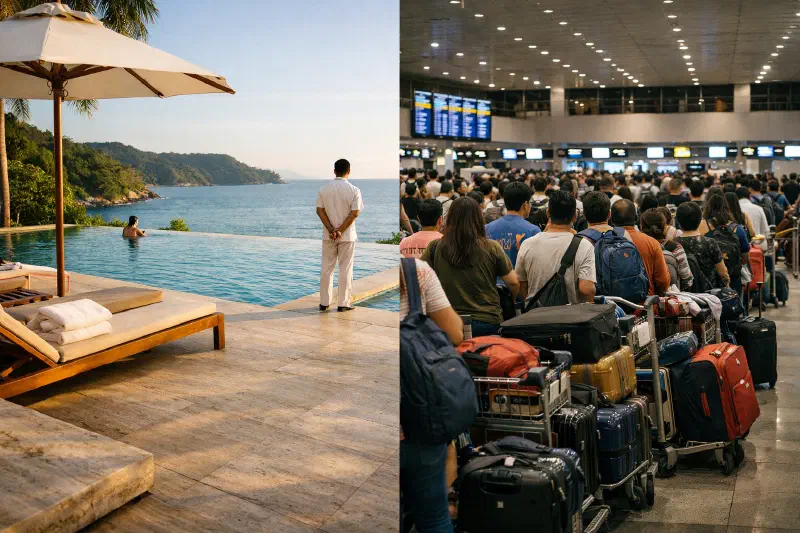
On June 20, Thailand raised international airport passenger service charges by 50%. The announcement was framed by most coverage as an increased cost burden on airlines — which it is. But that framing misses the more important signal: a destination only raises airport fees when it has enough leverage over airlines that those airlines cannot simply divert routes elsewhere. Bangkok is a mandatory waypoint for half the route networks operating through Southeast Asia. The fee increase is rent extraction from carriers who have no good alternative. That is what structural pricing power looks like in practice.
Two weeks earlier, at TTM+ 2026 — Thailand’s flagship B2B travel trade platform in Pattaya — the Tourism Authority of Thailand announced that the three-day event had generated more than 15,000 business appointments and was expected to create 5.08 billion baht in tourism revenue, up 12.9% from 2025 (accessed 22 Jun 2026). International buyers are not just visiting Thailand — they are making forward commitments at higher values.
Both of these data points are, at their core, about the same thing: the ability to raise prices while keeping demand. And when you place Thailand’s record alongside the Philippines’ tourism yield story — where per-visitor spend clocks in at approximately $2,000, among the highest in ASEAN — the comparison gets complicated in ways that matter.
What pricing power actually looks like #
In Thailand’s hotel sector, the evidence is specific. As covered in depth in my analysis earlier this month, Minor Hotels reported Anantara-brand RevPAR up 23% year-on-year for Q1 2026. Phuket’s luxury northern belt — Surin, Bang Tao, and the Laguna complex — posted average daily rates approximately 43% above recent norms, according to C9 Hotelworks’ 2026 Phuket Hotel and Tourism Market Update, with luxury occupancy running at 79.5% and peaking above 90%.
These numbers are not just high — they are holding. Revenue per available room is the critical metric because it captures both rate and occupancy simultaneously. You can get high ADR by emptying half your rooms. You can get high occupancy by discounting aggressively. When both move up together, that is the signal of genuine pricing power.
The mechanism behind Thailand’s hotel pricing power is increasingly structural. The medical and wellness tourism sector was valued at approximately 670 billion baht in 2025, with the medical component projected at 125 billion baht for 2026, according to the TAT. Medical tourists spend roughly 102% more per trip than standard leisure visitors. Crucially, a comprehensive longevity assessment in Bangkok — including full-body scans and genomic sequencing — currently costs approximately 60% less than an equivalent programme in the US or Europe (accessed 22 Jun 2026), while Thailand’s 90-day multi-entry medical visa provides the logistical framework for extended stays.
This is the layer of Thailand’s yield story that is most resistant to competitive erosion. A wellness resort in Phuket that runs multi-week longevity programs at rates between $300 and $2,000 per night is not competing with Boracay. It is competing with the Maldives and Oman and Bali’s premium end — and winning, partly on price-for-quality and partly on the clinical infrastructure that no ASEAN competitor has yet replicated at scale.
The airport fee increase fits within this logic. Airlines need Bangkok slots to run profitable long-haul operations through Asia. Suvarnabhumi’s planned East Expansion — 12 billion baht, lifting capacity from 60 million to 70 million passengers per year — is scheduled for construction from 2027 to 2029. That investment only makes sense if demand projections are sufficiently strong that Thailand’s airports could absorb a 50% fee increase without triggering significant route diversion. The investment and the fee increase are two sides of the same assessment.
The Philippines: yield that comes from a bottleneck #
Lourdes’s take: The Philippines recorded approximately ₱760 billion in tourism revenue in 2024 from 5.9 million international visitors — a figure that translates to roughly $2,000 per visitor and invites comparisons with Thailand’s yield-over-volume strategy. The comparison does not hold up. As I reported on June 19, NAIA is operating near its practical capacity ceiling of approximately 35 million passengers. The New Manila International Airport in Bulacan — which would break that ceiling — is now tracking toward 2028 at the earliest. Until then, the physics of Philippine aviation constrain both the volume and the mix of incoming visitors.
What this means for the yield number is specific. Travelers who arrive in the Philippines right now skew toward the motivated and the financially resilient: those who navigated the e-visa process (still required for Chinese nationals, unlike Thailand, Malaysia, Singapore, and now Cambodia), tolerated the NAIA experience, and accepted elevated fares caused by limited seat supply. This self-selection effect inflates per-visitor spend in exactly the same way that any sufficiently difficult journey inflates the average wealth of people who complete it. It is a filtering mechanism, not a strategy.
The problem with a filtering mechanism as a yield driver is that it is inherently fragile — and the macro context in the Philippines makes the fragility more visible. The Congressional Policy and Budget Research Department assessed, in a discussion paper published this week, that the Philippines has entered a stagflation episode: Q1 2026 GDP growth at 2.8% (the weakest expansion in three consecutive declining quarters), inflation at approximately 8%, and unemployment hovering near 5% (accessed 20 Jun 2026). Moody’s has maintained a negative outlook on the sovereign. Elevated energy costs from the Middle East conflict are hitting airline operating margins — particularly for Cebu Pacific, which is running its current fleet at capacity while waiting on A321neo deliveries that stretch through 2030.
The stagflation context suppresses precisely the domestic reinvestment cycle that hotel pricing power requires. Thai luxury hotel developers can finance expansion off strong RevPAR gains. Philippine hotel developers face elevated energy costs eroding EBITDA, a capital market pricing in sovereign risk, and an infrastructure timeline that delays the demand density any major hotel investment needs to underwrite its rates.
Cebu Pacific’s order of 152 Airbus A321neo aircraft — the largest aircraft order in Philippine aviation history — is the single most credible catalyst for genuine pricing power development. The A321neo’s 4,000-nautical-mile range enables routes that were previously uneconomical for a low-cost carrier based in Manila, and the additional seat supply would relieve the capacity-constraint premium that currently inflates fares and filters visitors. But the impact is a 2027-2030 story, not a 2026 story. In the meantime, the current yield figure is telling the wrong story about where the Philippines actually stands.
The asymmetry in the comparison #
The gap between Thailand and the Philippines on airline-hotel pricing power is not primarily a story about marketing budgets or destination branding. It is a story about what happens when structural investments compound over time — and what happens when they don’t.
Thailand’s 50% airport fee increase, its hotels’ 23% RevPAR gains, its TTM+ bookings up 12.9%, and its TAT’s deliberate move to reduce visa-free stay durations (choosing quality over volume) all point to a destination that is actively compressing the spread between its high-end and mid-market pricing upward. The direction of movement matters as much as the level.
The Philippines’ $2,000 per-visitor figure, by contrast, sits at a level that is not being actively managed — it is being passively received from a population of travelers self-selected by constraint. The direction of movement, once Bulacan opens and Cebu Pacific’s fleet expands, is likely downward in per-visitor spend even as total tourism revenue grows. That is not necessarily bad news for the Philippines: more visitors spending less per head could still generate more aggregate revenue. But it means the yield story requires a fundamental reframe.
The inflection point — probably somewhere in 2028, when Bulacan’s initial phases open and A321neo deliveries begin to scale — is when the Philippines will face its actual pricing power test. Can the hotel sector build enough differentiated product, at the right price points, to absorb a broader visitor mix and hold RevPAR? Can Philippine airports develop the B2B buyer ecosystem that TAT has built over decades, generating committed forward bookings at premium rates? Those are the questions that will determine whether the Philippines moves from accidental yield to earned yield.
For now, Thailand is the only one of the two countries that knows the answer to those questions. It raised airport fees by 50% on Friday. Demand will absorb it.
References #
-
TAT Newsroom (June 16, 2026). “TTM+ 2026 delivers strong business and measurable sustainability outcomes.” https://www.tatnews.org/2026/06/ttm-2026-delivers-strong-business-and-measurable-sustainability-outcomes/ (Accessed 22 Jun 2026)
-
TAT Newsroom (May 5, 2026). “Going for the Long Game – How Thailand is Redefining Longevity Tourism.” https://tatnews.org/2026/05/going-for-the-long-game-how-thailand-is-redefining-longevity-tourism/ (Accessed 22 Jun 2026)
-
Nyah Genelle C. De Leon, Philippine Daily Inquirer (June 20, 2026). “Gov’t think tank: PH under stagflation.” https://business.inquirer.net/596126/govt-think-tank-ph-under-stagflation (Accessed 22 Jun 2026)
-
C9 Hotelworks (2026). “Phuket Hotel and Tourism Market Update 2026.” Via SEA Weekly reporting, June 4, 2026. Data on luxury ADR (THB 5,652), occupancy rates (79.5%), and ADR premium (43%).
-
Minor Hotels (Q1 2026 results). Via SEA Weekly reporting, June 4, 2026. Anantara-brand RevPAR +23% YoY; Anantara ADR +10% YoY.