
The Philippines recorded ₱760 billion in tourism revenue in 2024 — a record — but welcomed just 5.9 million international visitors, still nearly 30% below the 8.26 million who arrived in 2019. Thailand, by contrast, is targeting 33 million arrivals in 2026 while simultaneously planning to reduce visa-free stay durations.
These two facts, read together, define a paradox that most coverage of Philippine aviation demand misses entirely. The country’s per-tourist spend — roughly $2,000 per visitor, among the highest in ASEAN — is not primarily a sign of strategic yield management. It is a symptom of structural constraints that are quietly funnelling Southeast Asia’s high-yield traveller growth toward competitors who have already solved for capacity.
The arithmetic of the ceiling #
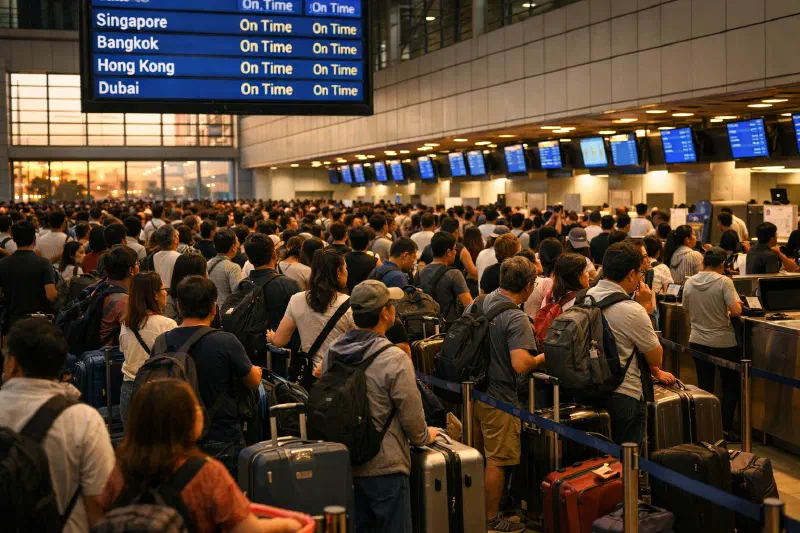
NAIA, the country’s primary international gateway, handled approximately 35 million passengers in 2025 — near its practical maximum. The SMC-led NNIC concession has produced genuine improvements: biometric e-gates at Terminal 3, new food halls, flood mitigation that removed over 139,000 metric tons of silt from nearby waterways. SIA Engineering is setting up maintenance operations. These are meaningful operational gains, but they are capacity-optimising moves within a fixed ceiling, not a structural expansion.
The New Manila International Airport in Bulacan — a P740 billion ($13.5 billion) project with four runways and a planned capacity of 100 million passengers — was originally expected to begin partial operations by 2025, then 2027. The current timeline points to 2028 at the earliest. SMC’s engagement with Dutch contractor Boskalis continues, and the project received recognition at the OECD forum in March 2026 for global standards alignment. But the gap between NAIA’s ceiling and Bulacan’s operational date is narrowing from both sides.
Meanwhile, Thailand just announced a THB 12 billion ($367 million) East Expansion of Suvarnabhumi Airport, scheduled for construction from 2027 to 2029, lifting capacity from 60 million to 70 million passengers annually. Combined with Don Mueang’s planned expansion, Bangkok’s two gateways would handle roughly 120 million passengers a year. Deputy Prime Minister and Transport Minister Phiphat Ratchakitprakarn framed the investment as central to Thailand’s ambition to become a regional aviation hub, leveraging its geography between China and India.
The divergence is not just about runways and terminals. Thailand raised airport fees for international travellers by 50%, effective June 20, 2026 — a move that signals confidence in its pricing power. The Philippines is still trying to get NAIA’s basic operations to a level where such a fee increase would not risk diverting traffic.
Where the demand actually lands #
The region’s aviation demand is structurally strong. Malaysia, Singapore, Indonesia, and Vietnam all reported increases in foreign arrivals in the first quarter of 2026 despite higher airfares driven by the Iran crisis and elevated jet fuel costs, which IATA noted in a May opinion piece on supply chain preparedness. The underlying traveller demand exists. The question is which destinations capture the yield from it.
Vietnam is absorbing a disproportionate share. The country received 10.6 million international visitors in the first five months of 2026 — a record — up 14.9% year-on-year, and is targeting 25 million for the full year. Its tourism sector grew 12.4% in Q1 2026, six times the global average, according to the United Nations Tourism Organization. Marriott International alone announced plans for 10 new hotels and resorts with 4,500 rooms in Phu Quoc and Vung Tau through 2030. IHG is also expanding. These are not speculative bets on future demand; they are responses to demand that is already materialising.
The Philippines is not seeing comparable hotel investment commitments at scale. The difference matters because hotel capacity, like airport capacity, is a leading indicator of tourism yield trajectory. If the rooms are not being built, the yield story rests entirely on price increases within existing supply — which has a natural ceiling.
The visa wall is real #
Cambodia launched a visa-free trial for Chinese citizens on June 15, 2026, allowing stays of up to 14 days through October 15. It joins Thailand, Malaysia, and Singapore in offering visa-free access to China’s outbound travellers. Tourism Minister Huot Hak said Cambodia targets more than 600,000 Chinese visitors during the four-month pilot and 1.2 million for the full year, following 331,199 Chinese arrivals in the first four months of 2026.
The Philippines still requires Chinese nationals to obtain an e-visa, with processing times and documentary requirements that are more cumbersome than what competitors offer. Every ASEAN neighbour that drops visa barriers captures a share of Chinese tourism spend that might otherwise consider the Philippines — especially the high-yield segment that books longer stays and higher-category accommodation.
Thailand’s visa strategy is even more revealing. Bangkok Post reported that Thailand is planning to reduce visa-free stay durations — a deliberate yield-over-volume move, signalling confidence that it can tighten policy without losing market share. Thailand is choosing quality over quantity because it can afford to. The Philippines is still struggling to attract quantity, and the quality that does arrive is partly an artefact of self-selection: only the most determined travellers navigate the capacity and visa bottlenecks.
Cebu Pacific’s bet changes the equation — partially #
The single most important variable in the Philippine aviation outlook is Cebu Pacific’s order of 152 Airbus A321neo aircraft, the largest aircraft order in Philippine aviation history, valued at roughly $18 billion at list prices. The A321neo’s extended range — up to 4,000 nautical miles — enables routes to Australia, the Middle East, and North Asia that were previously uneconomical for a low-cost carrier based in Manila.
If Cebu Pacific executes on this order, it becomes one of the largest A321neo operators globally and could significantly increase seat supply into and out of the Philippines. That would put downward pressure on airfares (currently elevated by capacity constraints), broaden the visitor mix, and potentially break the ceiling on tourism volume that NAIA’s infrastructure imposes — at least for the routes Cebu Pacific serves.
But there are two caveats. First, the A321neo cannot serve European routes, limiting long-haul ambition where Middle Eastern carriers (Emirates, Qatar, Etihad) dominate Philippine-origin traffic. Second, aircraft deliveries stretch through 2030, meaning the capacity injection is gradual, not immediate. Meanwhile, VietJet is expanding rapidly across ASEAN, AirAsia Group is post-restructuring and re-aggressifying, and Thailand’s aviation infrastructure is being upgraded on a timeline that does not wait.
The uncomfortable truth #
The Philippines’ high per-tourist yield is frequently cited as evidence that the country’s tourism strategy is working. But the more honest read is that the yield is inflated by a supply-side bottleneck. The travellers who make it through — who can find a seat, obtain a visa, and tolerate NAIA’s constraints — are disproportionately high-income or visiting friends and relatives who stay longer. The middle of the market, which drives tourism volume in Thailand and Vietnam, is being priced out or diverted.
This is not a sustainable advantage. It is a structural weakness that becomes more exposed with each competitor’s infrastructure upgrade. The travellers the Philippines cannot serve do not stay home — they go to Phuket, Da Nang, Siem Reap, or Bali. And because tourism yield compounds with density (more visitors supporting more direct flights, more hotel investment, more destination marketing), the gap widens over time.
The Philippines is not losing the ASEAN tourism yield competition because its beaches are less beautiful or its culture less compelling. It is losing it because its aviation infrastructure and visa policy create an artificial ceiling on supply, and every ASEAN competitor is investing to break through their own ceilings while the Philippines waits for Bulacan.
References #
-
VnExpress (June 16, 2026). “Major expansion planned for Southeast Asia’s second-largest airport to boost tourism.” https://e.vnexpress.net/news/travel/major-expansion-planned-for-southeast-asia-s-second-largest-airport-to-boost-tourism-5086637.html (Accessed 19 Jun 2026)
-
VnExpress (June 17, 2026). “Global hotel chains in Vietnam scramble amid record tourism growth.” https://e.vnexpress.net/news/travel/global-hotel-chains-in-vietnam-scramble-amid-record-tourism-growth-5083220.html (Accessed 19 Jun 2026)
-
VnExpress (June 15, 2026). “Cambodia joins Malaysia, Singapore in offering visa-free entry to Chinese tourists.” https://e.vnexpress.net/news/travel/visa/cambodia-joins-malaysia-singapore-in-offering-visa-free-entry-to-chinese-tourists-5086294.html (Accessed 19 Jun 2026)
-
VnExpress (June 2026). “Vietnam sees record tourist arrivals in 2026.” https://e.vnexpress.net/news/travel/vietnam-sees-record-tourist-arrivals-in-2026-5081525.html (Accessed 19 Jun 2026)
-
VnExpress (June 2026). “Vietnam’s tourism growth 6 times global average.” https://e.vnexpress.net/news/travel/vietnam-s-tourism-growth-6-times-global-average-5082605.html (Accessed 19 Jun 2026)
-
VnExpress (June 2026). “Southeast Asian nations report stronger tourism growth despite higher airfares.” https://e.vnexpress.net/news/travel/southeast-asian-nations-report-stronger-tourism-growth-despite-higher-airfares-5073066.html (Accessed 19 Jun 2026)
-
San Miguel Corporation (December 2025). “NNIC to launch biometric immigration e-gates, new food halls at NAIA T3.” https://www.sanmiguel.com.ph/corporate/news/nnic-to-launch-biometric-immigration-e-gates-new-food-halls-at-naia-t3 (Accessed 19 Jun 2026)
-
San Miguel Corporation (December 2025). “SMC says airport project in Bulacan advancing, affirms continued engagement with Boskalis.” https://www.sanmiguel.com.ph/corporate/news/smc-says-airport-project-in-bulacan-advancing-affirms-continued-engagement-with-boskalis (Accessed 19 Jun 2026)
-
San Miguel Corporation (August 2025). “SIA Engineering to set up operations at NAIA; more MRO firms eye entry.” https://www.sanmiguel.com.ph/corporate/news/sia-engineering-to-set-up-operations-at-naia-more-mro-firms-eye-entry (Accessed 19 Jun 2026)
-
Reuters (May 2, 2024). “Cebu Pacific orders 152 Airbus A321neo.” https://www.reuters.com/business/aerospace/cebu-pacific-orders-152-airbus-a321neo-2024-05-02/ (Accessed 19 Jun 2026)
-
Bangkok Post (2026). “Tourists in Thailand plan for cuts to visa-free stays.” https://www.bangkokpost.com/life/travel/3258668/tourists-in-thailand-plan-for-cuts-to-visafree-stays (Accessed 19 Jun 2026)
-
IATA (May 8, 2026). “Jet fuel flexibility: How the industry is preparing for supply disruptions.” https://www.iata.org/en/pressroom/opinions/jet-fuel-flexibility-how-the-industry-is-preparing-for-supply-disruptions/ (Accessed 19 Jun 2026)
-
VnExpress (June 2026). “Thailand to raise airport fees for international travelers by 50% next month.” https://e.vnexpress.net/news/travel/thailand-to-raise-airport-fees-for-international-travelers-by-50-next-month-5072129.html (Accessed 19 Jun 2026)