
Timor-Leste does not lack a port anymore. It lacks a corridor.
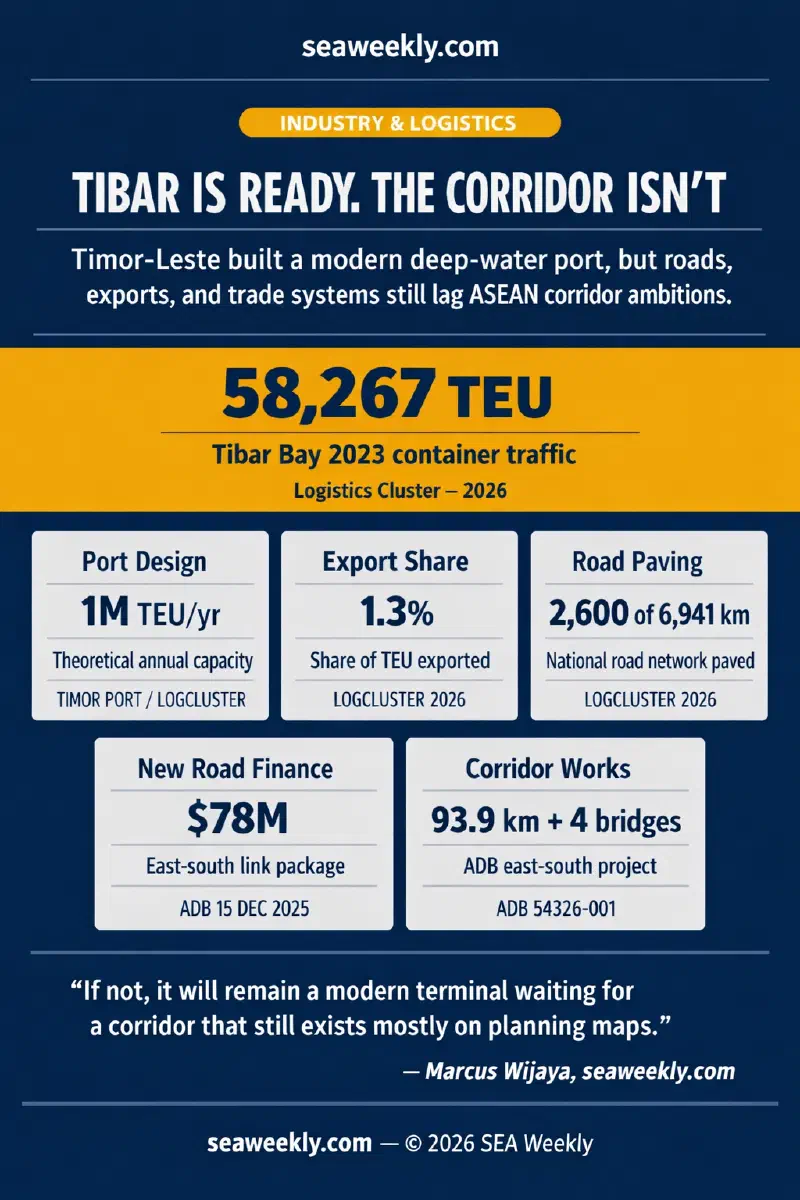
Tibar Bay’s deep-water terminal west of Dili can handle large container vessels, offers 16 meters of draft, and was built for roughly 1 million TEU of annual capacity. Yet the port handled just 58,267 TEU, and only 1.3 percent of that volume was exports. That is the real reason Timor-Leste’s port infrastructure gap still matters as ASEAN corridor investment accelerates around it: the quay is modern, but the road, customs, and cargo system beyond the gate is still thin. (Timor Port; Logistics Cluster, 2026)
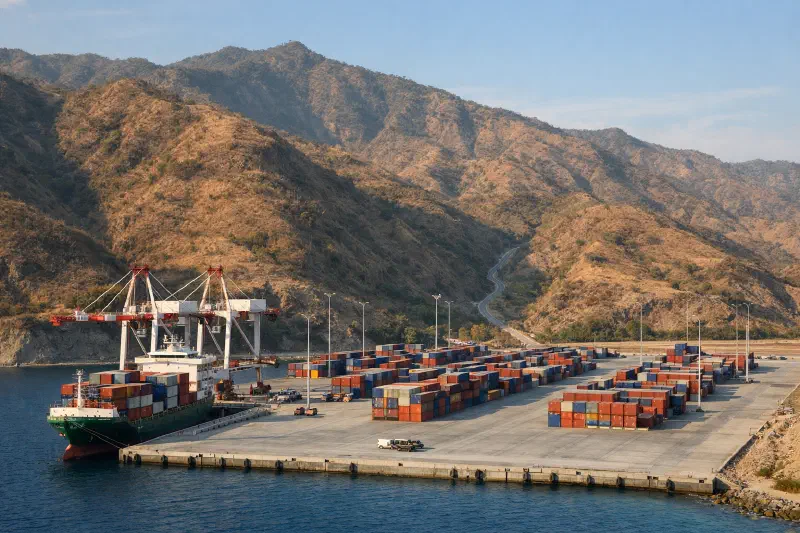
The language of “port infrastructure” can mislead here. If this were still the old Dili-port story, the answer would be simple: build a bigger terminal. But Tibar Bay already solved the berth problem. The harder problem is that ASEAN corridor competition in 2026 is no longer about standalone ports. It is about integrated systems: port, road, customs, trucking, warehousing, and enough export cargo to keep the whole chain commercially alive. Timor-Leste has built the most visible part first.
Tibar fixed the waterfront #
On its own terms, the Tibar Bay project is a serious achievement. The World Bank and IFC frame it correctly as Timor-Leste’s first public-private partnership, a $490 million project that created 1,000 jobs and gave the country a modern maritime gateway to international shipping lanes. The World Bank’s earlier MFD brief made the strategic intention explicit: Tibar was supposed to anchor a broader logistics and industrial-development story, not merely replace old port infrastructure. (World Bank Group, March 6, 2026; World Bank Group, February 24, 2019)
The problem is that the physical port has advanced faster than the economy around it. Logistics Cluster’s 2026 assessment shows a facility with 630 meters of quay, two berths, 27 hectares of stockyard, 20,000 TEU of storage capacity, and reefer connections that would be respectable for a much denser trading economy. What it does not show is a comparable level of export intensity. If only 1.3 percent of TEU handled are exports, the port is functioning primarily as a modern arrival gate, not yet as a true departure platform for a diversified economy. (Logistics Cluster, 2026)
That is the first non-obvious point investors and policymakers need to sit with. Timor-Leste’s weakest logistics link is no longer necessarily at the ship side. It is the commercial corridor feeding the ship.
This is also where my June 15 analysis of Timor-Leste’s investment outlook needs updating. Last month, the key question was whether ASEAN accession, the Petroleum Fund, and a functioning PPP model could make Timor-Leste look more investable than the region assumes. The answer was broadly yes. The next question is more operational: investable for what, and through which logistics system? Tibar gives Timor-Leste a gateway asset. It does not, by itself, create a corridor economy.
The missing corridor starts on land #
The fastest way to misunderstand Timor-Leste’s port gap is to imagine that a large vessel call automatically means internal connectivity has been solved. It has not. The same Logistics Cluster material that describes Tibar as a modern deep-water terminal also describes a road system that remains weather-sensitive and incomplete beyond the immediate Dili axis. The national network spans 6,941 kilometers, but only 2,600 kilometers are paved. South-coast and rural roads still include dirt sections. Landslides and flooding routinely damage roads and bridges during the rainy season. In some cases, communities can be cut off except by foot, motorbike, or horse. (Logistics Cluster, 2026)
That matters because ports do not compete alone. They compete as the seaward edge of inland transport systems. The road linking Tibar to Dili is paved and in good shape, but the onward cargo story is far less efficient. Logistics Cluster notes that freight moving beyond that segment relies on small-scale trucking operators, and farther inland transportation often shifts to flatbed or dump trucks because of road constraints. In other words, Timor-Leste can now receive cargo through a modern terminal and then move it across an internal network that still behaves like a frontier system.
The geography compounds everything. Timor-Leste is mountainous, which means many roads are steep, winding, and expensive to keep reliable. The Oecusse case is the clearest example of how unfinished the corridor story remains: overland access still requires crossing into Indonesia before re-entering Timor-Leste. That is not how an integrated ASEAN logistics node behaves. It is how a partially connected economy behaves.
ADB’s road-financing pipeline confirms that the government and donors understand the problem. In December 2025, ADB and Timor-Leste signed a $75 million loan and a $3 million grant to rehabilitate a vital road segment linking the eastern region to the southern coast. ADB’s East to South Coast Road Connectivity Project adds more detail: approximately 93.9 kilometers of national road upgrades plus four bridges, along with road-asset management and safety improvements. Earlier ADB support, including the 58-kilometer Baucau-Viqueque upgrade approved in 2018, was framed in basic access terms because the network was still narrow, partly unsealed, and slow enough that travel from Dili to Viqueque could take 10 hours by bus. (ADB, December 15, 2025; ADB Project 54326-001; ADB, March 2, 2018)
The implication is uncomfortable but clear. While ASEAN corridor investment is expanding, Timor-Leste is still financing the minimum road backbone a corridor needs before scale becomes possible. That is necessary work, but it is still pre-corridor work. Even ADB’s more recent $4 million resilient transport grant for Ermera, a remote and underserved district, reinforces the same point: Timor-Leste is still patching core access and climate resilience while its neighbors are increasingly competing on integrated port-road-industrial systems. (ADB, 2026)
Customs is moving. The system is not moving as fast. #
It would be wrong to say Timor-Leste is static on trade facilitation. The customs layer has improved materially. The ASYCUDA-backed electronic Single Window, launched in 2021 and expanded in 2022, linked customs with partner agencies and reduced the number of exemption letters and physical trips needed to clear consignments by about a tenth. That is not cosmetic. In a small market, cutting even a modest amount of physical bureaucracy can make trade much more usable for smaller operators. (ASYCUDA, June 17, 2022)
But a tenth less paperwork is not the same thing as corridor-grade commercial speed. The broader investment environment still imposes frictions that are harder to digitize away. The U.S. Department of State’s 2024 investment-climate statement remains blunt about the weak points: deficient infrastructure, limited personnel capacity, slow bureaucracy, land-title complexity, weak dispute resolution, and the absence of commercial courts. Business registration still requires in-person interaction. Foreign investors can lease land but land claims remain difficult to resolve. Those are not abstract governance complaints. They are exactly the kinds of frictions that determine whether warehouses, trucking fleets, agro-processing sites, and export-oriented SMEs are willing to invest around a port. (U.S. Department of State, 2024)
The difference between a modern port and a functioning corridor is usually made in these mundane layers. Does cargo clear quickly? Can trucks move reliably in wet season? Can exporters secure land, credit, and permits without month-long delays? Can a contract dispute be resolved before a business model breaks? Tibar Bay answers none of those questions by itself.
The real risk is import connectivity without export depth #
The second uncomfortable truth is that ASEAN integration can make Timor-Leste more open before it makes it more competitive. The World Bank’s April 2026 economic report makes the broader development point: the country still needs stronger private investment, better customs and licensing systems, and a larger tradeable sector if ASEAN membership is to translate into durable economic transformation. NBR pushed the warning further in 2025, noting that 60.2 percent of Timorese imports from 2004 to 2022 came from ASEAN markets and arguing that without domestic readiness the country risks becoming a passive consumer inside regional integration rather than a productive contributor. (World Bank, April 17, 2026; NBR, September 9, 2025)
That warning fits the port data almost perfectly. A modern port attached to a narrow export base will make imports easier first. Food, fuel, machinery, and consumer goods arrive more efficiently. But unless the inland economy starts generating repeat outbound cargo in agriculture, fisheries, tourism-linked supply chains, light manufacturing, or the blue economy, the gateway does not create bargaining power. It creates access.
IFC’s Timor-Leste page shows why the country still deserves serious attention. Since 2006, IFC has helped mobilize more than $150 million in private investment, maintained an advisory portfolio of $11.2 million as of July 2023, and expanded into other PPP-style opportunities, including the President Nicolau Lobato International Airport, diagnostics, and housing. That is not trivial. It means Timor-Leste has a real project-development base. (IFC)
But a PPP pipeline is not yet a corridor strategy. The danger is assuming that because Timor-Leste can now structure bankable infrastructure projects, it has already built the commercial density required to use them at scale. It has not.
That is why the port gap should now be read differently. The gap is not between Timor-Leste and the possibility of a modern maritime gateway; Tibar already closed much of that distance. The gap is between a modern maritime gateway and the still-fragile inland, institutional, and export economy meant to feed it. As I argued with Lourdes Reyes in last week’s analysis of ASEAN freight competition, regional vessel and logistics capacity is already being allocated more aggressively under Q3 pressure. Small gateways do not win simply because they are new. They win when cargo, roads, and institutions make them unavoidable.
Timor-Leste has built the port piece of ASEAN corridor connectivity. The next 18 to 24 months will show whether it can build the corridor itself. If the new roads, customs systems, and export sectors begin to work in sequence, Tibar can become a genuine gateway. If not, it will remain a modern terminal waiting for a corridor that still exists mostly on planning maps.
References #
- Logistics Cluster / WFP (2026). “2.1.2 Timor-Leste Port of Tibar Bay.” https://lca.logcluster.org/212-timor-leste-port-tibar-bay (Accessed July 13, 2026)
- Timor Port. “Terminal Capacity.” https://www.timorport.com/services/terminal-capacity/ (Accessed July 13, 2026)
- World Bank Group (March 6, 2026). “Setting Sail - Ports and Jobs: Timor-Leste (IFC).” https://www.worldbank.org/en/news/immersive-story/2026/03/06/ports-and-jobs-ida-miga-ifc (Accessed July 13, 2026)
- World Bank Group (February 24, 2019). “Timor-Leste: Tibar Bay Port: Gateway to the World.” https://www.worldbank.org/en/about/partners/brief/timor-leste-tibar-bay-port-gateway-to-the-world (Accessed July 13, 2026)
- World Bank (April 17, 2026). “Timor-Leste Economic Report: Leveling Up - How ASEAN Membership Can Support Timor-Leste’s Economic Transformation.” https://documents.worldbank.org/curated/en/099041526055538891 (Accessed July 13, 2026)
- Asian Development Bank (December 15, 2025). “ADB, Timor-Leste Sign $78 Million Financing to Upgrade National Road Network.” https://www.adb.org/news/adb-timor-leste-sign-78-million-financing-upgrade-national-road-network (Accessed July 13, 2026)
- Asian Development Bank (March 2, 2018). “ADB Support to Boost Road Connectivity in Timor-Leste.” https://www.adb.org/news/adb-support-boost-road-connectivity-timor-leste (Accessed July 13, 2026)
- Asian Development Bank. “Timor-Leste: East to South Coast Road Connectivity Project.” https://www.adb.org/projects/54326-001/main (Accessed July 13, 2026)
- Asian Development Bank (2026). “ADB to Improve Resilient Transport Connectivity in Timor-Leste.” https://www.adb.org/news/adb-improve-resilient-transport-connectivity-timor-leste (Accessed July 13, 2026)
- ASYCUDA (June 17, 2022). “More Timor Leste PGAs Signing Up to Use Electronic Customs Clearance System.” https://asycuda.org/en/timor-lestes-electronic-single-windows-increasing-capabilities/ (Accessed July 13, 2026)
- U.S. Department of State (2024). “2024 Investment Climate Statements: Timor-Leste.” https://www.state.gov/reports/2024-investment-climate-statements/timor-leste (Accessed July 13, 2026)
- IFC. “IFC in Timor-Leste.” https://www.ifc.org/en/where-we-work/country/timor-leste (Accessed July 13, 2026)
- National Bureau of Asian Research (September 9, 2025). “Timor-Leste’s Strategic Path in ASEAN: Turning Accession into Impact.” https://www.nbr.org/publication/timor-lestes-strategic-path-in-asean-turning-accession-into-impact/ (Accessed July 13, 2026)
- Logistics Cluster / WFP (2026). “2.3 Timor-Leste Road Network.” https://lca.logcluster.org/23-timor-leste-road-network (Accessed July 13, 2026)