
Jakarta-based analysts tend to discuss Timor-Leste as an afterthought to Indonesia’s investment story — a small neighbour, a market for Pegadaian’s microfinance, a footnote in maritime boundary talks. That framing is becoming outdated. Timor-Leste is entering the second half of 2026 with more structural advantages than at any time since independence, and the investment outlook shaping up here is more interesting than the region is giving it credit for.
The core story is not a frontier-market awakening. It is a tension between two timelines. One is the opportunity timeline — ASEAN membership, a well-governed sovereign wealth fund worth US$18.74 billion, a functioning public-private partnership framework, and growing regional investor attention. The other is the fiscal timeline — public spending at 85.3 per cent of GDP, deficits financed by Petroleum Fund withdrawals, and a depletion date of roughly 2038 unless the model shifts.
The Petroleum Fund Advantage — and Trap #
The starting point for any serious investment assessment of Timor-Leste is the Petroleum Fund. As of June 2025, the Fund held US$18.74 billion, equivalent to roughly ten times the country’s GDP or US$13,400 per capita (World Bank, April 2026). For context, that is a larger reserve buffer than most ASEAN economies with far larger GDP bases. The Fund is genuinely well-governed — established with rules-based withdrawal mechanisms, parliamentary oversight, and a mandate to smooth intergenerational resource wealth.
But the Fund’s size also obscures an uncomfortable arithmetic. Between 2014 and 2024, oil and gas revenues enabled public spending to grow by an average of 5.3 per cent per year, keeping expenditure at an average 85.3 per cent of GDP. Over the same period, fiscal deficits averaged 39.6 per cent of GDP, financed largely through Petroleum Fund withdrawals. The World Bank’s April 2026 economic report — subtitled “Leveling Up: How ASEAN Membership Can Support Timor-Leste’s Economic Transformation” — projects that without significant fiscal consolidation, the Fund could be depleted by 2038 (World Bank, April 2026).
This is the paradox that too few investors appreciate. Timor-Leste’s greatest asset — a disciplined, well-capitalised sovereign wealth fund — has enabled a public spending model that actively crowds out the private sector development the country needs. When government expenditure accounts for 85 per cent of economic activity, there is little room for private enterprise to build the operating history, talent base and capital allocation discipline that foreign investors demand.
ASEAN Membership as an Institutional Anchor #
Timor-Leste’s accession as ASEAN’s 11th member in 2025 was the culmination of a decade-long diplomatic effort, and the institutional implications are more significant than the short-term trade numbers suggest.
The Asian Development Bank’s April 2026 outlook identifies ASEAN integration as Timor-Leste’s single most important policy lever for private sector development (ADB, April 2026). The National ASEAN Economic Community Implementation Roadmap — Timor-Leste’s domestic reform blueprint — prioritises three areas: implementing ASEAN economic agreements to reduce trade barriers; domestic regulatory reforms including land titling, business licensing, and customs modernisation; and targeted investment promotion in agribusiness, tourism, and women-led MSMEs.
The real value of ASEAN membership for Timor-Leste is not the tariff preferences — those matter, but the country’s export base is too narrow to capture them immediately. The real value is the external reform anchor. Membership creates obligations — on customs harmonisation, standards alignment, investment rule transparency — that give Timor-Leste’s reform advocates external cover to push through changes that domestic political economy has resisted.
The Diplomat’s coverage throughout 2025-2026 has tracked this arc. “Timor-Leste Joins ASEAN” (June 2025) captured the tension between the ideal of inclusion and the reality of institutional adjustment. “Strategic Priorities for ASEAN’s Newest Member” (November 2025) noted that membership brings political visibility and economic opportunity but also new exposure to regional disputes. And “A Test for Timor-Leste, and ASEAN, on Myanmar” (April 2026) argued that Timor-Leste’s accession has created a rare opening for ASEAN to clarify whether it stands for more than procedural restraint (The Diplomat, multiple dates).
The question for investors is whether this institutional momentum can translate into faster reform implementation than the pre-accession track record suggests. The ADB’s assessment is cautiously optimistic but conditional: “close collaboration with ASEAN Investment Promotion Agencies and the ASEAN Coordinating Committee on MSMEs will be essential.”
Infrastructure: Tibar Bay and Beyond #
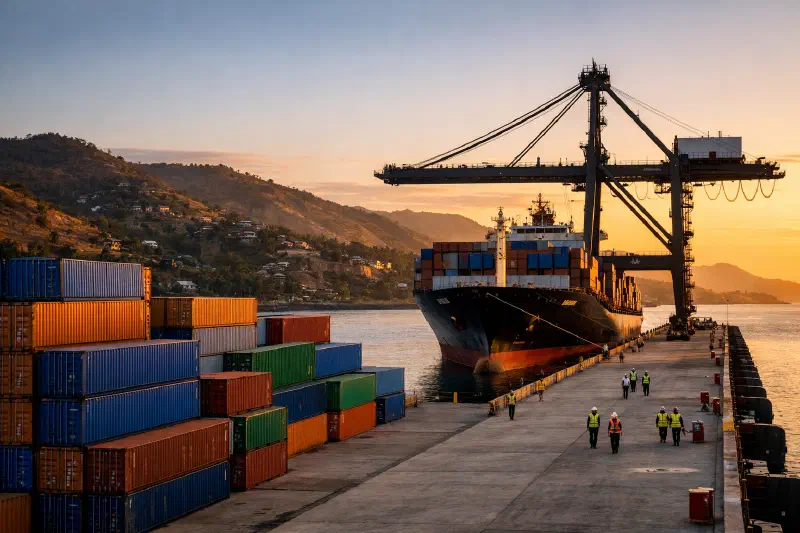
The most tangible evidence that Timor-Leste’s investment proposition is maturing sits west of Dili. The Tibar Bay Port — the country’s first public-private partnership — opened in 2022 with US$490 million in private investment, the largest single private infrastructure investment in the country’s history. IFC served as transaction adviser, and the project has created approximately 1,000 jobs while giving Timor-Leste a deep-water gateway to international shipping lanes (World Bank Group, March 2026).
Tibar Bay matters beyond its immediate economic impact. It demonstrated that international capital can work in Timor-Leste when the PPP framework is properly structured and backed by multilateral guarantees. Prime Minister Taur Matan Ruak described it at the time as “a signal to other investors that Timor-Leste is an attractive place to do business.”
That signal is being followed up. IFC is also advising on the expansion of President Nicolau Lobato International Airport — another PPP — as well as upgrades to the national medical diagnostics system and an affordable housing project in Dili (IFC Timor-Leste). These are individually modest projects. Collectively, they build a pipeline.
The open question is whether this pipeline is large enough to shift the investment narrative before the fiscal timeline becomes binding. The airport and housing PPPs will take years to reach financial close and construction. The Tasi Mane project — the strategic national priority LNG plant on the southern coast — remains mired in commercial uncertainty around Greater Sunrise gas field development, despite the 2018 Australia-Timor-Leste maritime boundary treaty and the more recent “Parseria Foun ba Era Foun” (New Partnership for a New Era) declaration signed in February 2026 (The Diplomat, February 2026).
Regional Capital Is Taking Notice #
The most interesting recent data point for Timor-Leste’s investment outlook came not from a development bank report but from Indonesia’s state-owned pawnshop.
Pegadaian opened its first international branch in Dili on March 30, 2026. Within two months, it had processed over 600 transactions, disbursing US$329,882 in financing and a further US$6,406 through a new interest-free microloan programme for local citizens (Jakarta Post, June 10, 2026). Pegadaian president director Damar Latri Setiawan described the move as part of “a broader mission to expand financial literacy and inclusion,” but the commercial signals are clear: Pegadaian’s 2025 net profit of Rp 8.3 trillion (US$510 million) and Q1 2026 net profit up 87 per cent year-on-year to Rp 4.3 trillion mean the company has both the balance sheet and the strategic incentive to expand regionally.
This is consistent with a pattern I traced in last week’s analysis of Indonesia banking liquidity. Indonesian financial institutions are at a point where domestic pressures are slowing outward expansion — but the early success of the Dili branch suggests the demand side in Timor-Leste is stronger than many assumed.
Two Questions for the Second Half #
The Timor-Leste investment story for H2 2026 and beyond comes down to two questions.
First, can the reform momentum from ASEAN membership accelerate private investment fast enough to offset the fiscal tightening that will eventually be necessary? The ADB projects GDP growth of 3.8 per cent in 2026 and 4.1 per cent in 2027, with inflation benign at 1.7 per cent (ADB, April 2026). Those numbers are respectable but well below the 5 per cent-plus the government targets and well below what is needed to make a meaningful dent in the Petroleum Fund withdrawal trajectory.
Second, can Timor-Leste differentiate itself in a region where capital is rotating toward selectivity? As I argued in the context of Indonesia, and as Chloe Tan captured in her June 6 SEA Weekly analysis, ASEAN capital flows are becoming more discriminating — concentrating in markets that can absorb volatility while still executing on investment conversion (SEA Weekly, June 6, 2026). Timor-Leste’s challenge is to demonstrate that the Tibar Bay model — not the public spending model — is the template for the future.
The country has something many frontier markets lack: a credible sovereign wealth fund, a functioning PPP track record, and the institutional backing of ASEAN. Those assets do not guarantee success. But they give Timor-Leste a better starting position than most analysts assume. The next 18 months will determine whether the opportunity timeline or the fiscal timeline wins.
References:
- World Bank (April 17, 2026). “Timor-Leste Economic Report: Leveling Up — How ASEAN Membership Can Support Timor-Leste’s Economic Transformation.” https://documents.worldbank.org/curated/en/099041526055538891 (Accessed June 15, 2026)
- ADB (April 2026). “Asian Development Outlook April 2026 — Timor-Leste.” https://www.adb.org/where-we-work/timor-leste/economy (Accessed June 15, 2026)
- Jakarta Post (June 10, 2026). “Pegadaian’s first overseas venture in Timor-Leste off to strong start.” https://www.thejakartapost.com/business/2026/06/10/pegadaians-first-overseas-venture-in-timor-leste-off-to-strong-start (Accessed June 15, 2026)
- World Bank Group (March 6, 2026). “Setting Sail — Ports and Jobs: Timor-Leste (IFC).” https://www.worldbank.org/en/news/immersive-story/2026/03/06/ports-and-jobs-ida-miga-ifc (Accessed June 15, 2026)
- The Diplomat (February 2026). “Australia and Timor-Leste: A New Partnership for a New Era.” https://thediplomat.com/2026/02/australia-and-timor-leste-a-new-partnership-for-a-new-era/ (Accessed June 15, 2026)
- The Diplomat (June 2025 — April 2026). “Timor-Leste tag archive.” https://thediplomat.com/tag/timor-leste/ (Accessed June 15, 2026)
- SEA Weekly (June 6, 2026). “SEA Weekly: Why ASEAN capital flows are rotating toward selective growth stories.” https://seaweekly.com/posts/2026-06-06-sea-weekly-why-asean-capital-flows-are-rotating-toward-selective-growth-stories/ (Accessed June 15, 2026)
- SEA Weekly (June 12, 2026). “How Indonesia banking liquidity is influencing ASEAN credit growth ahead of H2.” https://seaweekly.com/posts/2026-06-12-indonesia-banking-liquidity-asean-credit-growth/ (Accessed June 15, 2026)
- IFC Timor-Leste Country Page. https://www.ifc.org/en/where-we-work/country/timor-leste (Accessed June 15, 2026)