
On June 30, VPBank closed a $1.44 billion syndicated loan with 15 global financial institutions — its maiden sustainability-linked deal, oversubscribed and priced despite what the bank’s own press release described as “tighter liquidity conditions in global financial markets.” On July 7, ADB and HDBank closed a $721 million facility specifically structured to route credit toward Vietnamese MSMEs, mobilising 29 commercial banks to deliver capital to firms that the commercial system would otherwise have rejected. Both transactions happened within the same week. Both describe the same problem from opposite ends of the capital stack.

Three layers of tightening #
Working capital stress in trade finance tightens through three channels simultaneously, and Q3 is applying pressure to all three.
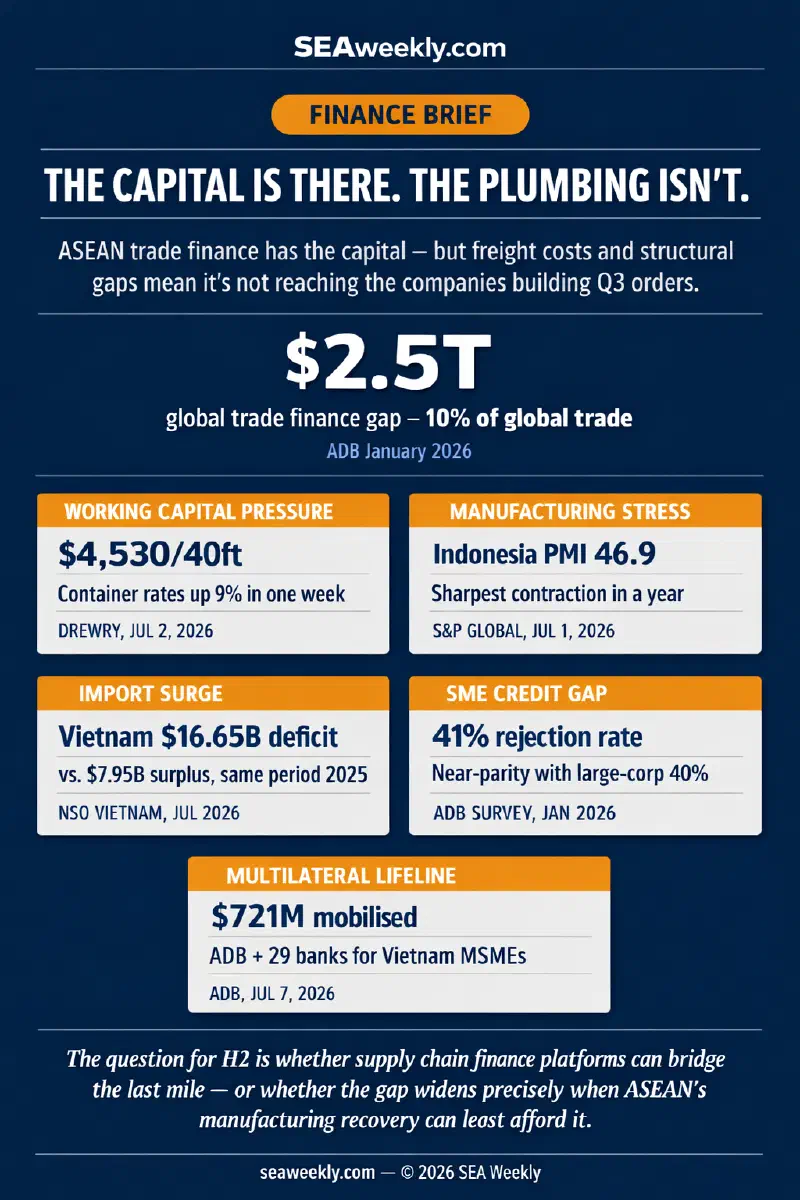
The cost channel is the most visible. Drewry’s World Container Index hit $4,530 per 40-foot container on July 2 — up 9% in a single week, and up from $4,166 on June 25 (Drewry, July 2, 2026). For an ASEAN exporter running a 90-day receivable cycle, every dollar of freight cost increase extends the financing gap proportionally. A Thai food processor bridging a 75-day payment term while absorbing a 9% spike in ocean freight this week needs more working capital today than it needed last week — and needs it from the same banks that are simultaneously fielding rising corporate demand from commodity importers.
The cycle channel is slower but more insidious. When buyers face their own margin pressure, they extend payment terms. When suppliers face rising input costs, they try to shorten them. That tension — buyer trying to delay, seller trying to accelerate — is playing out now across ASEAN’s supply chains. The result is an effective lengthening of the cash conversion cycle even when nominal contract terms stay constant. Invoice financing and receivables discounting are the instruments that should bridge this gap; they are also the instruments most dependent on the credit access infrastructure that is under stress.
The availability channel is the most structurally significant. ADB’s 9th Global Trade Finance Gap Survey, published in January 2026, estimated the global trade finance gap at $2.5 trillion — about 10% of global trade value, representing unmet demand that prevents businesses from capturing trade opportunities (ADB, January 15, 2026). The most telling data point in that survey is easy to miss: SME rejection rates for trade finance applications (41%) have fallen to nearly the same level as rejection rates for large and mid-cap corporates (40%). This looks like progress. It is not. It is the beginning of broad-based tightening — the gap is closing because large corporate access is deteriorating, not because SME access has improved.
Vietnam: the import accumulator #
Vietnam recorded a merchandise trade deficit of $16.65 billion in the first half of 2026 — against a surplus of $7.95 billion in the same period last year (Vietnam Investment Review, July 5, 2026). Total import-export turnover reached $549.7 billion, with exports up 21% and imports up 33.4% year-on-year. The National Statistics Office was careful to frame this as a manufacturing input story, not a warning sign: the surge in imports was driven by raw materials, machinery, and intermediate goods for production.
That framing is accurate. It is also incomplete.
Every dollar of those imports was financed somewhere — either through supplier credit extended by Chinese counterparties (Vietnam’s trade deficit with China widened to $77.3 billion, up 39% year-on-year), through letters of credit and trade facilities opened by Vietnamese commercial banks, or by compressing the working capital buffers of the manufacturing firms themselves. The net effect is that Vietnamese exporters are entering Q3 with more accumulated import costs to convert into export revenue — and that conversion takes time, container slots, and the financing that bridges the gap.
ADB’s July 7 facility with HDBank — $100 million from ADB, $621 million mobilised from 29 commercial banks — is calibrated to address exactly this kind of structural financing gap for MSMEs (ADB, July 7, 2026). MSMEs account for 97% of Vietnam’s registered businesses, 36% of total employment, and 40% of GDP, yet they continue to face limited collateral, constrained credit histories, and perceived risks that block efficient commercial bank access. The fact that ADB needed to mobilise a $721 million multilateral structure to route credit to firms comprising 97% of the economy’s enterprise base tells you more about the state of Vietnam’s trade finance infrastructure than any optimistic headline.
As I noted in my June 16 analysis of ASEAN banking liquidity, Vietnam’s banking sector is forecasting stronger second-half earnings on credit expansion — but the signals from the MSME tier tell a more nuanced story. The State Bank of Vietnam has separately proposed raising the short-term lending cap to 40% to ease working capital access (Vietnam Investment Review, May 2026). Policy adjustments of that kind reflect institutional recognition that working capital stress in the corporate sector is real — they do not appear in the quarterly earnings guidance of large Vietnamese lenders.
Indonesia: the credit desert beneath the PMI headline #
Indonesia’s S&P Global Manufacturing PMI collapsed to 46.9 in June from 50.0 in May — the sharpest contraction in a year and the first breach below the expansion threshold in several months (The Jakarta Post, July 1, 2026). The PMI reading alone is alarming. The input cost component is worse: input price inflation accelerated to its most pronounced level since September 2013, the second-highest rate in the survey’s history. New export orders recorded the steepest fall since August 2021 as higher prices made Indonesian goods less competitive.
Read this against Bank Indonesia’s 75 basis points of tightening since May — a cumulative move I tracked in June that has now landed directly in the PMI data. Indonesia’s manufacturing sector is being squeezed from three sides simultaneously: rising input costs, falling export order volumes, and the most restrictive monetary conditions in several years. The firms most exposed to this triple squeeze are the SMEs that produce the intermediate goods for larger exporters — companies where OJK has consistently described MSME lending as “persistently weak” even as aggregate credit growth continued (The Jakarta Post, June 7, 2026).
Indonesia’s May trade balance swung to a deficit of $1.61 billion — the first since April 2020 — as oil and gas imports surged 71% year-on-year to $4.51 billion (The Jakarta Post, July 1, 2026). That oil import surge competes directly with manufacturing SMEs for commercial bank trade finance capacity. When Pertamina draws on the same letter of credit infrastructure that an Indonesian garment exporter uses to open L/Cs with textile suppliers, the garment exporter is in a queue behind the state oil company. The aggregate numbers look fine. The credit allocation story is not.
The bifurcation the institutional data reveals #
Daniel Lim’s analysis of Singapore’s trade finance hub positioning this week documented the supply side: Singapore banks using significant risk transfers (DBS $1 billion SRT, Standard Chartered $1.5 billion SRT, HSBC preliminary discussions) to free up regulatory capital ahead of Q3 demand. That capital is real, and that pre-positioning is meaningful.
The structural question is who it reaches.
VPBank’s $1.44 billion closed despite “tighter global liquidity” because VPBank is a systemically significant Vietnamese bank with strong credit ratings, Moody’s upgrades on six Vietnamese banks earlier this year, and a 15-bank MLAUB consortium including SMBC, Standard Chartered, HSBC, and OCBC. The same global liquidity that VPBank characterises as tight remains accessible to it because its institutional profile eliminates most of the counterparty risk that constrains SME credit (Vietnam Investment Review, July 1, 2026).
The firms that cannot access this channel — and that account for the bulk of ASEAN’s actual supply chain employment — face the ADB survey’s 41% rejection rate, the OJK’s “persistently weak” MSME lending, and the choice between compressing their own working capital or passing cost increases up the value chain.
When ADB mobilised $4 billion in crisis financing in June — including $1 billion specifically for trade finance covering energy and food imports across nine countries — the mechanism it described was emergency liquidity for scenarios the commercial market was failing to serve (ADB, June 12, 2026). ADB’s trade finance crisis instruments are a diagnostic of market failure, not a substitute for it.
What Q4 will reveal #
The working capital stress accumulating in Q3 will appear in Q4 financial data. Cash conversion cycles that stretched in July and August will resolve in September and October — or they won’t. The companies that absorb Q3 input cost increases while managing longer payment cycles and tighter trade credit availability are the ones whose balance sheet quality will show in H2 bank credit data.
For ASEAN’s banking system, the signal to watch is not the headline loan growth numbers that Vietnamese and Indonesian regulators will point to with satisfaction. It is the SME NPL trajectory in Q4, the pace of invoice discounting facility draws, and whether OJK’s description of MSME lending as “persistently weak” evolves toward “deteriorating.” These are the data points that precede the visible problems.
On the demand side, the Q3 inflection point is container rate persistence. Drewry’s current level of $4,530 represents the financing burden that exporters must bridge through the peak monsoon shipping window. If rates normalise by September, the working capital pressure resolves into the Q4 order cycle. If they do not — if the structural factors that DHL identified in June (demand running 4% above year-ago levels against fleet capacity growth of only 3%, with Suez Canal detours constraining effective slot availability) persist — the cash cycle arithmetic for ASEAN manufacturers tightens again.
The answer to ASEAN’s trade finance gap is not more multilateral intervention. It is supply chain finance platforms — and the digitalisation of trade documentation that the ADB itself identified as the primary structural solution — reaching the scale needed to serve the tier where the gap actually lives. Singapore’s MAS is building that infrastructure (BLOOM, SAFR) and it matters. But as of Q3 2026, that infrastructure is at proof-of-concept stage. The companies navigating the current working capital cycle are doing so in the market that exists, not the one being designed.
References #
- Asian Development Bank (January 15, 2026). “Demand for Trade Finance to Rise Amid Supply Chain Realignment—ADB Report.” https://www.adb.org/news/demand-trade-finance-rise-amid-supply-chain-realignment-adb-report (Accessed July 8, 2026)
- Asian Development Bank (July 7, 2026). “ADB, HDBank Sign $100 Million Loan to Expand Access to Finance for MSMEs, Women-Owned Businesses in Viet Nam.” https://www.adb.org/news/adb-hdbank-sign-100-million-loan-expand-access-finance-msmes-women-owned-businesses-viet-nam (Accessed July 8, 2026)
- Asian Development Bank (June 12, 2026). “ADB Delivers Rapid Support as Middle East Impact Spreads.” https://www.adb.org/news/adb-delivers-rapid-support-middle-east-impact-spreads (Accessed July 8, 2026)
- Drewry (July 2, 2026). “World Container Index.” https://www.drewry.co.uk/supply-chain-advisors/supply-chain-expertise/world-container-index-assessed-by-drewry (Accessed July 8, 2026)
- The Jakarta Post (July 1, 2026). “RI factories slide into contraction in June amid soaring costs, weak demand.” https://www.thejakartapost.com/business/2026/07/01/ri-factories-slide-into-contraction-in-june-amid-soaring-costs-weak-demand (Accessed July 8, 2026)
- The Jakarta Post (July 1, 2026). “Indonesia posts first trade deficit in six years.” https://www.thejakartapost.com/business/2026/07/01/indonesia-posts-first-trade-deficit-in-six-years (Accessed July 8, 2026)
- The Jakarta Post (June 7, 2026). “Loan growth rises despite persistently weak MSME lending: OJK.” https://www.thejakartapost.com/business/2026/06/07/loan-growth-rises-despite-persistently-weak-msme-lending-ojk (Accessed July 8, 2026)
- Vietnam Investment Review (July 5, 2026). “Vietnam posts trade deficit as imports outpace exports in first half.” https://vir.com.vn/vietnam-posts-trade-deficit-as-imports-outpace-exports-in-first-half-156046.html (Accessed July 8, 2026)
- Vietnam Investment Review (July 1, 2026). “VPBank signs maiden $1.44 billion sustainability-linked loan.” https://vir.com.vn/vpbank-signs-maiden-144-billion-sustainability-linked-loan-155867.html (Accessed July 8, 2026)
- Vietnam Investment Review (May 2026). “SBV proposes raising short-term lending cap to 40 per cent.” https://vir.com.vn/sbv-proposes-raising-short-term-lending-cap-to-40-per-cent-155232.html (Accessed July 8, 2026)