
The most revealing sentence from Bank Indonesia last week was not the hike announcement. It was a short line buried in the central bank’s own retail sales report: tighter monetary policy, BI acknowledged, “could weigh on consumer confidence and retail sales in the months ahead.”
That sentence was published by the same institution that, five days earlier, had raised rates 25 basis points outside its regular meeting schedule to defend the rupiah — the second hike in three weeks, bringing the cumulative tightening to 75 basis points. A monetary authority simultaneously tightening financial conditions and warning that tighter conditions will reduce spending is not a contradiction. It is a confession.
And it tells you more about ASEAN banking liquidity in mid-2026 than any headline loan growth number ever will.
The Aggregate Numbers Are Fine. That Is The Problem. #
Across ASEAN, the loan growth data provides exactly the reassurance that policymakers want to broadcast. Indonesia’s credit expansion is still rising, OJK confirmed in its June 7 update. Singapore’s banking system remains the region’s most liquid. Malaysia’s domestic lending is supported by ringgit strength and benign inflation at 1.9%. Vietnam’s banks are expanding credit in an economy running near 6.5% growth.
These are real numbers. They are also, for the most part, describing the past three to six months, not the next six. Loan growth is a lagging indicator. Liquidity tightness is a leading one. And right now, the two are telling incompatible stories.
The problem is not in the loan book. It is in the deposit book — the funding base that makes loans possible in the first place.
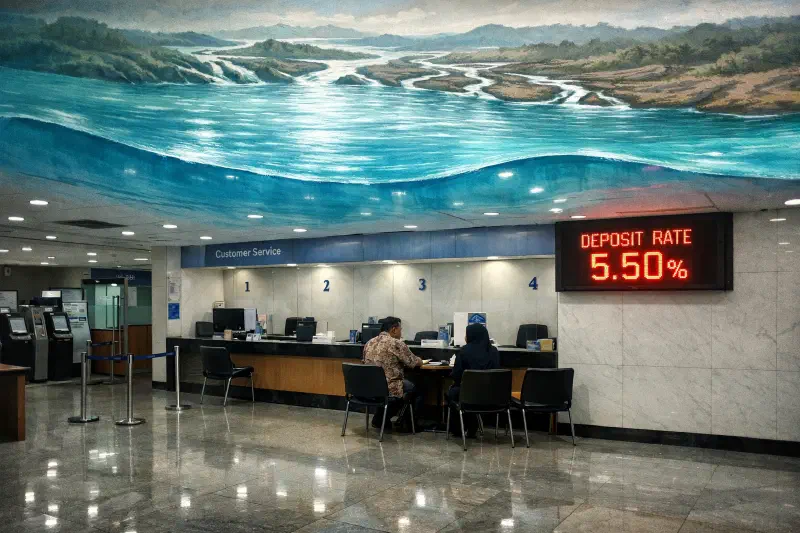
Indonesia is the most acute case, but it reveals a pattern that echoes across the region. The rupiah has lost nearly 8% against the dollar this year, the worst performance in ASEAN. The 10-year government bond yield has surged to 7.45%, within touching distance of 2022 highs (Bloomberg, June 11, 2026). At 5.50%, the benchmark rate is meant to attract deposits and stabilise the currency. But real rates — adjusted for rupiah depreciation expectations — remain negative or neutral at best.
Depositors are not being compensated for currency risk. And the revised Financial Sector Development and Strengthening Law, enacted on June 4, which expanded parliamentary oversight of Bank Indonesia and installed the president’s nephew as deputy governor, has done nothing to reassure them that the central bank’s independence — and therefore the stability of the currency it manages — is beyond question (CNA, June 9, 2026).
The result is a deposit squeeze that the aggregate numbers do not yet capture: depositors seeking dollar alternatives or non-bank instruments, funding costs rising faster than lending rates, and banks forced into a narrower set of lending decisions.
Three Liquidities, Three Stories #
To understand why this matters, it helps to distinguish three types of banking liquidity that markets habitually conflate. Each is telling a different story across ASEAN right now.
Funding liquidity — the ability to attract deposits at reasonable cost — is deteriorating fastest in Indonesia and Thailand. ING’s decision to cut its stake in TMBThanachart Bank to 19.5% via share buyback is not just portfolio rebalancing (Fintech News Singapore, June 15, 2026). It is a European bank reducing ASEAN exposure at a moment when capital repatriation pressure from head offices is rising. When foreign strategic shareholders retreat, the signal travels faster than the balance sheet adjustment.
Market liquidity — the ability to trade assets without moving prices — is deteriorating in tandem with the Indonesian bond selloff. The 7.45% 10-year yield sets a benchmark that other ASEAN sovereigns must price against. Vietnamese, Philippine, and even Malaysian issuers face a higher clearing rate because the regional anchor is being dragged up by Jakarta’s stress. This is not a credit event. It is a cost-of-capital event, and it affects every borrower in the region.
Credit liquidity — the ability of end-borrowers to access loans — is bifurcating. Large corporates, SOEs, and commodity exporters continue to access credit. Danantara’s project pipeline ensures that. But the SME segment — precisely where employment and household income growth originates — was already described by OJK as “persistently weak” before the latest 75 basis points of hikes (Jakarta Post, June 7, 2026). Indonesia’s May retail sales index dropped 0.9% month-on-month and 3.1% year-on-year, with ICT product sales plunging 17.5% (Jakarta Post, June 11, 2026). That is not a soft landing. That is a consumer segment running out of oxygen.
The uncomfortable truth about the 75 basis points of tightening since May is this: they are defending the rupiah at the cost of clogging the credit channel that Indonesian households and small businesses depend on. That trade-off may be defensible in the short term. In the medium term, it hollows out the very domestic demand that Indonesia’s growth narrative depends on.
The Regional Spillover Nobody Is Modelling #
Indonesia is not just another ASEAN banking market. It is the largest by assets, and its liquidity conditions radiate outward through three channels.
First, Indonesian banks are among the region’s most active expanders. Pegadaian opened its first international branch in Dili, Timor-Leste in March, processing over 600 transactions and disbursing $330,000 in financing within two months. BRI has been eyeing regional expansion. As domestic conditions tighten, that outward push slows — not because the opportunities disappear, but because home-market pressures absorb management attention and capital.
Second, Indonesia’s weight in ASEAN bond markets means that when Indonesian yields rise, the regional cost of capital rises with it. The “Sell Indonesia” narrative that swept trading desks in early June (Bloomberg, June 5, 2026) has a corollary: when the region’s largest bond market reprices, every other market reprices with it.
Third, and most significantly from a development perspective, the credit availability gap for ASEAN’s frontier markets widens. Laos, Cambodia, and Myanmar — the economies that most need credit to build resilience — are the ones the regional credit mechanism is least equipped to serve. Earlier this month, Marcus Wijaya tracked how Indonesia’s banking liquidity stress was already affecting credit conditions in Timor-Leste. That pattern is replicating across the frontier tier.
Where The Counter-Forces Are Forming #
The picture is not uniformly bearish. Three counter-forces are worth watching.
The CIMB–China CITIC Bank partnership, signed the same week as BI’s unscheduled hike, points toward an alternative credit channel: corridor banking. CIMB is not competing with DBS on institutional AI and is not competing with TNG eWallet on consumer ecosystem. It is building a bridge between China and ASEAN trade, payments, and financing flows. If domestic liquidity tightens, corridor-sourced credit may partially offset it — for the borrowers and sectors that corridor banks are designed to serve.
The Credit Bureau Singapore–Experian Malaysia memorandum of understanding on cross-border credit reporting is a quieter development but structurally significant. Information asymmetry is one of the binding constraints on cross-border SME lending in ASEAN. Reducing it makes cross-border credit allocation more efficient at the margin (Fintech News Singapore, June 10, 2026).
And the private credit market is stepping into the SME gap. Choco Up’s US$15 million credit facility from AlteriQ Global, announced on June 16, and Bizcap’s S$1 million lending cap for Singapore SMEs are signals that alternative lenders are building the infrastructure to serve borrowers that banks are tightening away from (Fintech News Singapore, June 16, 2026). Private credit will not replace bank lending at scale. But it reveals where the stress is concentrated and where the next generation of financial intermediation is forming.
What To Watch In H2 #
The direction of travel for ASEAN banking in the second half of 2026 is not toward a credit crunch. The system is too well-capitalised, and the macro growth story — even with China stalling to Covid-era spending levels — is too strong for that.
But the direction of travel is toward a deeper divergence between what the headline loan growth numbers say and what the underlying liquidity conditions actually are. And the metrics that will signal the shift before the loan data catches up are not the ones that make central bank press releases.
Watch the loan-to-deposit ratios at the country level — particularly Indonesia, where the ratio has been creeping up. Watch interbank spreads, which widen before credit conditions visibly tighten. Watch deposit betas: how much of the rate hikes are banks actually passing through to depositors? If the answer is “less than markets assume,” then the deposit squeeze is real and the credit funnel is narrowing even as loan growth stays positive.
And above all, watch the SME credit data six months from now. Because when banking liquidity tightens, loan growth is the last metric to turn — not the first.
References:
- Bloomberg (June 11, 2026). “Indonesia Market Rout Resumes as Interest Rate Hike Bets Mount.” https://www.bloomberg.com/news/articles/2026-06-11/indonesian-bonds-resume-decline-as-market-confidence-stays-weak (Accessed June 16, 2026)
- CNA/Bloomberg Opinion (June 9, 2026). “Commentary: Indonesia hits the panic button over the rupiah.” https://www.channelnewsasia.com/commentary/indonesia-rupiah-interest-rate-hike-prabowo-6173676 (Accessed June 16, 2026)
- Jakarta Post (June 7, 2026). “Loan growth rises despite persistently weak MSME lending: OJK.” https://www.thejakartapost.com/business/2026/06/07/loan-growth-rises-despite-persistently-weak-msme-lending-ojk (Accessed June 16, 2026)
- Jakarta Post (June 11, 2026). “Retail sales, consumer confidence ease as Idul Fitri boost dissipates.” https://www.thejakartapost.com/business/2026/06/11/retail-sales-consumer-confidence-ease-as-idul-fitri-boost-dissipates (Accessed June 16, 2026)
- Fintech News Singapore (June 15, 2026). “ING Cuts Stake in Thailand’s TMBThanachart Bank to 19.5%.” https://fintechnews.sg/133026/thailand/ing-tmbthanachart/ (Accessed June 16, 2026)
- Fintech News Singapore (June 10, 2026). “Credit Bureau Singapore, Experian Malaysia Plan Two-Way Credit Reporting.” https://fintechnews.sg/132832/lending/singapore-malaysia-credit-reporting/ (Accessed June 16, 2026)
- Fintech News Singapore (June 16, 2026). “Choco Up Secures US$15 Million Credit Facility for SME Financing.” https://fintechnews.sg/133111/funding/choco-up-secures-credit-facility/ (Accessed June 16, 2026)