
The working capital cycle for an ASEAN electronics exporter running a 90-day receivable book just got considerably more expensive. Drewry’s World Container Index hit $4,530 per 40ft container on July 2 — up 9% in a single week — and for every dollar that freight cost rises, the manufacturer’s financing need expands proportionally. The bank that prices and books that incremental credit facility is almost certainly doing it from Singapore.
That is not coincidence. It is structure.
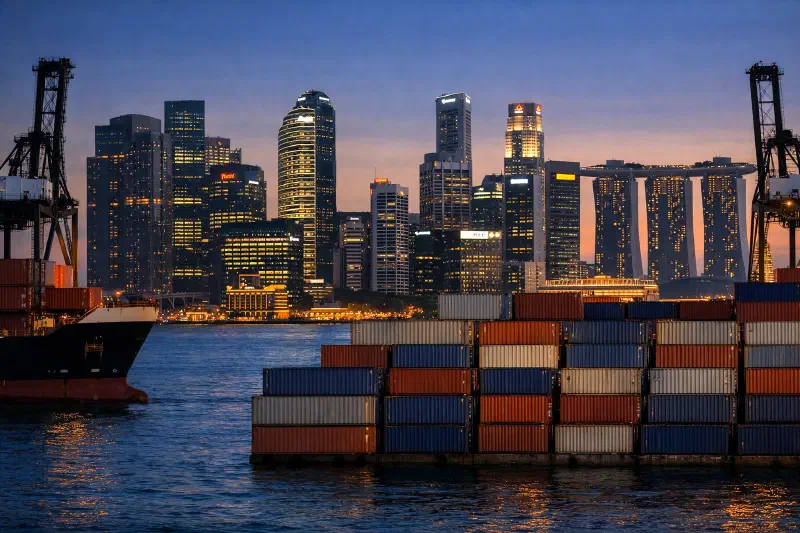
The structural argument: why Singapore captures this demand #
Two weeks ago, at the Association of Banks in Singapore annual dinner on June 25, Deputy Prime Minister Gan Kim Yong framed Singapore’s financial strategy with unusual directness: a more fragmented world needs trusted connectors (MAS, June 25, 2026). The numbers behind that framing are formidable. Singapore managed S$6.7 trillion in assets as of end-2025 — an 11% compound annual growth rate over three years. Singapore is Asia’s largest foreign exchange hub and the world’s third largest. Its financial sector contributes 14% of GDP and employs more than 200,000 people. Net inflows from international sources are substantial and sustained.
What those numbers describe is not scale for its own sake. They describe depth — the liquidity depth, regulatory premium, and counterparty credibility that make Singapore’s banks the natural home for the most complex cross-border trade finance instruments in the region. When a Vietnamese electronics manufacturer needs a letter of credit to cover a $30 million shipment rerouted around a congested Port Klang, or when a Thai food processor needs a supply chain finance facility to bridge a 75-day payment gap while freight surcharges eat into its gross margin, those transactions want Singapore on the other side.
The Q3 freight pressure Miguel Santos documented last week is the demand trigger for exactly that kind of financing. Rising freight rates extend payment cycles, increase inventory financing costs, and force exporters to hold more working capital against each unit of shipment. Singapore’s banks are built to absorb that demand at scale.
The $2.5 trillion opportunity — and its uncomfortable truth #
The global demand for trade finance was already structurally undersupplied before Q3 added pressure. ADB’s 9th Global Trade Finance Gap Survey, published in January 2026, estimated the global trade finance gap at $2.5 trillion — about 10% of global trade value, representing unmet demand that prevents businesses from capturing trade opportunities they would otherwise pursue (ADB, January 15, 2026). Eighty percent of banks polled expected that demand to rise further as companies reconfigure supply chains, diversify trade partners, and deepen intra-regional flows.
The uncomfortable truth embedded in that survey is that the gap did not close between 2023 and 2025 despite years of multilateral intervention, fintech innovation, and Singapore’s own financial-sector expansion. The gap persists because it is concentrated in the segment that is hardest to serve efficiently: SME borrowers in developing markets with thin credit histories and complex cross-border documentation requirements. ADB’s Trade and Supply Chain Finance Program has delivered $5.7 billion in supported transactions in 2025 alone — but even that scale is a partial offset against a $2.5 trillion shortfall.
ADB’s crisis response in June added context to where the pressure is sharpest right now. When Middle East conflict disruptions accelerated import stress across Asia, ADB mobilised $4 billion in crisis financing, including $1 billion specifically in trade finance for energy and food imports. Since March 1, ADB’s programme delivered $673 million for oil and gas and $390 million for food security transactions across nine countries (ADB, June 12, 2026). That is emergency liquidity — welcome, but not structural. Structural supply chain finance flows through commercial banking systems, and in ASEAN, those systems route through Singapore.
Banks moving up the risk curve — and what that signals #
The most revealing development in Singapore’s trade finance story in the past two weeks is not a policy announcement. It is a set of capital management decisions that collectively signal how Singapore’s banks are preparing for higher Q3 demand.
On June 30, DBS completed the first significant risk transfer (SRT) by a Singapore bank — referencing a US$1 billion portfolio of corporate loans (The Business Times, June 30, 2026). Under an SRT, the bank transfers a defined portion of credit risk to third-party investors without selling the underlying loans, freeing up regulatory capital that can be redeployed toward new lending. DBS group corporate treasurer Philip Fernandez described the deal as strengthening the bank’s ability to “prudently capture opportunities as we scale our franchise.” The bank’s CET1 ratio stood at a comfortable 16.9% at end-March — this was not a distressed capital move. It was strategic pre-positioning.
Standard Chartered had already done something similar in 2025 — an SRT linked specifically to US$1.5 billion of trade finance loans from its Singapore subsidiary, claiming capital relief while keeping the trade finance book intact. HSBC is now in preliminary discussions on an Asia-Pacific SRT linked to loans across Hong Kong, Singapore, India, and Australia, with the transaction expected later this year (The Business Times, July 3, 2026).
Read this cluster together. Three of the most active trade finance institutions in Asia are simultaneously using SRT structures to free up capital — and doing it ahead of Q3 peak demand, not in response to a balance sheet crisis. That is pre-positioning for a supply chain financing cycle they expect to be more demanding than what came before.
In the June 25 article on Singapore’s capital flows positioning, I argued that Singapore’s edge over other ASEAN financial centres is intermediation — the ability to take inbound capital flows and structure, price, and distribute them across regional credit needs. The SRT activity is the intermediation layer operating at its most sophisticated.
The technology advantage that compounds #
Singapore’s banking system is adding a second layer to its trade finance advantage that its ASEAN competitors cannot replicate at the same pace: AI and automation infrastructure applied directly to the trade finance workflow.
On June 9, HSBC completed a live proof-of-concept for B2B agentic commerce in Singapore — pairing a multinational corporate buyer with Singapore-based procurement platform SourceSage and supplier FortyTwo, using Mastercard Agent Pay for tokenised settlement (Fintech News Singapore, June 9, 2026). The pilot demonstrated how AI agents can manage supply chain purchasing and payment with compliance controls embedded at the point of action. HSBC’s Winnie Yap, Head of Global Payments Solutions in Singapore, noted directly that Singapore is where regional procurement and treasury centralisation creates the strongest demand for this kind of automation.
On July 3, MAS published the SAFR framework — Safeguards for Agentic Finance at Runtime — developed with institutions including Mastercard, Ant International, Visa, Circle, OCBC, and Bank of Singapore (Fintech News Singapore, July 3, 2026). SAFR creates a governance layer for AI agents that act autonomously in financial systems: payment initiation, credit approval, regulatory reporting. It is not yet mandatory, but its development under MAS’s BuildFin.ai initiative signals where Singapore’s regulatory environment is heading — toward enabling AI-driven finance at scale, with guardrails transparent enough that global counterparties will trust them.
For trade finance specifically, this matters because trade finance is one of the last high-volume financial services still running substantially on paper documentation and manual KYC processes. The platforms and jurisdictions that automate first will process more transactions at lower unit cost and higher speed. That is the direction of travel in Singapore’s banking infrastructure. As I noted in the June 1 growth momentum analysis, the AI compounding loop in Singapore’s banking system — where infrastructure investment feeds financial productivity, which deepens capital flows — is designed, not accidental.
The constraint Singapore has to solve #
Singapore’s trade finance positioning is not without challenge. Hong Kong’s assets under management reached a record US$5.38 trillion as of end-2025, and the HKMA is actively pushing banks to grow yuan-denominated business as China-ASEAN trade volumes rise (The Business Times, July 2, 2026). That yuan push targets trade corridor flows — energy, commodities, manufactured goods — that Singapore’s banks currently handle in significant volume. DBS’s strategic MOU with Bank of China on cross-border RMB trade finance, signed in March, is a direct response to that competitive dynamic.
The deeper constraint is structural and less frequently discussed. The ADB data shows SME trade finance rejection rates (41%) are still nearly identical to those for large and mid-cap corporates (40%). The trade finance gap lives in the SME segment — smaller ASEAN exporters with thinner credit histories, frontier market counterparties, and documentation complexity that requires manual underwriting effort per transaction. Singapore’s banks are world-class at pricing large-cap and corporate-grade trade finance. The technology tools now in deployment — agentic commerce, SAFR-governed credit automation, MAS’s BLOOM programmable settlement pilot — are the instruments that might eventually extend Singapore’s reach into SME trade finance at scale.
But “might eventually” is where the story currently stops. Those tools are at proof-of-concept stage, not deployed at the volume needed to meaningfully narrow a $2.5 trillion gap. Singapore’s macro case for trade finance hub status is strong. Its execution case for SME reach is still being built.
What comes next #
When Q3 freight costs spike in ASEAN, the first call is usually to a Singapore bank. The geography is partly historical — Singapore sits at the intersection of the sea lanes, capital flows, and regulatory premium that cross-border trade finance requires. What 2026 is demonstrating is that Singapore is not coasting on history. The SRT deals, the AI pilots, the SAFR framework, and the announced Future of Finance Institute are all signals that its banking system is actively retooling for a higher-volume, more complex trade finance environment.
The test in the second half of the year is whether that retooling extends down the credit stack — from the large-cap deals that define Singapore’s current positioning to the SME transactions that define the size of ASEAN’s actual financing need. Singapore’s banks have the capital, the infrastructure, and increasingly the technology to address that need. The question is whether the commercial model, the risk appetite, and the automation scale can converge fast enough to matter before the $2.5 trillion gap finds other solutions.
As this week’s SEA Weekly framing made clear, ASEAN supply chain signals are now the leading indicators for H2 growth. Singapore’s trade finance position is one of the clearest read-throughs from logistics stress to financial system performance. Watch the credit flow data as Q3 peaks — it will say more about Singapore’s competitive position than any policy speech.
References #
- Monetary Authority of Singapore (June 25, 2026). “Singapore as a Trusted Connector in a Changing World.” https://www.mas.gov.sg/news/speeches/2026/singapore-as-a-trusted-connector-in-a-changing-world (Accessed July 6, 2026)
- Asian Development Bank (January 15, 2026). “Demand for Trade Finance to Rise Amid Supply Chain Realignment—ADB Report.” https://www.adb.org/news/demand-trade-finance-rise-amid-supply-chain-realignment-adb-report (Accessed July 6, 2026)
- Asian Development Bank (June 12, 2026). “ADB Delivers Rapid Support as Middle East Impact Spreads.” https://www.adb.org/news/adb-delivers-rapid-support-middle-east-impact-spreads (Accessed July 6, 2026)
- The Business Times (June 30, 2026). “DBS completes US$1 billion significant risk transfer deal, a first for Singapore bank.” https://www.businesstimes.com.sg/companies-markets/dbs-completes-us1-billion-significant-risk-transfer-deal-first-singapore-bank (Accessed July 6, 2026)
- The Business Times (July 3, 2026). “HSBC, Standard Chartered weigh significant risk transfers as Asia-linked deals ramp up.” https://www.businesstimes.com.sg/companies-markets/banking-finance/hsbc-standard-chartered-weigh-significant-risk-transfers-asia-linked-deals-ramp (Accessed July 6, 2026)
- Fintech News Singapore (June 9, 2026). “HSBC Pilots B2B Agentic Payments in Singapore with Mastercard.” https://fintechnews.sg/132801/ai/hsbc-agentic-payments/ (Accessed July 6, 2026)
- Fintech News Singapore (July 3, 2026). “MAS and Industry Partners Set Guardrails for AI Agents With SAFR Framework.” https://fintechnews.sg/133965/ai/mas-agentic-ai/ (Accessed July 6, 2026)
- The Business Times (July 2, 2026). “Hong Kong’s assets under management grow to record US$5.38 trillion: survey.” https://www.businesstimes.com.sg/international/global/hong-kongs-assets-under-management-grow-record-us5-38-trillion-survey (Accessed July 6, 2026)
- Asian Development Bank. “Trade and Supply Chain Finance Program (TSCFP).” https://www.adb.org/what-we-do/trade-supply-chain-finance-program (Accessed July 6, 2026)