
Delta Electronics (Thailand) is now worth more than the next four-largest Thai stocks combined. That is not a tourism yield story or a domestic consumption story. It is an AI infrastructure story, and it is the clearest signal of how the ASEAN H2 repricing has actually played out.
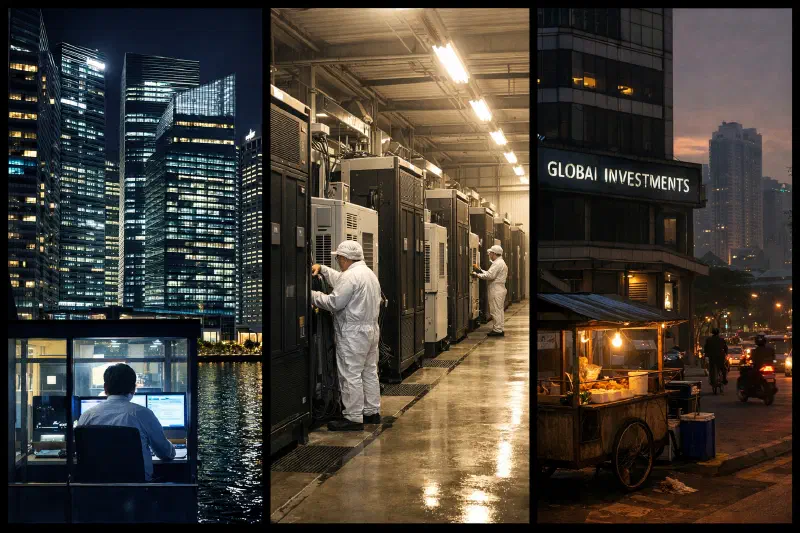
The maker of power management systems for data centres has surged more than 80% this year, crossed US$100 billion in market capitalisation — Thailand’s first — and now accounts for roughly 20% of the Stock Exchange of Thailand Index, double its weighting in June 2025 (The Business Times, June 25, 2026). It sits as the second-most valuable company in the MSCI ASEAN Index, behind DBS Group Holdings. Thailand’s benchmark index is up more than 20% in 2026 through this week — the best performance among Southeast Asian peers.
The consensus narrative for ASEAN H2 going into June was about which export economies would recover fastest, which central banks would cut rates, and whether regional tourism yield would hold. Those are real questions. But the market has spent this week answering a different one: which ASEAN economies have built the institutional or infrastructural foundations that capital is willing to bet on through the second half of the year?
The answers are cleaner than they were three months ago.
Three Tiers, Settling #
The capital allocation map that I first sketched in SEA Weekly on June 6 — when I argued that ASEAN capital was rotating toward markets that could absorb volatility while still converting capital into output — has hardened into actual market performance numbers this week.
At the top: Singapore and Thailand (for different reasons). In the ascending middle: Vietnam. Under systematic discount: Indonesia.
Singapore’s repricing is institutional in character. On June 26, MAS announced the Future of Finance Institute — a coordinating body to move AI and tokenisation projects from pilots to live deployment across institutions (Fintech News Singapore, June 26, 2026). The Institute builds on MindForge, PathFin.ai, Project Guardian, and Project Orchid — Singapore’s existing AI and programmable money frameworks — and will provide industry sandboxes for testing agentic AI, programmable compliance, and tokenised asset workflows. This is not research theatre. It is Singapore compressing the distance between regulatory frameworks and operational deployment, which is exactly what it has done with cross-border payments, FX clearing, and wealth management infrastructure over the past decade.
The same week, Airwallex raised US$320 million in a Series H round at a US$11 billion valuation — up from US$8 billion in December 2025 — with US$1.3 billion in annualised revenue and US$287 billion in annualised transaction volume (Fintech News Singapore, June 25, 2026). JPMorgan promoted Kelvin Goh and Alfons Halim to jointly lead its Southeast Asia investment banking operations, doubling its regional coverage structure (Fintech News Singapore, June 25, 2026). Singapore’s FAST-P energy transition fund closed its first raise at US$250 million for Asia infrastructure projects (Fintech News Singapore, June 25, 2026). Each of these is a small headline. Together, they describe the same thing: Singapore is deepening its financial infrastructure at every layer simultaneously, and institutional capital is treating this as a durable premium, not a cycle-dependent one.
As I argued in Thursday’s analysis on Brunei and Singapore with Daniel Lim, Singapore’s AUM reached S$6.07 trillion in 2024, up 12% year on year, with net inflows rebounding 50% from 2023. The city-state is selling intermediation velocity — and the velocity is accelerating.
Thailand’s Unexpected Angle #
Thailand’s repricing is more interesting, because it was less predicted.
Delta Electronics is a Thai manufacturer that makes power systems for servers and AI data centres. It has been doing this for years. What changed in 2026 is that the data centre investment supercycle — Microsoft’s US$1 billion Thailand investment, Bain Capital’s Bridge Data Centres seeking up to US$6 billion for Thailand expansion, Bridge’s pipeline of domestic data centre projects — created a direct demand link between global AI infrastructure spending and Thai industrial output. Bloomberg Intelligence Strategist Sufianti put it clearly: “Thailand isn’t a pure AI market, but its exposure to data centres, electronics, power systems and digital infrastructure gives investors a new way to view Thai equities beyond the traditional tourism, banks and domestic consumption cycle.”
That new view is being priced. The catch is concentration: Delta alone is 20% of the SET index. Thailand’s AI repricing is a single-stock phenomenon so far, and the rest of the industrial electronics sector — Cal-Comp, KCE Electronics, Hana Microelectronics — remains far smaller. What this week’s equity performance establishes is a proof of concept. Whether the rest of Thailand’s industrial base can broaden this AI-adjacent premium into H2 is the next question.
The tourism and pricing power narrative from Monday’s analysis on Thailand and the Philippines adds a second, different kind of repricing signal: Thailand raised international airport passenger service charges 50% on June 20, and demand held. Two repricing stories, two different asset classes, one country. The common denominator is leverage — the ability to extract more from the same base because demand does not have an alternative.
Indonesia’s MSCI Moment #
The most important capital market event of this week did not receive the attention it warranted.
On June 24, MSCI completed its annual market classification review and kept Indonesia at emerging market status — but added that the country “remains under evaluation,” with a potential downgrade to frontier status if information-flow reforms do not gain traction before the November review (The Business Times, June 24, 2026). MSCI had already flagged in June 19 analysis that Indonesia’s information flow criterion was under negative review, citing limited shareholding visibility and evidence of coordinated trading behaviour. A downgrade to frontier would force approximately US$13 billion in outflows — the Jakarta Composite Index is already down nearly 30% in 2026.
What is striking about MSCI’s complaint is its specific target. The issue is not that Indonesia’s economy is weak — it is growing, commodities are strategically significant, Danantara’s debt issuance this week was oversubscribed. The issue is that the information infrastructure of Indonesia’s capital markets — transparent ownership registries, auditable settlement records, clear free-float data — has not kept pace with the size of the market it is supposed to represent. This is the same family of governance-infrastructure problem I identified in the June 20 SEA Weekly when assessing Indonesia’s fintech divergence: when you cannot verify who owns what, you cannot price the risk.
The reported US$2 billion cut to Prabowo’s signature free meals programme — if confirmed — is a second governance signal, and a more ambiguous one (The Business Times, June 25, 2026). Fiscal adjustment is positive in isolation. But adjustment driven by fiscal distress rather than fiscal confidence produces different market readings. The JCI at -30% is telling you which reading the market has adopted.
Vietnam’s divergence from Indonesia this week is stark. The VN-Index is up approximately 5% in 2026 while Jakarta has lost a third of its value. MoMo, Vietnam’s leading digital payments firm, is drawing serious investor interest in a potential 50% stake sale from US-based and Asia-based private equity (Fintech News Singapore, June 22, 2026). Vietnam’s MSCI upgrade trajectory — a multi-year process, not a single event — is in motion; its November review will likely be a watch-and-improve outcome. As I showed in Friday’s deep dive on Malaysia and Vietnam’s electronics supply chain competition, Vietnam is simultaneously executing on manufacturing FDI absorption while closing the fintech infrastructure gap. Both layers are moving in the right direction.
Malaysia’s Two-Speed Signal #
Malaysia presents a different kind of puzzle this week. The ringgit sank to a seven-month low despite record bond inflows — a combination that initially looks contradictory (The Business Times, June 24, 2026). It is not. It is two separate pools of capital with different time horizons reading the same information differently.
Bond capital is institutional, long-duration, and fundamentals-driven: it sees Malaysia’s 4%–5% growth range, benign inflation, and fiscal credibility confirmed by the 2026 budget. That capital is buying Malaysian government bonds at record levels. Spot FX capital is shorter duration and rate-differential-driven: it sees Fed rate expectations staying elevated through Q3, which reduces the carry attractiveness of ringgit-denominated positions relative to dollar-denominated alternatives. Both pools are right in their own timeframe.
The practical consequence is that H2 FDI decisions involving ringgit-denominated cost structures — which includes most of the Malaysia electronics supply chain investment discussed in Friday’s article — face more execution uncertainty than Malaysia’s fundamental position would predict. This resolves as Fed rate clarity improves. The risk is that the temporal mismatch persists long enough to delay investment decisions that Malaysia needs to close before Vietnam locks them in first.
The Hormuz Variable #
The H2 tail risk that most strategies appear to be underpricing arrived on Friday: US strikes on Iranian targets in response to an attack on a cargo ship in the Strait of Hormuz (The Business Times, June 27, 2026). The Philippines foreign secretary’s comment this week that the Hormuz crisis was “sharpening” ASEAN’s push for a South China Sea code signals that the region is already connecting these geopolitical dots.
ASEAN’s energy import dependency is significant. Thailand’s recent airport fee increase and tourism pricing power are durable, but Thailand’s manufacturing competitiveness is exposed to energy cost pass-through if Hormuz shipping disruption persists. Indonesia’s energy-import stress — already a factor in Bank Indonesia’s 75 basis points of unscheduled rate hikes this year — worsens with any Hormuz risk premium on oil. The Philippines 2027 budget expansion announced this week (The Business Times, June 26, 2026) — 6% spending increase to 7.2 trillion pesos — was calibrated against current energy assumptions.
The energy transition investments Singapore finalised this week — FAST-P’s US$250 million first close and DBS’s US$210 million for ETAFCo — look less like ESG optics and more like strategic duration hedging when read against the Hormuz development. Singapore is positioning its financial capital for a world where Asia’s energy infrastructure cannot assume Gulf routes remain unconstrained through H2. The other ASEAN economies have no comparable hedge in place.
What the H2 Lock-In Actually Means #
The phrase “H2 strategies lock in” implies choice. What this week’s signals suggest is that for most ASEAN markets, strategy space is narrowing, not expanding.
Singapore’s H2 strategy — compound institutional depth, position AI and tokenisation infrastructure ahead of deployment demand, maintain premium capital flows — is locking in because it has been executed. The MAS Future of Finance Institute is the latest installation in a machine that has been running for years.
Thailand’s H2 strategy is locking in around AI infrastructure exposure and tourism pricing power — two separate bets that are both paying out, but only one (Delta Electronics) is genuinely structural.
Vietnam’s H2 strategy is locking in around MSCI credibility trajectory, fintech privatisation signals (MoMo), and electronics FDI competitiveness — three reinforcing themes that need to stay coordinated to sustain the upgrade narrative through November.
Indonesia’s H2 is not a strategy in the investment sense. It is a race against governance clocks — the MSCI November deadline, Danantara’s overdue financial report, the ongoing P2SK parliamentary oversight expansion — where the consequences of missing deadlines are no longer theoretical.
The capital that has been repricing ASEAN since the start of this year is finishing its rotation. The tiers are settling. The question for the second half is not who will be repriced — that is already known — but whether the markets that have been discounted have the institutional capacity to reverse their discount before the November windows close.
References #
- The Business Times (June 25, 2026). “Thailand emerges as South-east Asia’s surprise AI stock winner.” https://www.businesstimes.com.sg/international/asean/thailand-emerges-south-east-asias-surprise-ai-stock-winner (Accessed June 27, 2026)
- The Business Times (June 25, 2026). “Thai export growth slightly below forecast in May, shipments to China fall.” https://www.businesstimes.com.sg/international/asean/thai-export-growth-slightly-below-forecast-may-shipments-china-fall (Accessed June 27, 2026)
- The Business Times (June 24, 2026). “The quest for global capital: Vietnam eyes MSCI upgrade as Indonesia fights downgrade risk.” https://www.businesstimes.com.sg/international/asean/quest-global-capital-vietnam-eyes-msci-upgrade-indonesia-fights-downgrade-risk (Accessed June 27, 2026)
- The Business Times (June 25, 2026). “Indonesia weighing US$2 billion cut to Prabowo’s signature free meals programme: sources.” https://www.businesstimes.com.sg/international/asean/indonesia-weighing-us2-billion-cut-prabowos-signature-free-meals-programme-sources (Accessed June 27, 2026)
- The Business Times (June 24, 2026). “Ringgit sinks to seven-month low despite record bond inflows as Fed fears dominate.” https://www.businesstimes.com.sg/international/asean/ringgit-sinks-seven-month-low-despite-record-bond-inflows-fed-fears-dominate (Accessed June 27, 2026)
- The Business Times (June 25, 2026). “Malaysia’s Forest City family office push gains traction, but ecosystem gaps remain.” https://www.businesstimes.com.sg/international/asean/malaysias-forest-city-family-office-push-gains-traction-ecosystem-gaps-remain (Accessed June 27, 2026)
- The Business Times (June 26, 2026). “Philippines 2027 Budget to rise 6% to 7.2 trillion pesos.” https://www.businesstimes.com.sg/international/asean/philippines-2027-budget-rise-6-7-2-trillion-pesos (Accessed June 27, 2026)
- The Business Times (June 27, 2026). “US strikes Iran in response to attack on cargo ship in Strait of Hormuz.” https://www.businesstimes.com.sg/international/global/us-strikes-iran-response-attack-cargo-ship-strait-hormuz (Accessed June 27, 2026)
- Fintech News Singapore (June 26, 2026). “MAS Sets Up Future of Finance Institute to Move AI, Tokenisation Beyond Pilots.” https://fintechnews.sg/133708/ai/mas-future-of-finance-institute/ (Accessed June 27, 2026)
- Fintech News Singapore (June 25, 2026). “Airwallex Raises US$320M Series H at US$11B Valuation for AI Expansion.” https://fintechnews.sg/133619/funding/airwallex-series-h-funding-valuation/ (Accessed June 27, 2026)
- Fintech News Singapore (June 25, 2026). “JPMorgan Appoints Regional Co-Heads for Southeast Asia Investment Banking.” https://fintechnews.sg/133589/fintech/jpmorgan-southeast-asia-investment-banking-heads/ (Accessed June 27, 2026)
- Fintech News Singapore (June 25, 2026). “Singapore’s FAST-P Energy Transition Fund Raises US$250 Million for Asia Project.” https://fintechnews.sg/133572/green-fintech/fast-p-singapore/ (Accessed June 27, 2026)
- Fintech News Singapore (June 25, 2026). “DBS Backs Asia Energy Transition With US$210M Financing for ETAFCo.” https://fintechnews.sg/133608/funding/dbs-etafco-energy-transition-finance-singapore/ (Accessed June 27, 2026)
- Fintech News Singapore (June 22, 2026). “Vietnam’s MoMo Draws Investor Interest in Possible 50% Stake Sale.” https://fintechnews.sg/133407/payments/momo-stake-sale/ (Accessed June 27, 2026)
- SEA Weekly (June 6, 2026). “SEA Weekly: Why ASEAN Capital Flows Are Rotating Toward Selective Growth Stories.” https://seaweekly.com/posts/2026-06-06-sea-weekly-why-asean-capital-flows-are-rotating-toward-selective-growth-stories/
- SEA Weekly (June 20, 2026). “SEA Weekly: How ASEAN Fintech and Industry Signals Are Converging Into New Capital Flow Bets.” https://seaweekly.com/posts/2026-06-20-sea-weekly-asean-fintech-industry-signals-converging-capital-flow-bets/
- SEA Weekly (June 22, 2026). “How Thailand vs Philippines Tourism Yield Is Diverging in Airline-Hotel Pricing Power.” https://seaweekly.com/posts/2026-06-22-thailand-philippines-tourism-yield-airline-hotel-pricing-power/
- SEA Weekly (June 25, 2026). “Who is winning Brunei vs Singapore regional finance positioning for ASEAN capital flows?” https://seaweekly.com/posts/2026-06-25-brunei-singapore-regional-finance-positioning-asean-capital-flows/
- SEA Weekly (June 26, 2026). “How Malaysia industrial policy is competing with Vietnam for electronics supply chain upgrades.” https://seaweekly.com/posts/2026-06-26-malaysia-industrial-policy-vietnam-electronics-supply-chain-upgrades/