

SEA Weekly: Southeast Asia's Digital Economy and Industrial Landscape

A weekly audio series tracking the most significant developments in Southeast Asia's fintech, digital banking, AI governance, and technology ecosystem.

SEA Weekly: Southeast Asia's Digital Economy

SEA Weekly brings you an audio version of the SEA Weekly newsletter by Chloe Tan and Miguel Santos, analyzing the major events and developments reshaping Southeast Asia’s digital economy and industrial landscape each week.

Rather than surface-level recaps, these episodes dig into the underlying patterns: the infrastructure being built beneath consumer apps, the supply chains powering regional manufacturing, the regulatory frameworks governments are writing, and the flows of capital and FDI reshaping Southeast Asia.

Each episode connects this week’s news to bigger strategic questions: How is the fintech ecosystem maturing? What does industrial policy mean for the next decade of growth? Who controls the platforms and corridors billions of Southeast Asians rely on?

The audience is professional, analytical, and skeptical of hype. Expect insight over recap, specificity over generalization, and forward-looking analysis from two distinct vantage points: the Singapore-based fintech lens and the Jakarta-based industrial researcher perspective.

Available on Spotify, Apple Podcast, and LinkedIn

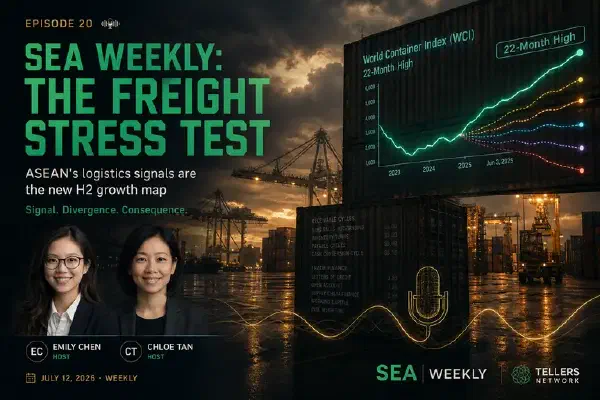
Episode 20: Why ASEAN Logistics and Freight Signals Are Emerging as the New Leading Indicators for H2 Growth

The Drewry World Container Index hit four thousand six hundred and thirty-nine US dollars per forty-foot container on July 9 — the highest since September 2024. Two days earlier, the ADB lowered its 2026 growth forecast for developing Asia to four-point-nine percent. Chloe Tan joins Emily Chen to work through why those two numbers are measuring the same economy, but one arrived weeks ahead of the other — and why the freight signal, not the GDP revision, is the more useful H2 guide.
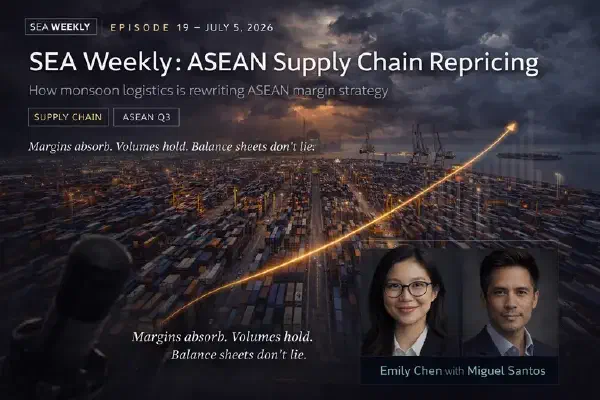
Episode 19: How ASEAN Supply Chain Repricing Is Reshaping Q3 Trade and Cost Expectations

ASEAN supply chains are entering Q3 with freight at a 22-month high and still accelerating — but the damage will show up in corporate margins and balance sheets weeks before export volumes confirm it. Miguel Santos joins Emily Chen to work through the week’s five articles: why the absorb-not-cancel dynamic makes trade data an unreliable early indicator, why Indonesia’s manufacturing contraction is structurally distinct from a regional demand slowdown, and why Vietnam’s import surge is more constructive than it looks.

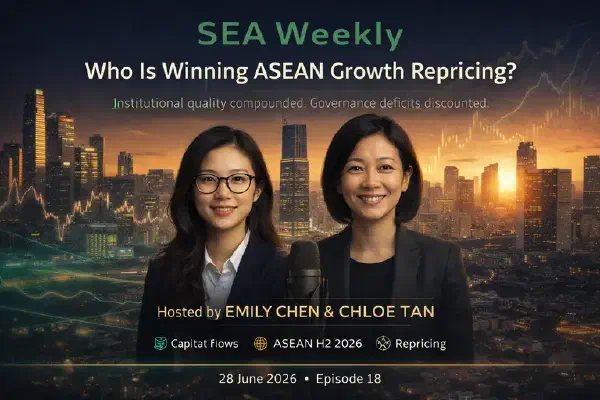
Episode 18: Who Is Winning ASEAN Growth Repricing as H2 Strategies Lock In?

Three simultaneous repricing events settled ASEAN’s H2 capital map this week. Chloe Tan joins Emily Chen to work through what the market was actually saying: Thailand’s Delta Electronics became ASEAN’s first US$100 billion company on the back of AI data centre infrastructure; Indonesia’s MSCI “remains under evaluation” verdict put a November deadline on governance reforms and a potential US$13 billion forced outflow on the table; Singapore compounded further still with the MAS Future of Finance Institute and Airwallex’s Series H. Then Friday closed with US strikes on Iranian targets in the Strait of Hormuz — a tail risk none of the strategies locking in this week are pricing. The H2 repricing competition, Chloe argues, was won on institutional quality, not growth rate.

Episode 17: How ASEAN Fintech and Industry Signals Are Converging into New Capital Flow Bets

The ASEAN capital allocation question in H2 2026 isn’t which markets are growing — it’s which markets have built the fintech-industry integration that lets institutional money deploy, monitor, and exit on terms it can underwrite. Chloe Tan joins Emily Chen to map the convergence: Singapore’s gold clearing system and OCBC’s ESG lending filter signal a financial infrastructure positioning ahead of capital need; Vietnam’s AWS Hanoi Local Zone and IFC bank lending confirm the fintech layer following manufacturing FDI. Indonesia, despite controlling roughly half of global nickel reserves, is failing the three-layer test. The gap between tiers is widening.

Episode 16: What's Driving ASEAN Supply Chain Risk Repricing Across Frontier Markets

The best supply chain news ASEAN frontier markets have had all year landed on Friday night — a US-Iran peace deal that could unwind the Strait of Hormuz risk premium. But the peace deal only fixes the cost of moving goods — not the cost of operating inside the region. Governance risk is now repricing upward on its own axis, and the two vectors don’t cancel. For anyone sourcing from, lending to, or investing in ASEAN’s frontier markets, the era of single-variable risk models is over.

Episode 15: Why ASEAN Capital Flows Are Rotating Toward Selective Growth Stories

ASEAN has not run out of capital, but it has run out of patience for undifferentiated stories. This week, Singapore posted 6% YoY growth driven by AI-linked manufacturing, while Vietnam’s manufacturing PMI rebounded to 52.8. At the same time, Thailand recorded a US$7.6 billion current-account deficit and Indonesia intervened to defend the rupiah. The key shift: investors are now rewarding markets and sectors that can convert capital into throughput while absorbing macro shocks, and the “ASEAN recovery” label is increasingly misleading.

Episode 14: The Balance Sheet Is the Story

Indonesia intervened to support the rupiah, Thailand posted a US$7.6 billion current-account deficit for April, and Singapore commodity traders described active rerouting decisions driven by Middle East disruptions — all in the same 48-hour window. Meanwhile, Vietnam expanded its industrial park network to 26 sites, entered the global top 10 for steel production, and secured Gulf energy investment on technology-transfer terms. Growth is the headline, but balance-sheet depth is the story. Who can absorb FX pressure, working-capital stress, and logistics disruption while still compounding capability?

Episode 13: The Cost-of-Carry Premium

Southeast Asia’s headline growth data still looks strong, but this week’s operating evidence points to a tougher regional constraint: who can finance volatility without pausing investment. Thailand’s airlines are seeing jet fuel rise to about 60% of operating costs, Vietnam’s exports are surging but still concentrated in foreign-invested firms, and venture capital is available mostly for a shrinking group of outliers. The moat is shifting from growth stories to carry capacity — the institutions that can absorb energy shocks, compliance costs, and capital-market tightening while still investing will take disproportionate share.

Episode 12: Capital Without Capture

Vietnam’s US$18.7 billion FDI surge, Thailand’s first licensed virtual bank, and the Philippines’ emergency energy intervention all point to the same harder regional problem: Southeast Asia can attract capital faster than it can localise resilience. The next bottleneck is not capital formation but domestic absorption — supplier depth, underwriting edge, energy security, and the ability to keep more of the margin at home once volatility hits. Listen to the podcast on:

Episode 11: The Corridor and the Cap

Indonesia’s 8% ride-hailing commission cap, one week on, has produced a governance picture most coverage missed: Danantara’s shareholding in Gojek is confirmed, golden-share language remains active in Grab-GoTo merger talks, and an entity controlling roughly 90% of Indonesia’s ride-hailing market is being structured with state veto rights. The same week, Indonesia and the Philippines signed a nickel corridor MoU covering 73.6% of global production. These are not isolated sector stories — they are structurally isomorphic instruments of the same regional shift.