
The easiest cross-border money in ASEAN right now is moving with tourists, not containers.
On July 16, RHB said merchants on its DuitNow QR network could accept payments from six Asian markets. One week later, Fiuu said it could process JCB card transactions directly in Malaysia, Singapore, and the Philippines. In the same month, the Asian Development Bank was still mobilizing $621 million from 29 commercial banks just to widen HDBank’s capacity to lend to Vietnamese MSMEs. Same region. Same quarter. Completely different capital physics.

The divergence matters because Q3’s demand mix is changing. July’s freight and commodity story has not disappeared, but the incremental growth narrative is rotating toward travel, hospitality, domestic mobility, and other service lines that can monetize consumer spending without tying up large balance sheets. Payment rails benefit from that shift. Logistics finance does not. It still has to fund inventory, receivables, fuel exposure, and the long cash-conversion cycle between factory gate and final payment.
The services-side rails are getting lighter and faster #
My June 6 analysis of ASEAN cross-border QR infrastructure argued that the real story was not adoption but plumbing. That plumbing now has a friendlier demand cycle to run through it.
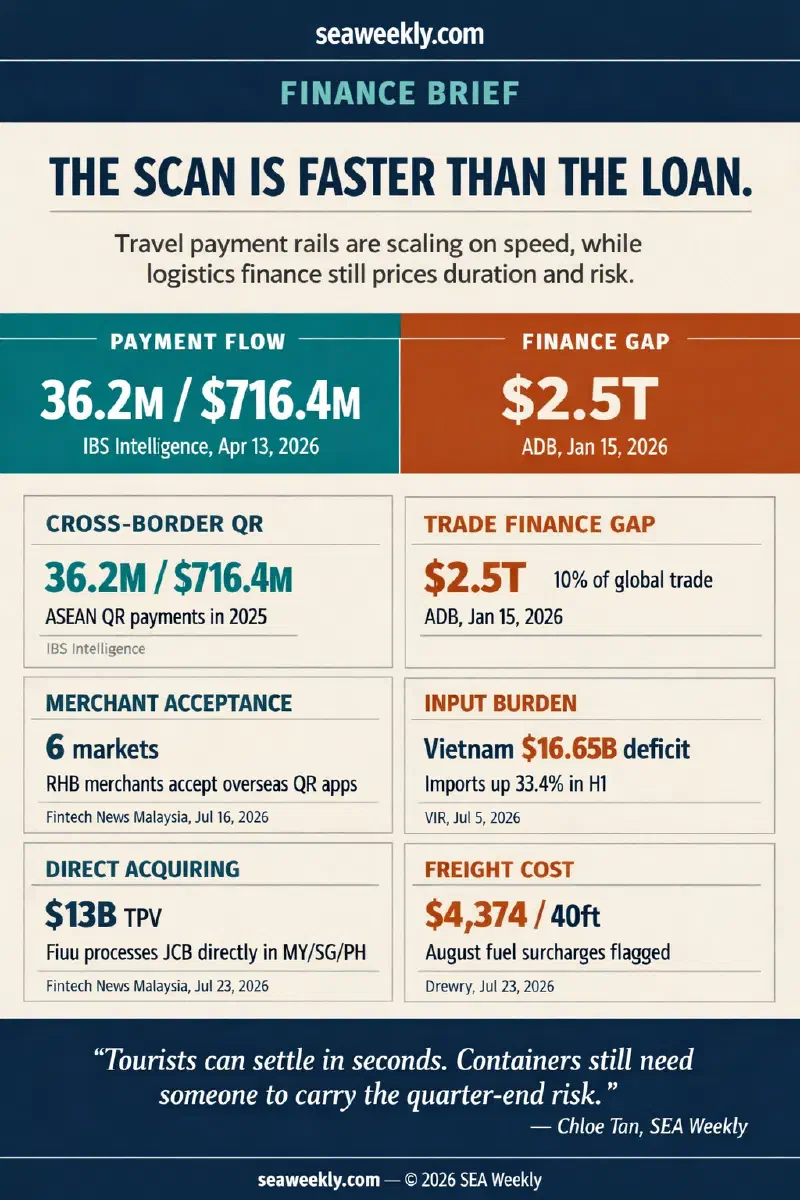
The authoritative data point remains the joint ASEAN ministers and central bank governors’ statement reported by IBS Intelligence on April 13: ASEAN cross-border QR payments reached 36.2 million transactions worth $716.4 million in 2025, including 1.6 million person-to-person transfers worth $305.7 million. Bernama reported on November 19, 2025 that the network had already processed 12.9 million transactions in the first half of 2025 alone, which implies a sharp acceleration in the back half of the year.
The infrastructure ceiling is also rising. The Asian Banker reported that Project Nexus, backed by MAS, BNM, the Bank of Thailand, BSP, and the Reserve Bank of India, is targeting live implementation in 2026 with sub-60-second settlement and a first-wave addressable market of 1.7 billion people. That is not a tourism gimmick. It is an operating system for small-value, cross-border payments that removes the bilateral-link bottleneck which used to slow corridor expansion.
What changed in July is that merchant monetization caught up with the infrastructure story.
RHB’s July 16 expansion allows merchants using DuitNow QR to accept payments from participating apps and e-wallets in China, Singapore, Indonesia, Cambodia, Thailand, and South Korea. PayNet’s framing was direct: as Visit Malaysia 2026 builds cross-border spending, wider QR acceptance gives local merchants a simpler way to capture it. One week later, Fiuu said on July 23 that it had secured a direct JCB acquiring licence in Malaysia, Singapore, and the Philippines. Fiuu processed $13 billion in payment volume in the 2025 financial year; direct scheme connectivity gives it greater control over settlement, merchant support, and acceptance economics across both digital and physical channels.
This is what travel payments look like when they move from novelty to infrastructure. The value is not only in the transaction fee. It is in owning the merchant relationship, controlling settlement, and using the payment flow to sell adjacent services.
TNG eWallet’s June 4 disclosure is the clearest regional example. More than half of its revenue now comes from businesses beyond payments, and cross-border, remittance, and international services account for 10% of total revenue after contributing almost nothing a few years ago. That is the services-era payment model in one sentence: payments attract the user, but travel, remittance, merchant services, and financial cross-sell monetize the relationship.
The demand rotation is visible in the travel data #
Travel demand is not universally booming. It is becoming more selective, more yield-sensitive, and more valuable precisely in the corridors where modern payments infrastructure already exists.
Thailand’s tourism authority said on June 10 that the country had already welcomed more than 14 million international visitors as of June 2, generating around THB 679 billion in tourism revenue, while explicitly pushing a value-over-volume strategy for the rest of the year. That is a useful signal for a finance brief. It means the services rotation is not only about headcount. It is about spend quality.
OAG’s July 2026 Southeast Asia aviation briefing shows the same pattern in airline capacity. Total regional seats are down 1.2% year on year to 50.4 million, and within-Southeast-Asia capacity is down 2.8% to 6.5 million seats. But mainline carriers are up 5.0% while low-cost carriers are down 8.1%, and capacity to Europe and North America is still growing at 10.7% and 11.5% respectively. In other words, the surviving travel flows are the ones with better yields, better connectivity, and stronger monetization.
The Philippines offers a second, messier version of the same story. BusinessMirror reported on July 20 that inbound arrivals reached 3.16 million in the first half of 2026, up 5.41% year on year, with China up 64.54% and India up 43.03%. The Inquirer reported on July 16 that Cebu Pacific carried 14.5 million passengers in the first half, with June domestic seat capacity up 17.7% while international capacity fell 18.5%. This is not a broad travel boom. It is a prioritization story. Carriers are keeping the routes that still turn demand into cash, and payments firms are building acceptance where those travelers actually spend.
That combination makes travel payments a lighter business than logistics finance even before margin is discussed. The payment provider does not need to finance hotel inventory, carry a 90-day receivable, or warehouse imported inputs. It sits in the spending flow, settles quickly, and monetizes adjacent services around it.
Logistics financing is still paying for duration #
Now compare that with the goods side.
ADB’s January 15 trade finance survey release estimated the global trade finance gap at $2.5 trillion in 2025, unchanged from 2023 and still equal to about 10% of global trade. Eighty percent of banks said demand for trade finance would rise as companies diversify supply chains and deepen intra-regional trade. The striking detail is the one I highlighted in my July 8 finance brief on trade-finance tightening: SME rejection rates for trade finance applications were 41%, almost identical to the 40% rate for large and mid-cap corporates. The gap is not gone. It is broadening upward.
Nor is the public sector treating this as a solved market. On June 12, ADB said it was deploying $4 billion in financing to help economies absorb the Middle East conflict shock, including about $1 billion in trade finance for energy and food imports. Since March 1, ADB’s Trade and Supply Chain Finance Program had already delivered $673 million for oil and gas imports and $390 million for food security across nine countries. That is emergency balance-sheet support, not frictionless financial infrastructure.
The Vietnam example shows why. Vietnam Investment Review reported on July 5 that the country ran a $16.65 billion trade deficit in the first half of 2026, versus a $7.95 billion surplus a year earlier, with imports up 33.4% because firms were bringing in raw materials, machinery, and intermediate goods for production. That sounds like industrial confidence, and in one sense it is. It is also a financing problem. Those inputs are paid for before they turn into export revenue.
ADB’s July 7 HDBank transaction is the clearest proof. ADB supplied $100 million and mobilized another $621 million from 29 banks so HDBank could extend more credit to MSMEs. Vietnam’s MSMEs account for more than 97% of registered firms, about 36% of total employment, and 40% of GDP, yet they still require a multilateral-backed structure of that size to widen access to funding. Travel payments do not need a 29-bank syndicate every time a tourist scans a QR code in Penang.
Indonesia tells a related story from the energy side. The Jakarta Post reported on July 1 that May posted a $1.61 billion trade deficit as oil and gas imports surged 71% year on year to $4.51 billion. The same paper reported on June 7 that overall bank credit growth was running at 9.98% year on year in April, but MSME lending had only just crawled back into positive territory at 0.16%. Aggregate banking liquidity exists. The logistics-linked firms that actually need working-capital support still do not access it cleanly.
Even freight-rate easing does not change the underlying capital burden. Drewry’s July 23 World Container Index fell 4% week on week to $4,374 per 40-foot container, but carriers were simultaneously flagging emergency fuel surcharges for August because of continuing Strait of Hormuz concerns. Lower than the July peak is not the same thing as cheap. More important, lower freight rates do not eliminate the need to finance inventory already in the system.
What the divergence means for H2 #
The financial distinction is simple.
Travel payments monetize velocity. Logistics financing monetizes duration.
When demand rotates toward services, the velocity business gets easier. A tourist arrives, taps or scans, and the merchant can be settled quickly through a rail that is increasingly interoperable, increasingly local-currency, and increasingly surrounded by higher-margin services. The financier behind containerized trade, by contrast, still has to hold risk across time: shipment lag, payment terms, fuel volatility, buyer quality, collateral, and the possibility that the final demand environment weakens before the receivable matures.
This is why the late-July divergence is not just a fintech curiosity. It is a capital-allocation signal. The cleaner earnings path in ASEAN finance over the next two quarters is likely to sit with merchant acquiring, QR acceptance, direct scheme connectivity, and consumer-facing ecosystem services. The harder but more economically essential work remains in invoice finance, supply-chain credit, and the unglamorous last-mile lending that keeps goods moving.
That should make readers slightly uncomfortable. The service economy can already travel on modern rails. The goods economy still needs someone to absorb the month-end risk.
For Q4, I would watch three things. First, whether Project Nexus and bilateral QR acceptance continue widening merchant reach faster than travel demand normalizes. Second, whether firms like TNG, RHB, and Fiuu show that cross-border travel spend is becoming a meaningful earnings contributor rather than a feature-layer add-on. Third, whether trade-finance stress actually recedes in the data: ADB program usage, HDBank’s MSME on-lending, Indonesia’s MSME credit growth, and the pace at which Vietnam converts imported inputs into export cash flow.
ASEAN is not short of payment innovation. It is short of cheap duration. Tourists can now settle in seconds. Containers still need someone to carry the risk until quarter-end.
Have a question or ground report on how travel spending or working-capital pressure is changing in your market? I would like to hear from you.
Email me at editorial@seaweekly.com
References #
- Asian Development Bank (January 15, 2026). “Demand for Trade Finance to Rise Amid Supply Chain Realignment—ADB Report.” https://www.adb.org/news/demand-trade-finance-rise-amid-supply-chain-realignment-adb-report (Accessed July 28, 2026)
- Asian Development Bank (June 12, 2026). “ADB Delivers Rapid Support as Middle East Impact Spreads.” https://www.adb.org/news/adb-delivers-rapid-support-middle-east-impact-spreads (Accessed July 28, 2026)
- Asian Development Bank (July 7, 2026). “ADB, HDBank Sign $100 Million Loan to Expand Access to Finance for MSMEs, Women-Owned Businesses in Viet Nam.” https://www.adb.org/news/adb-hdbank-sign-100-million-loan-expand-access-finance-msmes-women-owned-businesses-viet-nam (Accessed July 28, 2026)
- Bernama (November 19, 2025). “ASEAN Cross-border QR Payment Surges To 12.9 Million Transactions In 1H 2025 – BNM Governor.” https://asean.bernama.com/news.php?id=2492530 (Accessed July 28, 2026)
- BusinessMirror (July 20, 2026). “PHL visitor arrivals near 3.2M in 1H on China, India surge.” https://businessmirror.com.ph/2026/07/20/phl-visitor-arrivals-near-3-2m-in-1h-on-china-india-surge/ (Accessed July 28, 2026)
- Drewry (July 23, 2026). “World Container Index.” https://www.drewry.co.uk/supply-chain-advisors/supply-chain-expertise/world-container-index-assessed-by-drewry (Accessed July 28, 2026)
- Fintech News Malaysia (June 4, 2026). “TNG eWallet Refreshes Homepage as Revenue Shifts Beyond Just Payments.” https://fintechnews.my/58879/e-wallets-malaysia/tng-ewallet-revenue/ (Accessed July 28, 2026)
- Fintech News Malaysia (July 16, 2026). “RHB Merchants Can Now Accept QR Payments From Six Asian Markets.” https://fintechnews.my/59614/payments-remittance-malaysia/rhb-cross-border-qr-payments/ (Accessed July 28, 2026)
- Fintech News Malaysia (July 23, 2026). “Fiuu Secures JCB Direct Acquiring Licence in Three ASEAN Markets.” https://fintechnews.my/59744/payments-remittance-malaysia/fiuu-jcb/ (Accessed July 28, 2026)
- IBS Intelligence (April 13, 2026). “ASEAN cross-border QR payments hit $716.4m.” https://ibsintelligence.com/ibsi-news/cross-border-qr-payments-hit-716-4m-in-asean/ (Accessed July 28, 2026)
- OAG (July 2026). “Southeast Asia aviation market briefing.” https://www.oag.com/south-east-asia-aviation-flight-data (Accessed July 28, 2026)
- Philippine Daily Inquirer (July 16, 2026). “Cebu Pacific rebounds in June; H1 traffic hit 14.5M.” https://business.inquirer.net/600604/cebu-pacific-rebounds-in-june-h1-traffic-hit-14-5m (Accessed July 28, 2026)
- The Asian Banker (September 13, 2024; accessed 2026 for live implementation details). “Project Nexus to transform global payments, going live in 2026.” https://www.theasianbanker.com/updates-and-articles/project-nexus-to-transform-global-payments-going-live-in-2026 (Accessed July 28, 2026)
- Tourism Authority of Thailand (June 10, 2026). “Thailand Tourism Update at TTM+ 2026 reinforces quality-led growth direction.” https://www.tatnews.org/2026/06/thailand-tourism-update-at-ttm-2026-reinforces-quality-led-growth-direction/ (Accessed July 28, 2026)
- The Jakarta Post (June 7, 2026). “Loan growth rises despite persistently weak MSME lending: OJK.” https://www.thejakartapost.com/business/2026/06/07/loan-growth-rises-despite-persistently-weak-msme-lending-ojk (Accessed July 28, 2026)
- The Jakarta Post (July 1, 2026). “Indonesia posts first trade deficit in six years.” https://www.thejakartapost.com/business/2026/07/01/indonesia-posts-first-trade-deficit-in-six-years (Accessed July 28, 2026)
- Vietnam Investment Review (July 5, 2026). “Vietnam posts trade deficit as imports outpace exports in first half.” https://vir.com.vn/vietnam-posts-trade-deficit-as-imports-outpace-exports-in-first-half-156046.html (Accessed July 28, 2026)