
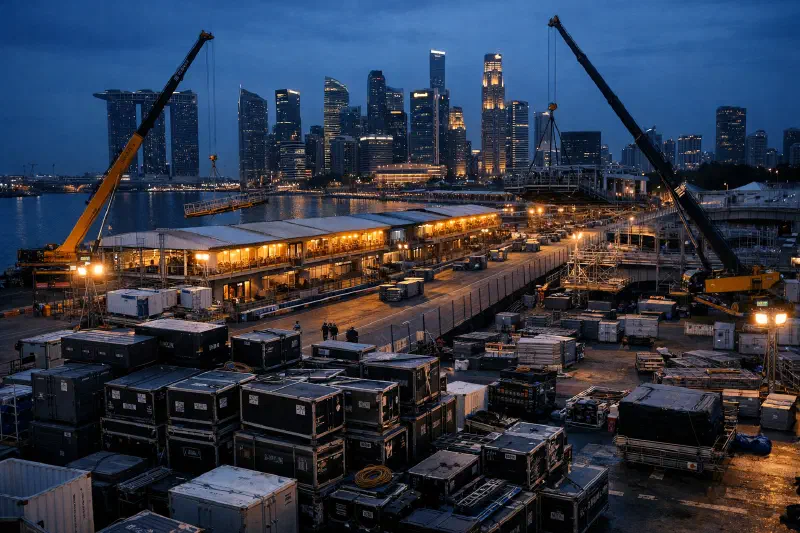
The expensive part of a big sports weekend in Southeast Asia is no longer the headline act. It is the temporary city that has to arrive before the first whistle: freight cases, broadcast compounds, grandstands, generators, barriers, buses, hotel rooms, police, cleaners, volunteers, and the teardown crews that make the whole thing disappear again on schedule.
ASEAN has enough sports demand. The business question is whether a host can turn that demand into repeatable margin instead of a one-off spectacle bill. In my June 24 brief on sponsorship repricing, I argued that the region’s sports market was already moving away from blunt reach metrics and toward measurable return. The same repricing is now landing on the host side. The venue is no longer just the venue. It is the supply chain wrapped around it.
The event is the supply chain #
The global motorsport operators have already told us how to read this. Formula 1’s own logistics explainer notes that teams move everything from cars and tyres to fuel, motorhomes, and hospitality kit from race to race, coordinated by specialist staff and by DHL as logistics partner (Formula 1, October 20, 2023). Its calendar team says each Grand Prix is effectively a year in the making and that the order of races matters because freight has to move efficiently and sustainably, with promoters acting as the “unsung heroes” who make the event real on the ground (Formula 1, September 13, 2024).
That is not just an F1 curiosity. It is the right business lens for ASEAN sport. A race or tournament only looks like a media property from the sofa. At operator level, it is a logistics product. Formula 1’s latest impact report says the sport has cut its carbon footprint by 35 percent since 2018, reduced logistics emissions by 21 percent versus 2024, and plans to remove more than half of broadcast-related freight from air transport by 2030 by leaning harder on sea freight and regional hubs (Formula 1, June 17, 2026). That means host cities are increasingly being judged not just on glamour or crowd noise, but on how neatly they fit a lower-friction operating map.
The implication is uncomfortable and useful. In ASEAN sport, fan demand is necessary, but it is no longer sufficient.
Singapore sells compression, not just spectacle #
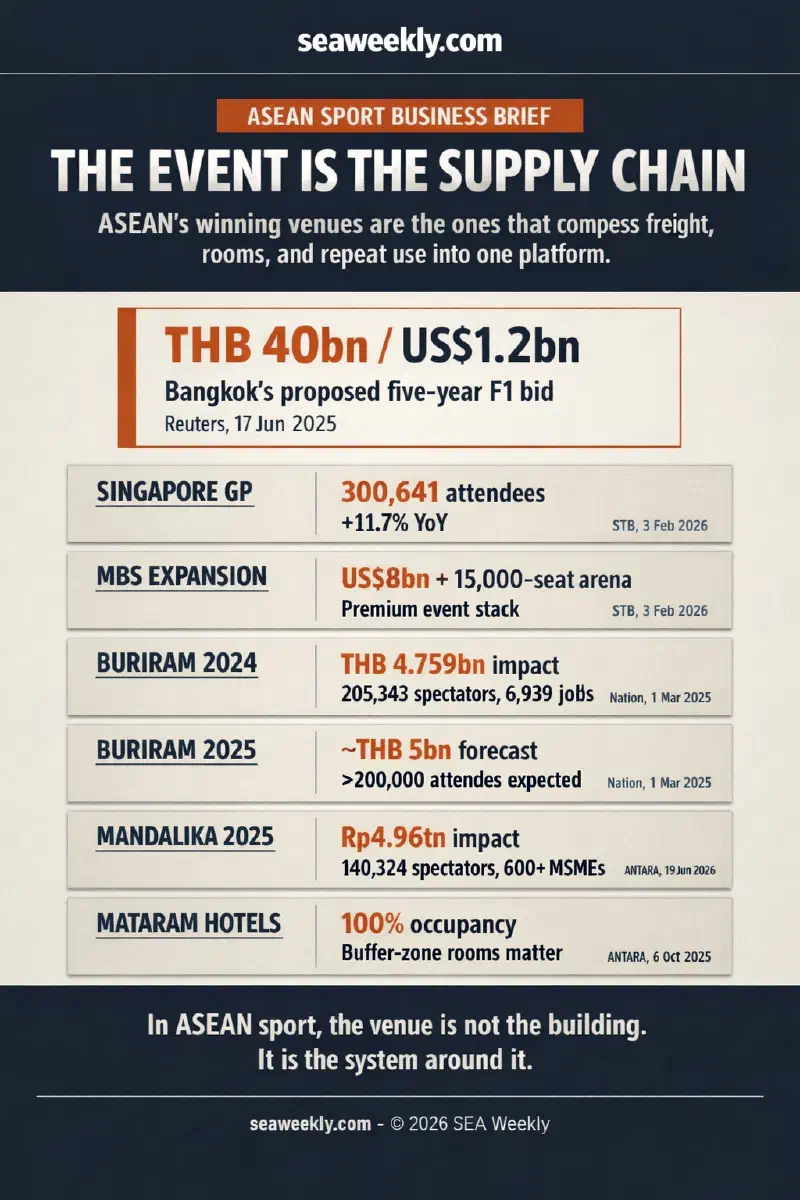
Singapore remains the clearest regional example of a host that understands this. The Singapore Tourism Board said the 2025 Formula 1 Singapore Grand Prix drew 300,641 attendees over three days, up 11.7 percent from 2024 (STB, February 3, 2026). That attendance number matters, but it is not the whole story. The same STB update tied the broader tourism machine to S$23.9 billion in receipts in the first three quarters of 2025, highlighted MICE momentum, and noted Marina Bay Sands’ US$8 billion expansion that will add a 570-suite luxury hotel tower, 200,000 square feet of meeting space, and a 15,000-seat arena.
Go back one step and the pattern is even clearer. In a May 2024 speech, STB chief Melissa Ow said the 2023 Singapore Grand Prix had already attracted more than 264,000 attendees, with business events and fringe activities built around the weekend (STB, May 10, 2024). That is the part many sports-business conversations miss. Singapore is not monetizing a race in isolation. It is monetizing adjacency.
The high-spend fan, the sponsor guest, the C-suite visitor, the conference delegate, and the hospitality buyer can all be served within one dense urban operating zone. Hotels, nightlife, airport access, restaurants, meeting space, and corporate hosting are compressed tightly enough that the city’s expensive street-race overlay can be spread across multiple revenue streams. Singapore wins because it behaves less like a venue and more like a premium event platform.
Buriram proves permanent circuits can still work #
Buriram offers the opposite model and proves it can also be commercially sound. When MotoGP confirmed Thailand would open the 2025 and 2026 seasons, Dorna and Thailand’s sports authorities framed the move as both market validation and an economic opportunity. The Nation’s summary of that announcement said more than 800,000 fans had already come through Buriram’s gates across the first four events held there (The Nation, August 21, 2024).
The harder numbers came as the 2025 event opened. The Nation reported that the 2024 Buriram weekend had drawn 205,343 spectators, including 50,677 international visitors, generated an estimated THB 4.759 billion in economic impact, supported 6,939 jobs, and produced at least THB 300 million in tax revenue. Organisers were projecting more than 200,000 attendees and about THB 5 billion in impact for 2025 (The Nation, March 1, 2025).
Buriram’s lesson is not that permanent circuits are automatically superior. It is that repeatability matters. A fixed track removes a large share of annual setup uncertainty that a street race carries. You are not rebuilding a downtown operating environment from scratch each year. But the circuit alone is not the moat. The real work still sits in accommodation, policing, cleaning, vendor discipline, volunteer mobilisation, and transport coordination. Buriram works because the surrounding system has learned how to host, not because tarmac by itself is valuable.
Bangkok’s F1 bid is a balance-sheet question disguised as a prestige question #
This is why Bangkok’s Formula One ambition deserves a colder reading than the promotional headlines suggest. Reuters first reported in May 2025 that Thailand planned a “Sustainable F1” bid for a Bangkok street race from 2028 (Reuters, May 26, 2025). Three weeks later, Reuters reported that the Thai cabinet had approved a five-year bid worth about THB 40 billion, or US$1.2 billion, for 2028 to 2032 (Reuters, June 17, 2025).
Thailand already has Buriram. So Bangkok only makes sense if it can produce a different kind of return: bigger sponsor hospitality, stronger premium tourism yield, deeper urban entertainment spend, and tighter integration with MICE and corporate calendars than a provincial permanent circuit can offer. Otherwise, the country would be choosing the most expensive possible version of a lesson it has already learned more cheaply.
To Thailand’s credit, the government seems to understand that sport-business value is built in the plumbing. The Tourism Authority of Thailand’s sports-year campaign aims to stitch together events, transport, rooms, and destination marketing into one platform, with goals of 39 million visitors and THB 3 trillion in tourism revenue in 2025 (TAT, February 3, 2025). A follow-up cabinet framework went further, listing airline incentives, slot activation, secondary-city connectivity, public transport, venue and hotel investment, cashless tourism tools, and multilingual staffing as policy priorities (TAT, May 8, 2025).
That is the giveaway. Thailand is not just bidding for races. It is trying to build an event-delivery stack.
Mandalika shows why the buffer zone is part of the venue #
If Singapore is the dense-city model and Buriram the repeatable-circuit model, Mandalika is the destination-circuit test. ANTARA reported in June 2026 that the 2025 Indonesia MotoGP drew 140,324 spectators and produced Rp4.96 trillion in national economic impact, with Rp2 trillion to Rp4 trillion in turnover in West Nusa Tenggara, more than 600 MSMEs involved, and around 3,000 local workers participating (ANTARA, June 19, 2026). Those are strong numbers, and they explain why Indonesia keeps treating Mandalika as a national-priority sports-tourism asset.
But the more revealing number is not the headline impact. It is the hotel data. ANTARA reported in October 2025 that Mataram hotel occupancy hit 100 percent during the race weekend against an 80 percent target; three- and four-star hotels were fully booked; and this was achieved without the room-rate jumps that had been allowed the previous year (ANTARA, October 6, 2025).
That detail is more important than it looks. Destination circuits do not have Singapore’s natural urban compression. Their commercial model depends on the buffer zone behaving as part of the venue product. If the hotels overcharge, if transport fails, if local merchants are excluded, or if staffing is thin, the circuit may still sell tickets and the host can still claim a large crowd, but the repeat business case weakens quickly.
Mandalika’s strongest signal is not simply that it can attract fans. It is that the host system is learning how to absorb them.
The new venue arithmetic #
The common thread across these examples is that ASEAN sport is moving into a venue-utilization era. Standalone prestige weekends are getting harder to justify. Hosts need enough adjacent demand, enough transport capacity, enough room inventory, and enough repeat use to spread the operating burden across more than one event.
That is why Thailand wants MotoGP, the Volleyball World Championship, the SEA Games, and a wider sports-year calendar under one policy umbrella. It is why Singapore keeps widening the district around the race instead of treating the race as a self-contained spectacle. It is why Mandalika’s room discipline and MSME participation matter so much. And it is why Formula One itself is increasingly optimizing around freight routes, regional hubs, and calendar rationalisation.
In ASEAN sport, the venue is no longer the stadium or the circuit. It is the system around it.
The next winners will not simply be the loudest bidders for major events. They will be the operators who can move parts, people, and premium spend with the least friction, and then reuse that machinery again and again. Promoters who forget that may still get a sold-out weekend. They can also still lose money.
Have a venue-cost wrinkle, promoter spreadsheet, or event-operations story from the ground? I’d like to hear it.
Email me via editorial@seaweekly.com and mark it for Rafael Mendoza.
References #
- Formula 1 (October 20, 2023). “F1 Explains: The incredible logistics of F1 and how the sport moves more sustainably than ever around the world.” https://www.formula1.com/en/latest/article/f1-explains-the-incredible-logistics-of-f1-and-how-the-sport-moves-more.1FZRbv4U6DpFMThxNoj31X (Accessed July 23, 2026)
- Formula 1 (September 13, 2024). “F1 Explains: Organising new races, planning for the future and prioritising sustainability - how the F1 calendar is created.” https://www.formula1.com/en/latest/article/f1-explains-organising-new-races-planning-for-the-future-and-prioritising.6JYojnJYg1XRVxw1B8NDL4 (Accessed July 23, 2026)
- Formula 1 (February 27, 2024). “Formula 1 and DHL build on 20-year partnership in expanded multi-year renewal.” https://www.formula1.com/en/latest/article/formula-1-and-dhl-build-on-20-year-partnership-in-expanded-multi-year.5eDcqE9SiryWYL0THT3Qsl (Accessed July 23, 2026)
- Formula 1 (June 17, 2026). “Formula 1 on track to meet Net Zero 2030 target as it reports a 35% reduction in its carbon footprint.” https://www.formula1.com/en/latest/article/formula-1-on-track-to-meet-net-zero-2030-target-as-it-reports-a-35-reduction-in-its-carbon-footprint.EfXQ6vLKcQvuUiNHHrtnM (Accessed July 23, 2026)
- Singapore Tourism Board (May 10, 2024). “Speech by Ms Melissa Ow, Chief Executive, Singapore Tourism Board, at the Tourism Industry Conference 2024.” https://www.stb.gov.sg/about-stb/media-publications/speeches/speech-by-ms-melissa-ow--chief-executive--singapore-tourism-board--at-the-tourism-industry-conference-2024/ (Accessed July 23, 2026)
- Singapore Tourism Board (February 3, 2026). “Record Singapore tourism receipts from January to September 2025.” https://www.stb.gov.sg/about-stb/media-publications/media-centre/record-singapore-tourism-receipts-from-january-to-september-2025/ (Accessed July 23, 2026)
- Reuters (May 26, 2025). “Thailand plans to submit bid for F1 race in 2028.” https://www.reuters.com/sports/formula1/thailand-plans-submit-bid-f1-race-2028-2025-05-26/ (Accessed July 23, 2026)
- Reuters (June 17, 2025). “Thai cabinet approves $1.2 billion bid to host Formula 1 race in 2028.” https://www.reuters.com/sports/formula1/thai-cabinet-approves-12-bln-bid-host-formula-1-race-2028-2025-06-17/ (Accessed July 23, 2026)
- The Nation (August 21, 2024). “Thai GP at Buriram set to open 2025 MotoGP season.” https://www.nationthailand.com/blogs/news/sport/40040783 (Accessed July 23, 2026)
- The Nation (January 7, 2025). “Thailand to harness power of sports tourism in 2025.” https://www.nationthailand.com/news/tourism/40044890 (Accessed July 23, 2026)
- The Nation (March 1, 2025). “MotoGP 2025 season opens with race in Buriram.” https://www.nationthailand.com/life/travel/40046907 (Accessed July 23, 2026)
- TAT Newsroom (February 3, 2025). “Amazing Thailand Grand Tourism and Sports Year 2025 Unveiled.” https://www.tatnews.org/2025/02/amazing-thailand-grand-tourism-and-sports-year-2025-unveiled/ (Accessed July 23, 2026)
- TAT Newsroom (May 8, 2025). “Cabinet Approves Cooperation Framework for Amazing Thailand Grand Tourism & Sports Year 2025.” https://www.tatnews.org/2025/05/cabinet-approves-cooperation-framework-for-amazing-thailand-grand-tourism-sports-year-2025/ (Accessed July 23, 2026)
- ANTARA (June 19, 2026). “Indonesia MotoGP boosts world-class sports tourism: Minister.” https://en.antaranews.com/news/419703/indonesia-motogp-boosts-world-class-sports-tourism-minister (Accessed July 23, 2026)
- ANTARA (October 6, 2025). “Hotel occupancy in Mataram surpasses target during MotoGP Indonesia.” https://en.antaranews.com/news/384481/hotel-occupancy-in-mataram-surpasses-target-during-motogp-indonesia (Accessed July 23, 2026)