
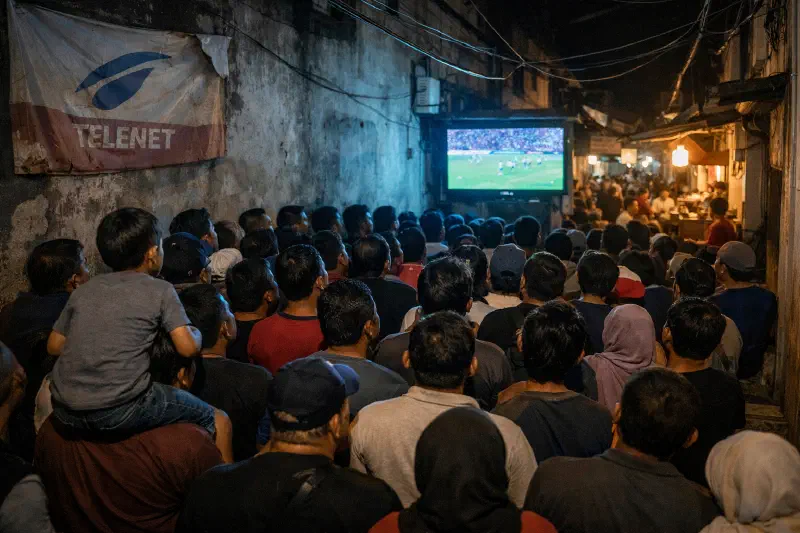
The 2026 FIFA World Cup kicked off in North America on June 11 to record viewership figures. In ASEAN, the moment was more anxious. Thailand was hours away from a broadcast blackout when Jasmine International sealed a last-minute deal to air the tournament. Malaysia had already reshuffled its entire broadcast consortium, with incumbent pay-TV operator Astro replaced by public broadcaster RTM and Telekom Malaysia’s Unifi TV. Vietnam quietly handed the rights back to state broadcaster VTV weeks earlier. The football was the same. The commercial mechanics beneath it were not.
These were not orderly renewals. They were a regional reckoning — three markets, three variations on the same pressure: when consumer household budgets compress and piracy erodes paid-TV economics, who is actually willing to pay for sports rights, and at what price?
The Week Before the Whistle #
Thailand’s rights situation in the weeks before the World Cup opener read like a cautionary tale played in fast forward. Jasmine International’s deal — announced hours before the opening game — averted what would have been an unprecedented blackout for Thai viewers. The fact that an eleventh-hour intervention was required at all tells you the commercial calculus failed right up to the deadline. Somebody — and probably several somebodies — looked at the rights fee and decided it was too expensive until the political cost of not showing the World Cup became larger than the commercial cost of showing it.
A day before that story broke, a minister attached to the Thai prime minister’s office had stated publicly that the rights fee must be justifiable to the taxpaying public. That framing is significant. Invoking taxpayer accountability in a commercial sports rights transaction is not normal market language. It signals that public pressure — driven by household budgets already squeezed by the Iran war energy shock — had entered the negotiation. When governments talk about sports rights as a public good rather than a commercial transaction, it means market mechanisms have buckled.
Then, on June 23, came the other Thailand story: True Corporation had secured media rights to the Thai national football team for 2026 to 2029 — not through a competitive auction, but through the resolution of a decade-long legal dispute between the Football Association of Thailand and media company Siam Sport Syndicate. A debt settlement handed True the rights. This is what happens when a sports organisation cannot generate sufficient commercial value to stay solvent in its contractual obligations. The rights don’t disappear. They change hands through legal resolution rather than market competition.
Malaysia Hands the Ball Back #
Malaysia’s story was calmer but structurally more revealing. RTM and Telekom Malaysia’s Unifi TV secured the 2026 World Cup rights after Astro — Southeast Asia’s largest pay-TV operator — was unsuccessful with its bid. Astro’s public explanation cited piracy and match timings as the reasons its bid didn’t succeed.
That statement deserves to sit on the record. Astro has been an ASEAN pay-TV anchor for over two decades. It knows sports rights better than almost any operator in the region. When a company of that calibre explicitly says that piracy has undermined the subscriber economics that justify the rights price, it is making a structural admission about the health of the paid-TV sports model in Malaysia — and by extension, in the broader region.
The timezone problem is real but not new. FIFA World Cup games in the Southeast Asian timezone have always involved late-night or early-morning kick-offs for the marquee European and South American matchups. That has never stopped ASEAN broadcasters from paying up in previous cycles. The fact that Astro cited both piracy and timing together suggests the timing issue is the proximate reason, but piracy has been eroding the base that made paying through the night economically rational. When the subscription base is smaller and the audience is partly watching via illegal streams, even bad timing becomes a dealbreaker.
The Budget Equation That Broke #
The structural causes here go beyond any single rights negotiation. Three forces have converged across ASEAN to compress what commercial sports rights are worth to a paying operator.
The first is household budget pressure. The Iran war fuel shock pushed crude oil from below US$70 to above US$100, and the effects landed across the region disproportionately in fuel-import-dependent markets. Transport costs rose. Utility bills followed. Household discretionary spending — the category that includes pay-TV subscriptions, event tickets, and sport merchandise — is where ASEAN consumers cut first. When a Thai family is paying more for their motorbike fuel and their monthly grocery bill, the satellite subscription is the line item under review.
The second is structural piracy. Astro named it explicitly. Across ASEAN, the piracy problem for live sport has not gone away — if anything, the proliferation of streaming infrastructure has made illegal high-definition streams easier to access than they were five years ago. This directly attacks the paid-TV subscriber base that is the revenue foundation for commercial rights fees.
The third is the evidence problem. Sponsors increasingly want measurable ROI. A rights-holder that can only offer broadcast reach numbers — including viewers accessing via pirated streams — is offering a metric that does not map to commercial outcomes. Advertisers paying for sports rights expect the audience to be paying for the content too. When a material share of the audience is not, the premise of the sponsorship investment starts to look uncertain.
Sponsors Are Not Retreating — They Are Repricing #
The conclusion many will draw is that ASEAN sports sponsorship is in decline. The more accurate read is that it is repricing — and the composition of who sponsors is shifting in ways that matter.
Telecom and utility operators have stepped into the gap vacated by commercial pay-TV because they have non-advertising reasons to do so. RTM has a public-service mandate. Unifi TV acquires subscribers. True Corporation builds platform engagement. These operators are not buying sports rights to run beer ads — they are acquiring audience access and justifying it through subscriber data, platform growth, and occasionally regulatory goodwill. Their ROI model is different, which means they can justify prices that pure advertising-driven operators cannot.
Meanwhile, major consumer brands are pivoting their activation models. The AB InBev approach for the 2026 World Cup — 200,000 watch parties across more than 40 countries — is the clearest example: rather than paying for broadcast rights, the brand owns the consumption moment by creating the viewing environment directly. The bar becomes the billboard. This model is replicable across ASEAN at local scale, and it is cheaper per contact than broadcast sponsorship in a market where part of the broadcast audience is watching illegally.
Digital payment and fintech platforms remain aggressive in sports sponsorship because their ROI is direct and measurable. A QR payment sponsor at a stadium or a futsal court generates data on every transaction — frequency, average spend, demographic inference. That is a fundamentally different accountability standard than CPM-based broadcast reach, and it means fintech platforms are better positioned than FMCG brands in the current environment.
What Budget Pressure Is Actually Clarifying #
The counterintuitive finding is that consumer budget tightening is not uniformly bad for sports sponsorship. It is selectively destructive — and selectively creative.
Premium international event rights are where the damage is worst. The cost structure is high, the audience is partly inaccessible via legitimate channels, and the ROI is broad rather than targeted. That is exactly the profile that struggles in a performance-accountability environment.
Community and grassroots sport is experiencing the opposite pressure. Futsal leagues, esports tournaments, 3x3 basketball, local football academies — these have passionate, regular audiences with low entry costs and easy sponsor integration. A telco that sponsors a futsal league in Bandung or a gaming tournament in Ho Chi Minh City gets measurable audience contact at a fraction of the cost of a premium stadium naming rights deal. When CFOs are scrutinising marketing budgets, the option with lower absolute cost and measurable conversion wins the pitch.
What the H2 Pipeline Demands #
The AFF Championship and domestic football leagues across ASEAN are preparing commercial renewal cycles for late 2026 and 2027. The rights-holders and sponsors entering those conversations are doing so in a fundamentally different environment than the one that shaped the previous cycle.
The new sponsorship model is not about reach. It is about conversion. Sponsors want activation, data, and a direct line from their investment to commercial outcomes — subscriber acquisition, payment volume, merchant sign-ups, event attendance. Sports properties that can build those measurement pipelines will find sponsors. Those that can only offer broadcast eyeballs on a channel where piracy has diluted the paying audience will find the negotiation much harder.
The World Cup’s ASEAN rights market ran the experiment in real time. The results are already telling rights-holders and sponsors what the next cycle will look like: fewer commercial bidders, more utility operators, more activation-led campaigns, and a hard floor on reach-based pricing. The adjustment is uncomfortable, but it is honest. ASEAN’s sports commercial market needed to reckon with what its audiences are actually worth to paying advertisers. That reckoning is happening now.
Sources
- SportBusiness (June 23, 2026). “True nets Thai team rights in FAT debt settlement.” https://www.sportbusiness.com/news/true-nets-thai-team-rights-in-fat-debt-settlement/ (Accessed 24 June 2026)
- SportBusiness (June 11, 2026). “Jas deal averts World Cup blackout in Thailand.” https://www.sportbusiness.com/news/jas-deal-averts-world-cup-blackout-in-thailand/ (Accessed 24 June 2026)
- SportBusiness (May 22, 2026). “Thai government fires World Cup rights warning.” https://www.sportbusiness.com/news/thai-government-fires-world-cup-rights-warning/ (Accessed 24 June 2026)
- SportBusiness (May 6, 2026). “RTM, Telekom Malaysia net Fifa World Cup rights.” https://www.sportbusiness.com/news/rtm-telekom-malaysia-net-fifa-world-cup-rights/ (Accessed 24 June 2026)
- SportBusiness (April 14, 2026). “VTV nets 2026 World Cup rights in Vietnam.” https://www.sportbusiness.com/news/vtv-nets-2026-world-cup-rights-in-vietnam/ (Accessed 24 June 2026)