
Laos inflation eased to 9% year-on-year in May, down from 10.2% in April — the first monthly CPI decline in four months at −0.48%, according to the Bank of Lao PDR. The headline looks like progress. It is not yet a structural turn.
The reason has little to do with monetary policy or demand management. Laos is running near-10% inflation because it is caught between two energy paradoxes that most conventional macroeconomic frameworks do not fully capture. Until both are addressed, inflation in Laos will remain structurally elevated regardless of what the central bank does with interest rates.
Paradox one: the power producer that cannot afford itself #
Hydropower accounts for approximately 83 percent of Laos’ primary energy supply, according to ADB’s April 2026 Asian Development Outlook. The country already exports electricity to Thailand, Vietnam, and Singapore through the Laos–Thailand–Malaysia–Singapore Power Integration Project, ASEAN’s first multilateral cross-border electricity trading system (ADB, April 2026; Laotian Times, May 9, 2026).
Yet Électricité du Laos (EDL), the state utility, is the single largest source of systemic fiscal risk in the country. The ADB’s policy chapter on Laos is unusually blunt: EDL’s debt burden is a key contributor to public and publicly guaranteed debt, exacerbated by foreign-currency-denominated borrowings, opaque power purchase agreements, and the absence of cost-reflective tariffs. Public-sector customers in arrears perpetuate circular debt that transfers risk from EDL’s balance sheet to the sovereign’s (ADB ADO April 2026, Policy Challenge).
The currency mismatch is the most dangerous mechanism. EDL earns revenue in depreciating kip but services debt in foreign currency. Every percentage point of kip depreciation widens the gap between what EDL collects from domestic customers and what it owes external creditors. That gap does not disappear — it becomes either a fiscal transfer (taxpayer-funded) or an inflation tax (monetized through the banking system).
This is not abstract. On June 4, EDL announced scheduled power outages across three districts of Vientiane from June 5 to 9, affecting areas in Xaysettha, Sikhottabong, and Chanthabouly for up to nine hours daily, citing “maintenance, infrastructure upgrades, and equipment installation” (Laotian Times, June 4, 2026). These are the visible symptoms of an utility caught between deferred investment, constrained revenue, and operational pressure ahead of the rainy season.
Paradox two: abundant renewable energy, zero refining capacity #
Laos has no operational oil refinery. A domestic refinery project remains under development with no firm completion date. That means the country imports essentially all of its refined petroleum — and more than 97 percent comes from Thailand.
The numbers are stark. In 2025, Laos imported more than USD 4.4 billion worth of Thai goods, with diesel accounting for nearly a quarter of that total. When the Strait of Hormuz crisis hit in March 2026, Thailand suspended most refined oil exports to protect domestic reserves, exempting only Laos and Myanmar. Laos still received approximately 5.29 million liters per day from its northern neighbor, but volumes were down 25 percent from pre-crisis levels (Laotian Times, June 3, 2026).
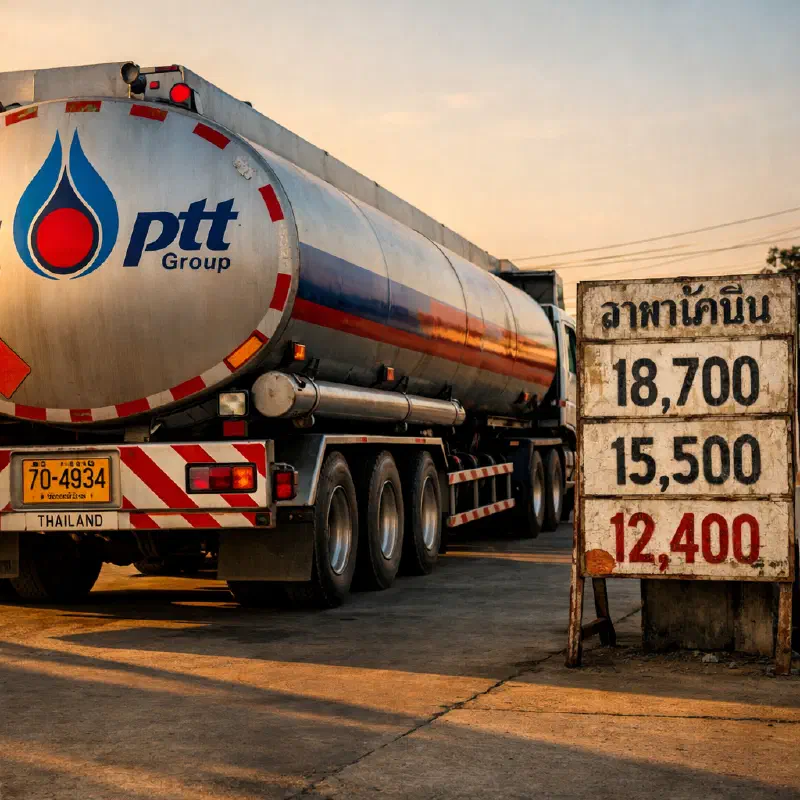
The new petroleum supply agreement signed between the Lao State Fuel Company and Thailand’s PTT Group in Vientiane on June 2 formalizes what was already a critical dependency. It provides supply certainty — a genuine improvement after March’s scare — but it does not address pricing. Laos pays international crude prices, plus Thai refining margins, plus cross-border transport costs. Transport accounts for 24.2 percent of the Lao CPI basket. Until that cost structure changes, transport-fuel inflation is structurally imported, not domestically controllable.
The same logic applies to food. Food and non-alcoholic beverages make up 36.5 percent of the CPI basket, the largest single component. Laos imports fertilizers, agricultural inputs, and processed food products — much of it from Thailand and increasingly from China. The Laos-China agreement in May to develop an NPK compound fertilizer industry using Laos’ potash reserves with Chinese phosphorus and nitrogen inputs is a medium-term step toward localizing input costs, but it will take years to reach production scale (Laotian Times, June 4, 2026).
Why the rainy season is the next inflation variable #
The counterintuitive risk for H2 2026 is not global oil. The ADB forecasts global crude prices moderating. The risk is the wet season.
On June 5, the Ministry of Industry and Commerce ordered all hydropower projects nationwide to strengthen dam safety measures ahead of the rainy season — mandatory inspections, spillway gate testing, emergency response drills, and daily water data reporting by 9:00 AM, increasing to hourly during high-water conditions (Laotian Times, June 5, 2026). The directive follows public controversy after Nam Ngum 1 dam was accused of causing flooding in Vientiane Province in late 2025, accusations EDL-Gen has denied.
The operational logic is correct: pre-emptive reservoir drawdown reduces flood risk. But lower reservoir levels also reduce hydropower generation capacity. If EDL must backstop generation shortfalls with diesel-fired or imported thermal power — both priced in foreign currency and tied to global fuel markets — the cost of keeping the lights on rises exactly when food-price seasonality is peaking.
This is the connection most Lao inflation commentary misses. The food-energy-currency triangle operates as a self-reinforcing loop: weak hydropower generation forces diesel purchases, which widen the trade deficit, which pressures the kip, which raises the kip cost of imported food and fuel inputs. ADB’s inflation forecast of 9.8 percent for 2026 and 6.7 percent for 2027 assumes this loop gradually loosens (ADB, April 2026). That assumption rests entirely on whether EDL’s restructuring — liability reprofiling, tariff adjustment, and the planned state enterprise reform law — can break the cycle before the next external shock.
The forward view: security without affordability #
The June fuel deal with PTT and the ASEAN leaders’ push at the 48th Summit in Cebu for a regional petroleum security framework (Laotian Times, May 9, 2026) address supply security. Philippine President Ferdinand Marcos Jr. explicitly compared the proposed mechanism to ASEAN’s existing rice reserve system, and Laos is central to the conversation because its hydropower exports are essential to the ASEAN Power Grid vision.
But supply security and price stability are different problems. A regional fuel reserve ensures Laos will not run out of diesel during a crisis. It does not ensure Lao households can afford the diesel that arrives. Cost-reflective electricity tariffs — which ADB identifies as a core reform pillar — would improve EDL’s finances but raise household electricity costs in the short term, directly feeding CPI.
The real test is whether Laos can sequence these reforms so that the inflation curve bends before the social tolerance for high prices breaks. The ADB’s medium-term target of placing EDL on a path to financial recovery by 2030 is an honest assessment of how long structural change takes in a small, landlocked economy with limited fiscal space. The question for 2026 is whether Laotian households — already carrying the weight of near-10 percent inflation — can wait that long.
This article is part of SEA Weekly’s ongoing coverage of ASEAN frontier-market economies. Previous installments examined Vietnam’s export recovery and the Indonesia-Vietnam manufacturing competitiveness shift.