
Phnom Penh Autonomous Port handled 276,151 twenty-foot equivalent units of containers between January and May this year — a 34% increase over the same period in 2025. Cambodia’s goods exports grew 17.7% in the first quarter. The garment, footwear, and travel goods sector generated approximately $16 billion in 2025 exports and still employs more than 1.2 million workers. By every volume metric that manufacturing analysts typically reach for, Cambodia looks like it is in a strong position heading into the second half of the year.
It may not be.
The problem with volume metrics is that they measure activity, not resilience. Resilience — the ability to sustain orders through Q3 and Q4, to hold buyer relationships through tariff shifts, to keep factories running as Cambodia’s preferential trade access begins to erode — is a function of order-book quality. And order-book quality is not something port throughput data can tell you. You have to ask what is inside those containers, and who ordered it.
The divergence no one is explaining #
The World Bank’s June 2026 Economic Update for Cambodia — titled, without much optimism, Navigating Shocks — offers the clearest signal that the volume headline is incomplete. Goods exports grew 17.7% in Q1. Real GDP growth is projected to moderate to 3.9% for the full year, down from the 6.0% recorded in 2024, before recovering toward 4.9% in 2027. Headline inflation hit 5.8% in April, driven by surging fuel costs from the Iran war. The World Bank noted on June 9 that a 10% increase in fuel prices is estimated to raise Cambodia’s poverty rate by 1.4 percentage points.
Strong exports, moderating growth, rising inflation, compressed household budgets. The standard reading is that Cambodia is resilient but under strain. The structural reading is more uncomfortable: the export surge is not translating into broad-based economic strength because the composition of those exports — the order-book type — determines how much of the revenue actually flows into wages, into re-investment, into structural capability. A factory running 90% capacity on thin-margin fast-fashion orders does not produce the same economic multiplier as a factory at 70% capacity on quality industrial contracts. But both factories appear identically in the export data.
Three compounding threats to commodity order books #
Cambodia’s manufacturing sector is navigating three simultaneous pressures that specifically disadvantage commodity-grade, volume-first order books.
The first is the Iran war fuel shock. Air freight rates have surged since the conflict began, with carriers including DHL Express imposing fuel surcharges and platforms like Shein expanding European warehouse capacity to shift away from direct air cargo. China’s low-cost e-commerce exports — a proxy for the fast-fashion, air-freight-dependent order type that downstream ASEAN factories also service — fell 10.9% in April, the fifth consecutive monthly decline, according to Trade and Transport Group analysis published June 8. “If you’re buying a top that is 300-400 grams you’re getting to the stage where air freight is 60% of the cost,” Frederic Horst of Trade and Transport Group said. Factories whose order books are oriented toward short-lead-time, air-shipped, fashion-cycle production are absorbing that cost squeeze directly.
The second is US tariff volatility. As covered in this publication’s April analysis, the operative baseline under Section 122 is 10–15% — far less damaging than the 49% “Liberation Day” tariff Cambodia briefly faced, but structurally significant in the buyer calculus. The real damage is not the rate; it is the uncertainty. Buyers sourcing from Cambodia for purely cost-arbitrage reasons — who came when the margin was thick and trade preferences were reliable — will reprice that sourcing decision every time Washington signals another shift. Buyers who came to Cambodia for compliance records, labour stability, and logistical reliability have a fundamentally different relationship with tariff volatility.
The third, and the most structural, is Cambodia’s impending graduation from Least Developed Country status. When EU Everything But Arms preferences phase out — the most consequential change expected in the 2027-2028 window — buyers who placed orders at Cambodia because of EBA duty savings will face a forced re-evaluation. At the June 16 Cambodia Textile Summit, Ken Loo, secretary-general of the Textile, Apparel, Footwear and Travel Goods Association in Cambodia, was unusually direct about this: “Cambodia’s garment sector has always competed on cost, but that’s no longer enough on its own. As we approach LDC graduation, the factories that will succeed are the ones that can offer something beyond price: reliability, quality, and a workforce that can move up the value chain alongside the products themselves.”
That is a precise description of order-book quality — and an acknowledgement that the factories currently operating on the wrong type of order book are running a countdown clock.
What quality order books look like in practice #
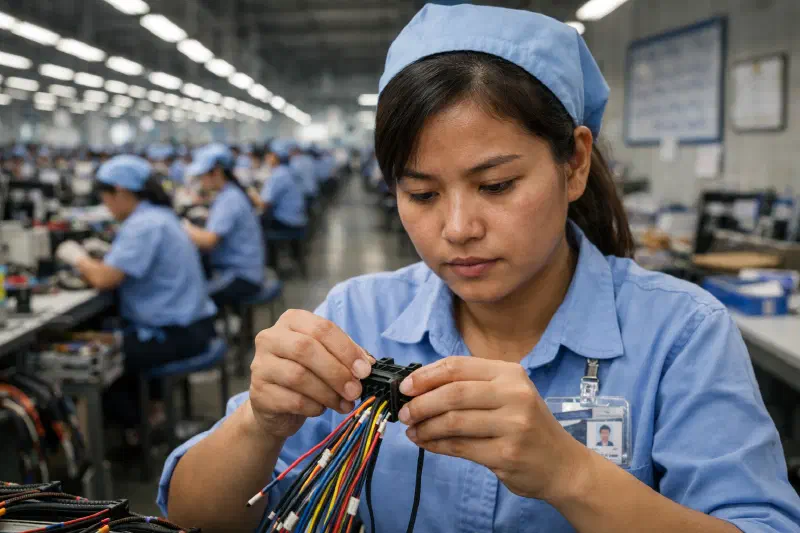
The factories best positioned for H2 are not abstract — they are identifiable. The clearest example in Cambodia right now is Kyungshin Co., Ltd., the Korean manufacturer of wiring harnesses, connectors, and electrical systems for electric vehicles. Kyungshin has operated a factory in Vihear Suor commune, Khsach Kandal district, Kandal province since 2012 — a $20 million investment that now employs 1,467 workers. It is not a garment factory. Its order book is tied to the EV component supply chains of a Korean automotive manufacturer with a 14-year commitment to Cambodian production.
When CDC Deputy Prime Minister Sun Chanthol led an investment roadshow to Incheon, South Korea, on June 16 — visiting Kyungshin and automotive group Daejoo KC, as well as targeting EV systems and healthcare technology investors — the explicit message was that Cambodia wants the next wave of investment to bring precisely this type of order book: longer-cycle, precision-manufacturing, sea-freight eligible, structurally insulated from fashion cycles. Kyungshin’s factory is not what fills Phnom Penh port’s headline TEU numbers. But it is what makes those numbers durable.
Better Factories Cambodia (BFC) compliance certification plays a similar function in the conventional garment segment. BFC-audited factories are visible and accountable to the buyers who require third-party labour auditing before committing to long-term orders. The ILO’s Director for Cambodia Xiaoyan Qian said at the June 16 summit: “our focus must be on skills, productivity, innovation and value-added production.” That focus is not just ethical positioning — it is a commercial filter. Buyers with sticky, long-cycle procurement relationships require what BFC certification signals. Buyers making tariff-timing purchase decisions do not.
The frontloading problem in the throughput number #
There is a specific risk embedded in Phnom Penh port’s container surge that deserves more attention than it has received. When trade policy uncertainty is elevated — as it was in Q1 2026, with Section 122 rates freshly in place and buyers uncertain about H2 US trade moves — importers frequently accelerate purchases to build inventory before the window closes. This frontloading behaviour appears in export data as volume growth; it is not demand growth. It is temporal displacement.
If a meaningful share of Cambodia’s Q1 container surge reflects buyers pulling forward H2 orders, then the Q1/Q2 volume headline is the mirror image of an H2 inventory overhang. The factories with the largest volume surges in H1 may face the sharpest H2 pullbacks — precisely because their buyers are now sitting on pre-built stock. The factories with moderate, steady H1 order flow from buyers who buy on actual consumption cycles — not tariff-timing cycles — are in the better structural position.
This is not a certainty. But it is the question that the volume metrics cannot answer, and that factory-level buyer relationship tracking can.
The 18-month window #
Cambodia’s government has the right investments on the table. The 1.5 Million TVET Programme is building workforce skills capacity. The Funan Techo Canal — 180 kilometres connecting river cargo to seaports through Kandal, Takeo, Kampot, and Kep — will reduce logistics costs structurally once operational. The BFC programme is expanding. The South Korea investment mission represents a genuine attempt to diversify Cambodia’s order-book composition beyond commodity garment assembly.
The variable is time. LDC graduation represents a forcing function approximately 18-24 months away for the most critical EU preference changes. That is the window in which Cambodia’s factories need to shift their buyer relationships — from EBA-driven sourcing to capability-driven sourcing. The factories that use this period to accumulate BFC certification, invest in the Cambodia Skills Framework that TAFTAC launched at the summit, and move toward product complexity — wire harnesses, precision footwear, recycled textile processing — will be in a position to absorb the preference cliff. The factories that treat 2026’s volume surge as validation of the status quo will discover, in 2027, that volume and resilience are not the same number.
Cambodia’s manufacturing story in 2026 is not about whether the containers are full. It is about whether the orders inside them will still be arriving when the port expansion is complete.
References #
- Phnom Penh Post (June 19, 2026). “Cambodia’s garment sector urged to move up value chain as LDC graduation nears.” https://phnompenhpost.com/business/cambodias-garment-sector-urged-to-move-up-value-chain-as-ldc-graduation-nears/ (Accessed 23 June 2026)
- Phnom Penh Post (June 17, 2026). “Sour: Garment manufacturing still engine room of Cambodian economy.” https://phnompenhpost.com/business/sour-garment-manufacturing-still-engine-room-of-cambodian-economy/ (Accessed 23 June 2026)
- Phnom Penh Post (June 17, 2026). “From garments to high tech: Cambodia seeks new era of industrial investment with South Korea.” https://phnompenhpost.com/business/from-garments-to-high-tech-cambodia-seeks-new-era-of-industrial-investment-with-south-korea/ (Accessed 23 June 2026)
- Phnom Penh Post (June 16, 2026). “Phnom Penh port sees container throughput surge by more than one-third.” https://phnompenhpost.com/business/phnom-penh-port-sees-container-throughput-surge-by-more-than-one-third/ (Accessed 23 June 2026)
- World Bank (June 9, 2026). “Strong Policy Action Key to Protecting Cambodia’s Jobs and Livelihoods Amid Shocks.” https://www.worldbank.org/en/news/press-release/2026/06/09/strong-policy-action-key-to-protecting-cambodia-s-jobs-and-livelihoods-amid-shocks (Accessed 23 June 2026)
- Reuters (June 8, 2026). “China’s global e-commerce push stalls as Iran war lifts costs, dampens demand.” https://www.reuters.com/business/autos-transportation/chinas-global-e-commerce-push-stalls-iran-war-lifts-costs-dampens-demand-2026-06-08/ (Accessed 23 June 2026)
- SEAWeekly (June 9, 2026). “How Cambodia vs Myanmar garment competitiveness is reshaping ASEAN supply chain risk.” https://seaweekly.com/posts/2026-06-09-cambodia-myanmar-garment-competitiveness-supply-chain-risk/ (Accessed 23 June 2026)