
The math of the global garment industry has always been simple: chase the lowest-cost needle. For a decade, that chase led brands into the factories of Cambodia and Myanmar, where young workforces and preferential trade access promised a safe harbor from China’s rising wages and geopolitical friction.
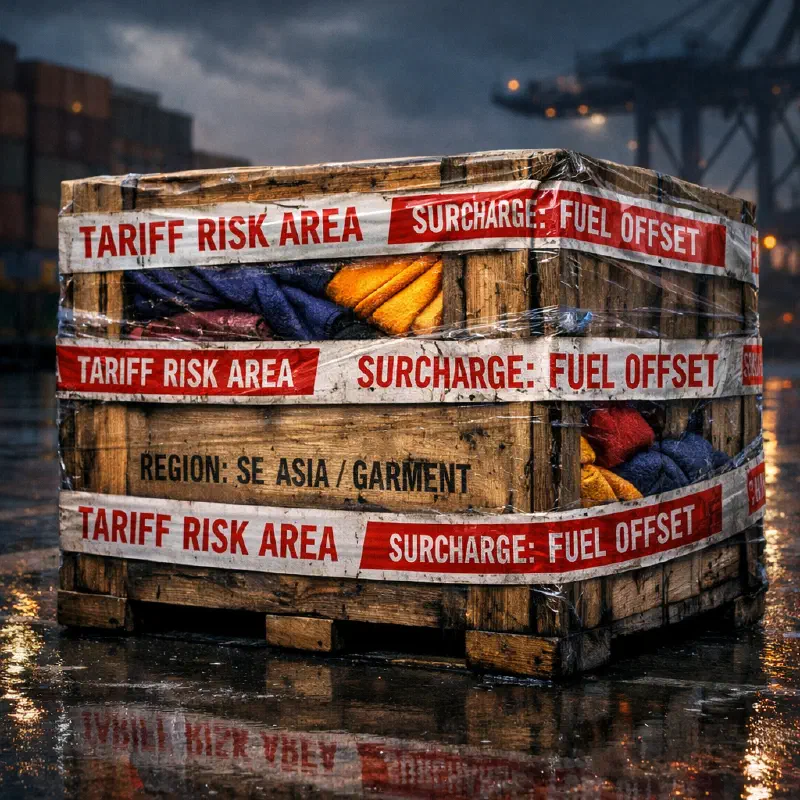
But as of June 2026, that math is breaking. A combination of the four-month-old Iran war—which has sent jet fuel and marine freight costs to levels that “crush the margins of even the most efficient budget apparel players,” as Reuters detailed on June 8—and the structural scarring of last year’s “Liberation Day” tariffs has introduced a new variable: Logistics Entropy.
In this environment, the saving of a few cents per shirt in a Myanmar factory is being systematically suffocated by the $2,000 surcharge on a container and the 15% trade risk premium that now clings to every ASEAN export bound for California. The contest between Cambodia and Myanmar is no longer a race to the bottom on wages; it is a race for the exits on risk.
The Death of the “Safe Haven” Myth #
For years, Cambodia and Myanmar were marketed as the “China+1” solution—stable, low-cost alternatives that would insulate American and European brands from Washington-Beijing tensions. The shock of the 2025 “Liberation Day” tariffs, which briefly saw Cambodia facing a 49% tax on US-bound exports, effectively decapitated that thesis.
Even though the US Supreme Court struck down the initial executive action in early 2026, the replacement 10–15% Section 122 tariffs remain the operative baseline. “The damage was not in the rate, but in the discovery that US trade policy can swing 40 percentage points in twelve months,” we noted in our April analysis on the lingering tariff impact.
Investors who moved production to Phnom Penh as a hedge against China now find that the hedge itself is a vulnerability. This has forced a capital rotation. While Cambodia’s public debt remains healthy as of Q1 2026, indicating structural resilience, the private sector is in a defensive crouch.
Myanmar: The “No-Go” Node #
If Cambodia is “stable but expensive,” Myanmar has become “cheap but toxic.” The combination of civil unrest and the Iran war’s “fuel shock” has turned the logistics route from Yangon to regional hubs into a high-stakes gamble.
Retailers like Shein and Temu, already stalling due to surging delivery costs, are finding it impossible to justify the “reputational and physical risk” of Myanmar. When the sea lanes are expensive and the roads are frequently blocked by conflict, cheap labor is irrelevant. Myanmar is no longer a competitor in the garment race; it is a cautionary tale of what happens when the infrastructure of movement collapses before the infrastructure of making.
P’Chai’s take: The Hidden Cost of the Commute #
While Miguel focuses on the macro-valuation of these markets, the reality on the factory floor tells a more visceral story of risk. On June 4, another overcrowded van carrying factory workers overturned in Svay Rieng, injuring 27 people. This isn’t an isolated incident; it’s a symptom of a garment sector that has prioritized floor-space growth over the basic safety of the humans who power it.
For multi-national brands, these accidents are no longer just “local tragedies”—they are ESG (Environmental, Social, and Governance) liabilities that are increasingly difficult to hide.
However, there is a counter-narrative emerging. Cambodia is doubling down on its “ironclad” relationship with Beijing, signing $2M in new Lancang-Mekong projects this month. More significantly, the June 6 launch of the “Computational Thinking Education Programme” signals a government that finally realizes it cannot sew its way to middle-income status. They are trying to build a digital workforce before the garment industry leaves them behind.
The most confusing signal for any supply chain manager right now is the US policy toward Cambodia. While the Trade Representative’s office maintains the Section 122 tariffs, the US DFC just committed $100 million to help build the new Techo International Airport. It is a market that is simultaneous being taxed and funded by the same superpower.
The Rise of Logistics Entropy #
The uncomfortable truth for ASEAN is that the “Cheap Labour” era is being choked out by the friction of the world.
Logistics Entropy—the tendency of global supply chains to become more chaotic, expensive, and fragile over time—is now the primary driver of manufacturing strategy. In 2021, you moved to Cambodia to save on wages. In 2026, you stay in Cambodia (or move back to a more expensive, closer-to-home hub) because you can’t afford the risk of being stuck in a Myanmar roadblock or a US-China tariff crossfire.
For the garment industry, this means the end of the “lowest-cost needle” era. The new winners will not be the countries with the lowest minimum wage, but the ones with the shortest, most politically insulated, and most fuel-efficient route to the consumer’s doorstep. On that map, both Cambodia and Myanmar are currently fighting for a relevance that the world’s new economic geography is rapidly redrawing.
Miguel Santos is a Jakarta-based investment analyst specializing in manufacturing and logistics. He holds the CFA charter.
Pichaya “P’Chai” Srisuk is a Bangkok-based correspondent covering travel, aviation, and regional industry.