
The most misleading way to read the Indonesia-versus-Vietnam manufacturing story in 2026 is to ask which country is “winning.” Supply-chain managers are no longer making that decision in such tidy terms. They are assigning different roles to each market.
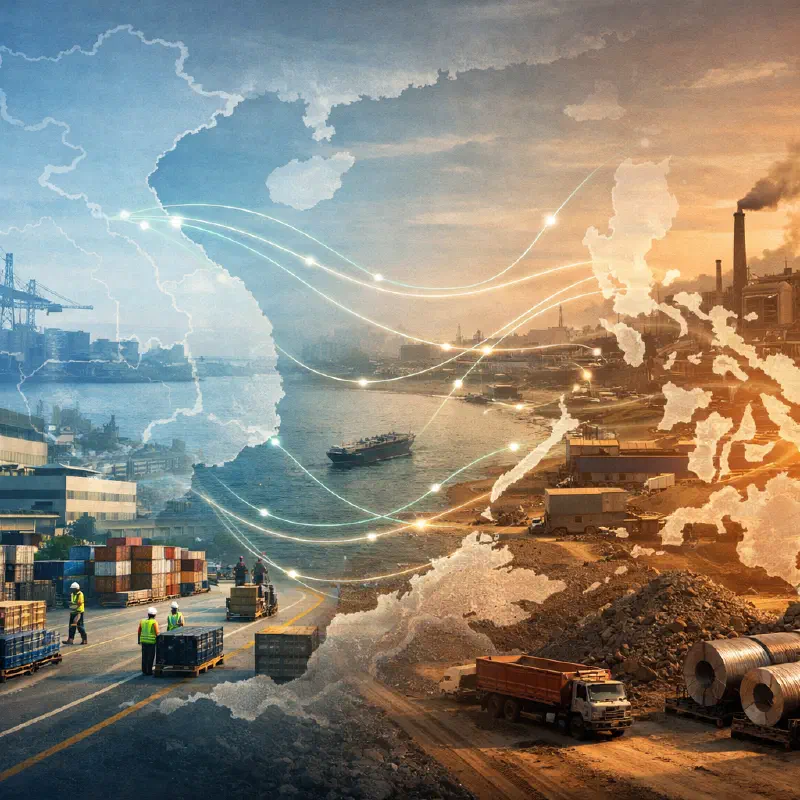
Vietnam is still the cleaner choice when the priority is export execution, supplier density, and speed to volume. Indonesia is becoming more useful in a different way: as a scale market, a tariff hedge, and a resource-adjacent manufacturing base for firms that can tolerate more policy friction and a longer operating runway.
That distinction matters because the underlying data are pulling in different directions. Vietnam’s manufacturing PMI rebounded to 52.8 in May after slipping to 50.5 in April, while registered foreign direct investment reached US$18.2 billion in the first four months of 2026, up 32% year on year, with manufacturing taking roughly 69% of newly registered and expanded capital (Vietnam Investment Review, June 1; Vietnam Investment Review, May 14).
Indonesia’s story is less elegant but more interesting than many outside investors admit. Its manufacturing PMI hit 52.6 in January, essentially level with Vietnam’s 52.5 in the same ASEAN comparison. In the first quarter of 2026, the economy grew 5.61%, manufacturing expanded 5.04%, and capital-goods imports rose 14.27% — evidence that capacity expansion is still happening (Antara, February 2; Antara, May 26).
So the right question is not who looks stronger in a monthly print. It is what kind of manufacturing each country is becoming best suited for.
Vietnam Still Wins on Execution Depth #
Vietnam’s advantage in 2026 is not just that foreign capital keeps arriving. It is that the capital is landing inside a system that already knows how to convert investment into export throughput.
The World Bank still describes Vietnam as one of the world’s most trade-oriented economies, with trade equal to nearly 170% of GDP and learning-adjusted years of schooling at 10.2 years, second-highest in ASEAN (World Bank). That mix matters. A workforce that is improving in quality, an economy built around export discipline, and a state apparatus that has spent years streamlining the investor pathway together create a manufacturing environment that global firms understand.
The result is visible in the composition of Vietnam’s growth. Electronics and computer component imports rose 52.3% to US$65.3 billion in the first four months of the year, a sign that manufacturers are not merely maintaining output; they are feeding higher-value production lines. ADB’s support pipeline for 2026-2029 and Vietnam’s heavy use of trade and supply-chain finance add a second layer of competitiveness: factories are backed by financing infrastructure that helps them keep moving when freight, FX, and working capital conditions deteriorate.
Nguyen Minh An’s reporting from Vietnam points to the underappreciated piece of the story: Vietnam’s manufacturing edge increasingly looks like ecosystem density rather than simple labour-cost advantage. Suppliers, financiers, shippers, and industrial parks are coordinated enough that export manufacturers can get from approval to shipment with less friction than in most neighbouring markets.
But Vietnam’s Strength Is Also a Transmission Channel #
That same openness creates vulnerability. Vietnam’s manufacturing model is more exposed to external shipping and energy shocks because it is more deeply wired into global flows.
Vietnam Investment Review reported in March that 90% of surveyed logistics firms were facing moderate-to-severe disruption from the Middle East conflict, while 43% cited surging freight costs as their biggest challenge. Another March analysis noted that Vietnam imports roughly US$20 billion a year in crude oil and petroleum products, with about 80% of crude sourced from the Middle East, while marine freight can represent 10% of export value in textiles and as much as 20%-30% in furniture (Vietnam Investment Review, March 16; Vietnam Investment Review, March 10).
That is why Vietnam’s April stumble mattered even though May recovered. The country remains the better export machine, but it is also the one that feels global disruption first. For supply-chain planners, that means Vietnam is the higher-performance node, not necessarily the lower-risk one.
Indonesia’s Opportunity Is Real, but Conditional #
Indonesia’s manufacturing case is often framed too defensively, as if the country is merely a late beneficiary of diversification away from China. The stronger case is that Indonesia is becoming more valuable in precisely the segments where companies want to diversify away from overconcentration in export-heavy hubs.
Start with tariffs. Under the tariff shock scenario that dominated supply-chain planning in 2025, Indonesia faced a 32% additional US tariff while Vietnam faced 46%, giving Indonesia a meaningful relative advantage in price-sensitive sectors such as footwear and some light manufacturing. Add to that Indonesia’s domestic market, its resource base, and its downstreaming push, and the country starts to look less like Vietnam’s understudy and more like a different kind of manufacturing proposition (Antara, April 9, 2025).
There is also real strategic capital behind that proposition. Japan and South Korea have pledged roughly US$32.3 billion of investment, while Q1 realized investment exceeded target and created more than 706,000 jobs. For firms tied to metals, batteries, chemicals, and processing industries that want upstream proximity, Indonesia offers something Vietnam cannot: a manufacturing strategy adjacent to raw-material control and large domestic demand (Antara, April 22).
Marcus Wijaya’s reporting from Indonesia, however, makes the condition clear: this advantage is only valuable if projects can move from pledge to operation with less friction than they do today.
Indonesia’s Constraint Is the Gap Between Interest and Readiness #
The recurring Indonesian problem is not lack of interest. It is the interval between investor enthusiasm and operational certainty.
The Indonesian Industrial Estate Association says the country now has more than 170 industrial estates across 24 provinces covering around 160,000 hectares. Yet the same industry body says investors’ main concern is execution speed, policy synchronization, and clear timelines. That is an unusually candid admission that the problem is coordination, not capacity (Antara, May 29).
The government clearly knows this. Danantara has created a new holding company, Kawasan Industri Indonesia, to consolidate state-owned industrial estate management. That may improve professionalism and focus over time. But the legal restructuring runs through the end of 2026, with full operation not expected until 2027 (Antara, May 26). For an investor making a 2026 siting decision, that is still a transition story, not a completed reform.
Meanwhile, several of Indonesia’s supporting risks are becoming harder to ignore. The rupiah’s stress forced Bank Indonesia into an emergency 50-basis-point rate increase in May, raising financing costs for manufacturers. Local reporting also flagged grid reliability as a decisive issue after the Sumatra blackout, precisely the kind of signal that makes higher-uptime manufacturers cautious. Indonesia can absorb volatility better than Vietnam in some ways because it is less externally exposed; it can also create its own volatility through slower coordination and policy ambiguity.
What the Smartest Supply Chains Will Actually Do #
The emerging ASEAN supply-chain strategy is not binary. It is architectural.
Vietnam remains the stronger choice for speed-sensitive export manufacturing, especially in electronics, machinery, and sectors that depend on dense supplier ecosystems and fast integration into trade-finance networks. Indonesia is becoming more attractive for firms that want a second manufacturing leg tied to tariff diversification, upstream resource access, domestic-demand ballast, or downstream industrial policy.
That logic also explains why neither country cleanly displaces the other. Vietnam is too efficient to ignore. Indonesia is too large and too strategically useful to treat as optional. The companies making the most durable decisions will increasingly place different functions in each market rather than trying to nominate a single ASEAN champion.
This extends a line we have been tracing in recent weeks. In SEA Weekly: The Cost-of-Carry Premium, we argued that export growth and domestic value capture can diverge. In SEA Weekly: The Balance Sheet Is the Story, we argued that the decisive contest in ASEAN is shifting toward who can absorb volatility while still compounding capability. Indonesia and Vietnam now embody two different answers to that challenge.
Vietnam compounds capability faster. Indonesia absorbs certain shocks better and offers more upstream leverage. The supply-chain strategist’s job in 2026 is not to pick which story sounds better. It is to decide which combination of both creates the more resilient manufacturing map.
References #
- Vietnam Investment Review (01 Jun 2026). “Vietnamese manufacturers record a rebound in new orders in May.” https://vir.com.vn/vietnamese-manufacturers-record-a-rebound-in-new-orders-in-may-153853.html (Accessed 02 Jun 2026)
- Vietnam Investment Review (14 May 2026). “Vietnam enters manufacturing and investment-led growth phase.” https://vir.com.vn/vietnam-enters-manufacturing-and-investment-led-growth-phase-152649.html (Accessed 02 Jun 2026)
- Vietnam Investment Review (16 Mar 2026). “Middle East conflict disrupts supply chains, pressures logistics firms.” https://vir.com.vn/middle-east-conflict-disrupts-supply-chains-pressures-logistics-firms-148581.html (Accessed 02 Jun 2026)
- Vietnam Investment Review (10 Mar 2026). “Middle East tensions raise energy, logistics and FX risks for Vietnam corporates.” https://vir.com.vn/middle-east-tensions-raise-energy-logistics-and-fx-risks-for-vietnam-corporates-148209.html (Accessed 02 Jun 2026)
- Antara News (02 Feb 2026). “Indonesia’s manufacturing PMI rise spurs confidence: Finance Ministry.” https://en.antaranews.com/news/402586/indonesias-manufacturing-pmi-rise-spurs-confidence-finance-ministry (Accessed 02 Jun 2026)
- Antara News (26 May 2026). “Indonesia’s Q1 economy remains solid on strong consumption: BPS.” https://en.antaranews.com/news/417028/indonesias-q1-economy-remains-solid-on-strong-consumption-bps (Accessed 02 Jun 2026)
- Antara News (22 Apr 2026). “Indonesia logs US$32 bln Japan, South Korea investment pledges.” https://en.antaranews.com/news/413213/indonesia-logs-us32-bln-japan-south-korea-investment-pledges (Accessed 02 Jun 2026)
- Antara News (29 May 2026). “Indonesia pushes faster investment in industrial estates.” https://en.antaranews.com/news/417328/indonesia-pushes-faster-investment-in-industrial-estates (Accessed 02 Jun 2026)
- Antara News (26 May 2026). “Indonesia sets up new SOE industrial estate holding.” https://en.antaranews.com/news/416941/indonesia-sets-up-new-soe-industrial-estate-holding (Accessed 02 Jun 2026)
- Antara News (09 Apr 2025). “A silver lining in the US tariff policy for Indonesia’s economy.” https://en.antaranews.com/news/351121/a-silver-lining-in-the-us-tariff-policy-for-indonesias-economy (Accessed 02 Jun 2026)
- World Bank (2025–2026). “Viet Nam Overview.” https://www.worldbank.org/en/country/vietnam/overview (Accessed 02 Jun 2026)
- World Bank (2025–2026). “Indonesia Overview.” https://www.worldbank.org/en/country/indonesia/overview (Accessed 02 Jun 2026)
- Asian Development Bank (Sep 2025). “Asian Development Outlook September 2025: Growth Slows as a New Global Trade Environment Takes Shape.” https://www.adb.org/publications/asian-development-outlook-september-2025 (Accessed 02 Jun 2026)