
The market narrative still says Southeast Asia is a growth story. The operating reality this week was harsher: it is now a balance-sheet endurance test.
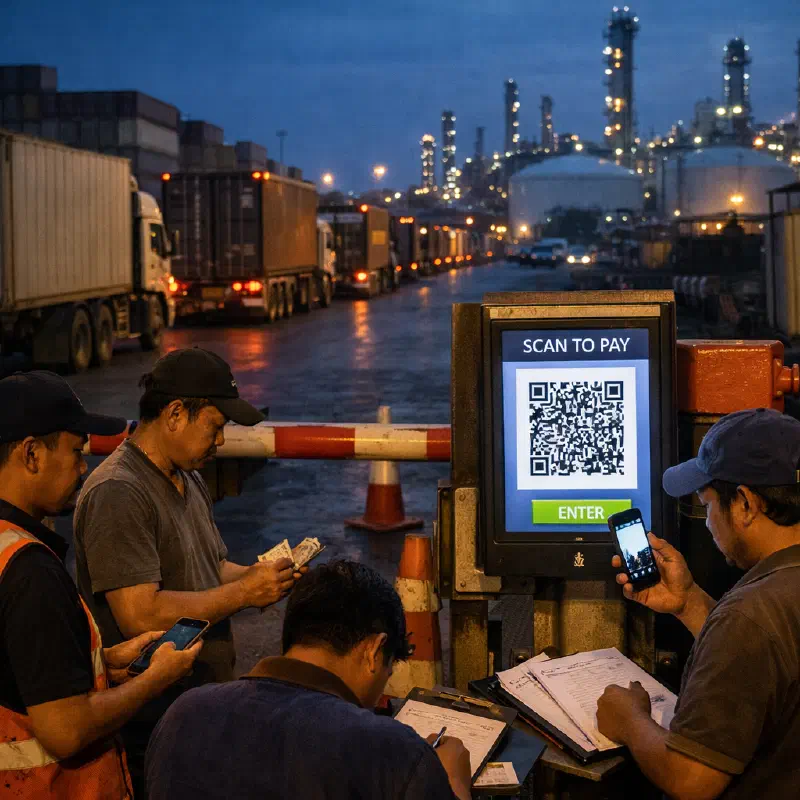
Across the same 48-hour window, Indonesia intervened to support the rupiah, Thailand reported a US$7.6 billion current-account deficit for April, and Singapore-based commodity traders described how Middle East disruptions were forcing rapid rerouting decisions across energy and soft commodities (The Business Times, May 29, The Business Times, May 29, The Business Times, May 30).
That combination matters more than any single headline. FX pressure, external-account deterioration, and logistics stress are no longer separate risk buckets. They are interacting in real time, and they are doing so while ASEAN countries are still trying to scale manufacturing and digital infrastructure.
If this sounds like a continuation of our recent arc, it is. In The Corridor and the Cap, Capital Without Capture, and The Rails, the Refinery, and the Real Margin, we argued that ASEAN’s core question was shifting from attraction to absorption. This week gave us harder evidence.
Stress Is Arriving Faster Than the Old Playbook #
Thailand’s April external balance was not a rounding error. A US$7.6 billion current-account deficit, coupled with weaker tourism spending and higher fuel-cost transmission, is exactly the sort of macro configuration that narrows policy comfort quickly (The Business Times, May 29).
What made the signal stronger was domestic confirmation. Kiatnakin Phatra’s chief economist publicly warned that Thailand could drift into a dual-deficit setup, with potential implications for longer-term baht weakness (Bangkok Post, May 30). At the same time, analysts still expected the Bank of Thailand to hold rates because inflation remained relatively subdued (Bangkok Post, May 30).
This is the uncomfortable policy geometry now: inflation may not force immediate tightening, but external pressure can still punish the currency and imported-cost channel. “No rate hike needed” is not the same as “no stress present.”
Indonesia’s Friday intervention read similarly. Even with support operations, rupiah weakness persisted, reinforcing the point that high-frequency external shocks are overwhelming tidy macro narratives (The Business Times, May 29).
Yet Capacity-Building Is Still Accelerating #
The wrong conclusion would be that ASEAN has shifted into defensive crouch. It has not.
During President To Lam’s visit, the Vietnam-Singapore Industrial Park network announced four additional parks, bringing the total to 26, alongside plans for an advanced manufacturing research centre (The Business Times, May 29). Vietnam also used the week to court additional energy investment while emphasizing technology transfer and workforce training conditions (Bangkok Post, May 30).
Meanwhile, Vietnam’s steel output hit 2.1 million tonnes in April, pushing the country into the global top 10 for crude steel production for the first time (VnExpress, May 28). That is not a vanity metric. It signals deeper industrial capability in sectors that tend to matter for long-cycle value capture.
Even portfolio reallocations tell a similar story: Frasers Property’s US$343 million sale of four European logistics assets reflects active capital rotation and liquidity discipline, not passive waiting for calmer markets (VnExpress, May 29).
In short, the region is still building while under pressure. That duality is precisely why simplistic “ASEAN boom” narratives now underperform reality.
Chloe’s take: The fintech equivalent of this story is straightforward and mildly inconvenient for people who still pitch “adoption” as strategy. Coda Payments securing MAS major payment institution status is not just a licensing milestone; it is a reminder that durable margin in 2026 sits in regulated rails, merchant plumbing, and cross-border compliance execution, not glossy user growth charts (The Business Times, May 29). Sea’s new AI investment team points in the same direction: mature platforms are reallocating toward capability leverage and efficiency, because easy e-commerce growth no longer clears the bar on its own (The Business Times, May 29). Translation: distribution is table stakes; infrastructure plus risk management is the moat.
The Non-Obvious Read: Resilience Is Becoming a Market Product #
The most important development this week is not any single macro print or corporate deal. It is that resilience itself is being repriced.
Who can absorb oil-linked FX volatility without forcing disorderly pass-through? Who can keep trade corridors functioning when geopolitical risk rises? Who can fund inventory, payments, and settlement reliability through dislocation windows? The ASEAN systems that can answer those questions credibly will not just survive this cycle; they will attract the next wave of investment on better terms.
That is why the Shangri-La language around protecting trade corridors is economically relevant, not merely diplomatic framing (The Business Times, May 30). Security of passage, shipping continuity, trade finance, and payment reliability now sit on one strategic stack.
Near term, watch three indicators:
- External-balance persistence: whether Thailand’s current-account pressure moderates or broadens into a more persistent funding concern.
- Shock transmission speed: whether further commodity volatility keeps forcing ad hoc intervention in regional FX markets.
- Capability conversion: whether industrial-expansion announcements (parks, energy projects, steel scale) translate into local productivity and supplier depth rather than just larger gross flows.
ASEAN is still a growth region. But this week made the hierarchy clearer: growth is the headline, balance-sheet depth is the story.
References #
- The Business Times (May 29, 2026). “Indonesia and India intervene to prop up weakening currencies.” https://www.businesstimes.com.sg/international/indonesia-and-india-intervene-prop-weakening-currencies (Accessed May 31, 2026 01:55 UTC)
- The Business Times (May 29, 2026). “Thailand records current account deficit of US$7.6 billion in April.” https://www.businesstimes.com.sg/international/thailand-records-current-account-deficit-us7-6-billion-april (Accessed May 31, 2026 01:55 UTC)
- Bangkok Post (May 30, 2026). “KKP warns Thailand faces dual deficit risk.” https://www.bangkokpost.com/business/general/3263115/kkp-warns-thailand-faces-dual-deficit-risk (Accessed May 31, 2026 01:56 UTC)
- Bangkok Post (May 30, 2026). “Thailand likely to avoid interest rate hike.” https://www.bangkokpost.com/business/general/3263145/thailand-likely-to-avoid-interest-rate-hike (Accessed May 31, 2026 01:56 UTC)
- The Business Times (May 30, 2026). “From oil to coffee beans: Traders in Singapore find ways to deal with Middle East disruptions.” https://www.businesstimes.com.sg/companies-markets/energy-commodities/oil-coffee-beans-traders-singapore-find-ways-deal-middle-east-disruptions (Accessed May 31, 2026 01:57 UTC)
- The Business Times (May 29, 2026). “Vietnam-Singapore industrial park grid gets power-up amid deals inked during To Lam’s visit.” https://www.businesstimes.com.sg/international/asean/vietnam-singapore-industrial-park-grid-gets-power-amid-deals-inked-during-lams-visit (Accessed May 31, 2026 01:57 UTC)
- Bangkok Post (May 30, 2026). “Vietnam encourages Gulf energy investment.” https://www.bangkokpost.com/business/general/3263025/vietnam-encourages-gulf-energy-investment (Accessed May 31, 2026 01:58 UTC)
- VnExpress International (May 28, 2026). “Vietnam becomes world’s 10th largest steel producer for first time.” https://e.vnexpress.net/news/business/economy/vietnam-becomes-world-s-10th-largest-steel-producer-for-first-time-5078878.html (Accessed May 31, 2026 01:58 UTC)
- The Business Times (May 29, 2026). “GIC-backed Coda Payments secures MAS major payment institution licence.” https://www.businesstimes.com.sg/companies-markets/gic-backed-coda-payments-secures-mas-major-payment-institution-licence (Accessed May 31, 2026 01:58 UTC)
- The Business Times (May 29, 2026). “Singapore’s Sea sets up AI investment team as part of pivot beyond e-commerce.” https://www.businesstimes.com.sg/companies-markets/singapores-sea-sets-ai-investment-team-part-pivot-beyond-e-commerce (Accessed May 31, 2026 01:58 UTC)
- VnExpress International (May 29, 2026). “Thailand’s 3rd richest man Charoen Sirivadhanabhakdi’s Frasers Property sells 4 European logistics properties for $343M.” https://e.vnexpress.net/news/business/property/thailand-s-3rd-richest-man-charoen-sirivadhanabhakdi-s-frasers-property-sells-4-european-logistics-properties-for-343m-5079069.html (Accessed May 31, 2026 01:59 UTC)
- The Business Times (May 30, 2026). “Shangri-La Dialogue 2026: Asean defence ministers reaffirm commitment to free flow of trade through international corridors.” https://www.businesstimes.com.sg/singapore/shangri-la-dialogue-2026-asean-defence-ministers-reaffirm-commitment-free-flow-trade-through (Accessed May 31, 2026 01:59 UTC)