
The ports are deciding this race, not the factories.
Vietnam’s manufacturing sector has just posted its fourteenth consecutive month of output expansion. Realised foreign direct investment hit $13.03 billion in the first half of 2026 — the highest first-half figure in five years — and manufacturing absorbed 82.6 per cent of it. Electronics exports are running at $71.16 billion through June, up 49.1 per cent on-year. Every number in the production column looks healthy. But the question that actually determines where the next phase of this growth lands — which provinces capture the subsequent investment wave, which logistics networks get overloaded, which corridors become bottlenecks — is not answered in the PMI data. It is answered by which provinces have, or are about to have, a multimodal connection to a deep-water port.
That is the race. And right now, it is not close.
The northern circuit is being locked in #
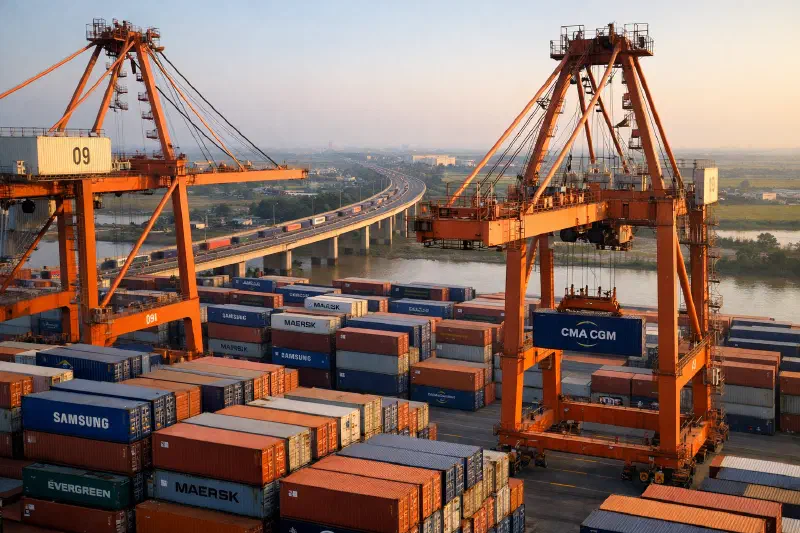
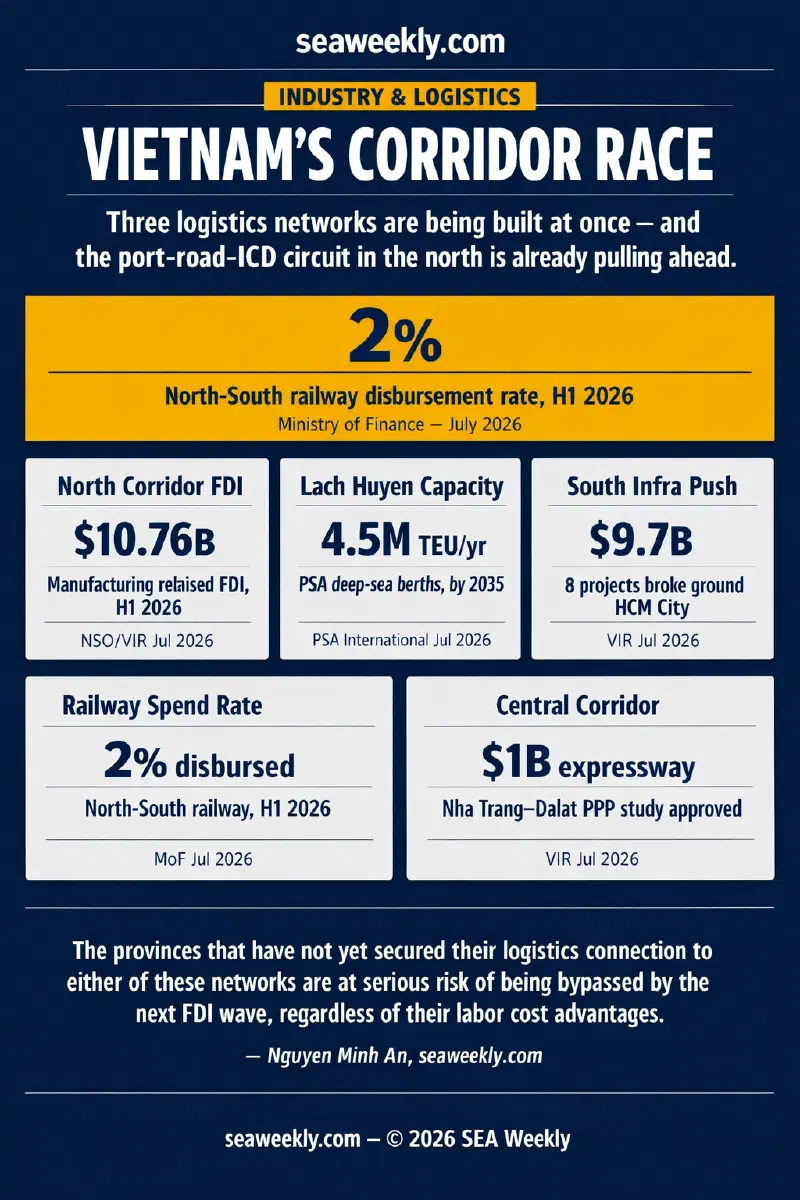
On July 5, PSA International confirmed it had signed an agreement with Lach Huyen Port Investment JSC to jointly develop four deep-sea container berths at Lach Huyen Port in Haiphong. The first two berths start construction at the end of 2026, targeting completion in 2028. Full four-berth capacity — 4.5 million TEUs per year — is expected by 2035. PSA’s statement noted that this investment “complements PSA’s existing projects in North Vietnam, including its inland container depot facilities in Bac Ninh.” Those five words — inland container depot in Bac Ninh — are the real news. PSA is not just building a port berth. It is building a closed logistics circuit: factory in Bac Ninh or Thai Nguyen puts container into the ICD; ICD feeds the Haiphong-bound expressway; container ships deep-sea at Lach Huyen. For any manufacturer already in that circuit, or considering entering it, the logistics equation has just improved materially.
The provinces that sit inside this circuit are winning by virtue of where they are. Bac Ninh — home to Samsung’s flagship complex, AMC Robotics’ new 6,150-square-metre facility, and dozens of tier-two electronics suppliers — is at the centre. Thai Nguyen, which broke ground on July 2 on its $140 million, 200-hectare Yen Binh Digital Technology Park, is 45 kilometres from Noi Bai airport and five kilometres from the Hanoi-Thai Nguyen Expressway. Hung Yen, where Kinh Bac City Development (KBC) and Malaysia’s JLand Group signed a memorandum of understanding last week to develop high-tech industrial parks modelled on Johor’s Ibrahim Technopolis, sits between Hanoi and Haiphong on the same logistics spine.
These are not accidents of geography. They are the result of a decade of expressway construction that connected the northern industrial belt to Haiphong. PSA’s Lach Huyen investment is the latest — and arguably the most consequential — upgrade to that network, because deep-sea access removes the transshipment step through Singapore or Kaohsiung that currently adds cost and time to North Vietnam exports. When berths one and two open in 2028, that transshipment premium disappears for manufacturers already positioned in the northern circuit.
The southern scramble #
Ho Chi Minh City is not waiting to be outpaced. On July 1, eight major infrastructure projects worth a combined VND253 trillion ($9.7 billion) broke ground simultaneously, marking the 50th anniversary of the city’s renaming. The list is instructive: Ho Tram-Long Thanh Expressway, Can Gio-Vung Tau Sea Bridge, Binh Tien bridge and road, Ho Chi Minh City–Moc Bai Expressway linking Vietnam overland to Cambodia. The city separately began construction on QTM International Port, and proposed the development of a special maritime economic zone in the Can Gio-Ba Ria-Vung Tau corridor. The southern ring is not being built incrementally. It is being built all at once.
This matters for the manufacturing geography question because Long Thanh International Airport — already operational and under capacity expansion — anchors an air-freight corridor that serves the high-value, time-sensitive end of Vietnamese manufacturing: semiconductors, high-end electronics, pharmaceuticals. Dong Nai’s industrial parks, which include Coherent’s newly announced second manufacturing facility, sit directly in the Long Thanh logistics catchment. Binh Duong — the southern manufacturing heartland — benefits from the expressway network being reinforced around it.
The southern corridor’s weakness, relative to the north, is port depth. Cat Lai handles enormous volume but its draft limits rule out the largest vessels. The Can Gio-Vung Tau development, if it materialises into a deep-water terminal equivalent to Lach Huyen, could resolve that gap — but the timeline for that outcome is 2030 at the earliest. For H2 2026 through 2028, the southern corridor is capacity-constrained at the port layer in a way the north will not be once PSA Lach Huyen opens.
The central corridor — the long shot with transformative potential #
Vietnam approved a feasibility study for a $1 billion, 99-kilometre PPP expressway linking Nha Trang to Dalat in late June. The Ministry of Construction’s approval of Khanh Hoa province as the competent authority for this project is the first credible signal that the east-west corridor connecting the Central Highlands to the Van Phong deep-water system could be built before 2030. The financing structure — 65 per cent state, 35 per cent private — reflects the project’s economic logic: the terrain is difficult, traffic is thin in the early years, but the strategic payoff is a logistics gateway for a region that has historically shipped agricultural and industrial goods via overland routes to Ho Chi Minh City.
If this corridor develops, it changes the competitive map for provinces like Lam Dong and Dak Lak, which currently rely on road trucking to reach the coast. The Central Highlands hold Vietnam’s largest coffee-processing capacity, growing industrial agriculture, and emerging industrial zones. A rail- or road-to-port connection through Khanh Hoa would open new options for those logistics flows.
The honest assessment is that this corridor remains a long shot on the 2026 timeline. Feasibility study approval is not construction. The complex terrain, the 65 per cent state-funding requirement, and the 2030 construction start target all signal a project that lives in the planning layer for now. But the decision to approve the study at all — particularly the east-west orientation toward Van Phong rather than north-south along the coast — tells you something about where Vietnam sees its next port infrastructure bet after Haiphong.
The railway shadow #
There is one number in this story that should concern any analyst watching Vietnam’s logistics modernisation: 2 per cent.
That is the disbursement rate for the North-South high-speed railway project through June 2026. The project was allocated roughly $2 billion for 2026. It has spent $43 million. The Lao Cai-Hanoi-Haiphong railway — which would, if completed, transform the northern logistics corridor from a road-dependent system into a genuine multimodal one — has disbursed $48 million, or 2.5 per cent of its annual allocation.
Together, these two projects absorb 75.6 per cent of the Ministry of Construction’s 2026 investment plan. They have collectively deployed less than 2.3 per cent of what they were given. The MoC is now proposing to redirect $3.2 billion of their capital to other projects. The reasons cited — land clearance delays, construction material shortages, incomplete investment procedures — are the same reasons these programmes have slipped before.
This is not a construction problem. It is a programme delivery problem. Vietnam has allocated the capital to build a rail-based logistics backbone that would make the road+port model of today redundant within a decade. But until that backbone exists, the competitive advantage accrues to provinces that have locked in road and port connections. The delays in railway disbursement are, in effect, extending the window during which the port-road-ICD circuit determines the winners.
I noted in June that Vietnam’s logistics costs running at 16-20 per cent of GDP mean every freight rate swing hits Vietnamese exporters harder than their ASEAN peers. The corridor upgrades underway — PSA Lach Huyen, the southern ring, the PPP expressway programme — address the physical bottlenecks. What they cannot fully address, absent the rail layer, is the structural cost drag that comes from a country shipping most of its goods on trucks.
Who is winning, and what it means for H2 #
The northern circuit — anchored by Bac Ninh, Thai Nguyen, Hung Yen, and the Haiphong port complex — has the clearest claim to current advantage. PSA’s commitment secures the port layer through 2028. The expressway connections are largely in place. The new industrial parks (Yen Binh, KBC-JLand, Bac Ninh logistics hubs) add the high-tech layer on top. If the $10.76 billion in manufacturing FDI attracted in H1 2026 converts into operating factories — and 39.4 per cent of manufacturers expect Q3 improvement — the northern provinces capture most of that activity.
The southern circuit is spending its way into relevance. The $9.7 billion in infrastructure that broke ground on July 1 addresses the expressway gaps that have constrained southern logistics. But port-depth constraints mean the south remains partly dependent on Cat Lai’s draft limits until the Can Gio-Vung Tau development matures.
The Central corridor is the transformation bet that Vietnam has not yet made — but has just stepped closer to making.
The uncomfortable forward read, which I noted in my June 30 piece on factory order visibility, is that Vietnam’s export recovery will be tested not just by whether buyers commit orders, but by whether the physical infrastructure exists to fulfil them at competitive cost. The corridor upgrades underway are the right investments. The railway programmes behind them are the right long-term bets. The gap between the two is the risk that should occupy manufacturing operators, logistics planners, and provincial governments through the second half of 2026 — and well beyond.
References #
- Vietnam Investment Review (July 05, 2026). “Vietnam’s realised FDI reaches five-year high in first half.” https://vir.com.vn/vietnams-realised-fdi-reaches-five-year-high-in-first-half-156057.html (Accessed July 9, 2026)
- Vietnam Investment Review (July 05, 2026). “PSA Vietnam to develop container berths at Lach Huyen Port in Haiphong.” https://vir.com.vn/psa-vietnam-to-develop-container-berths-at-lach-huyen-port-in-haiphong-156058.html (Accessed July 9, 2026)
- Vietnam Investment Review (July 08, 2026). “Transport infrastructure spending hits $2.3 billion in first half of 2026.” https://vir.com.vn/transport-infrastructure-spending-hits-23-billion-in-first-half-of-2026-156250.html (Accessed July 9, 2026)
- Vietnam Investment Review (July 04, 2026). “Manufacturing boosted by FDI, export recovery and public investment.” https://vir.com.vn/manufacturing-boosted-by-fdi-export-recovery-and-public-investment-156056.html (Accessed July 9, 2026)
- Vietnam Investment Review (July 01, 2026). “Eight major infrastructure projects break ground in Ho Chi Minh City.” https://vir.com.vn/eight-major-infrastructure-projects-break-ground-in-ho-chi-minh-city-155859.html (Accessed July 9, 2026)
- Vietnam Investment Review (July 03, 2026). “Vietnam approves PPP study for $1 billion expressway for Central Vietnam.” https://vir.com.vn/vietnam-approves-ppp-study-for-1-billion-expressway-for-central-vietnam-156048.html (Accessed July 9, 2026)
- Vietnam Investment Review (July 02, 2026). “Digital technology park project kicked off in Thai Nguyen.” https://vir.com.vn/digital-technology-park-project-kicked-off-in-thai-nguyen-156039.html (Accessed July 9, 2026)
- Vietnam Investment Review (July 08, 2026). “Hung Yen Group and JLand Group sign MoU to explore industrial park cooperation.” https://vir.com.vn/hung-yen-group-and-jland-group-sign-mou-to-explore-industrial-park-cooperation-156240.html (Accessed July 9, 2026)
- Vietnam Investment Review (July 05, 2026). “Vietnam posts trade deficit as imports outpace exports in first half.” https://vir.com.vn/vietnam-posts-trade-deficit-as-imports-outpace-exports-in-first-half-156046.html (Accessed July 9, 2026)
- Vietnam Investment Review (July 01, 2026). “Manufacturing sector ends the first half of 2026 on a positive note.” https://vir.com.vn/manufacturing-sector-ends-the-first-half-of-2026-on-a-positive-note-155872.html (Accessed July 9, 2026)
- Vietnam Investment Review (July 01, 2026). “Global investors welcome Resolution 10 focus on high-quality FDI.” https://vir.com.vn/global-investors-welcome-resolution-10-focus-on-high-quality-fdi-155870.html (Accessed July 9, 2026)
- Vietnam Investment Review (July 03, 2026). “JBIC pledges to advance $20 billion investment in Vietnam.” https://vir.com.vn/jbic-pledges-to-advance-20-billion-investment-in-vietnam-156067.html (Accessed July 9, 2026)