
Vietnam’s export rebound in 2026 is easiest to celebrate at headline level and hardest to understand at operating level. The headline case is straightforward: electronics and industrial-input shipments are climbing again, foreign manufacturers are still allocating capacity to Vietnam, and May’s PMI rebound suggests factories are getting cleaner order flow after a softer April.
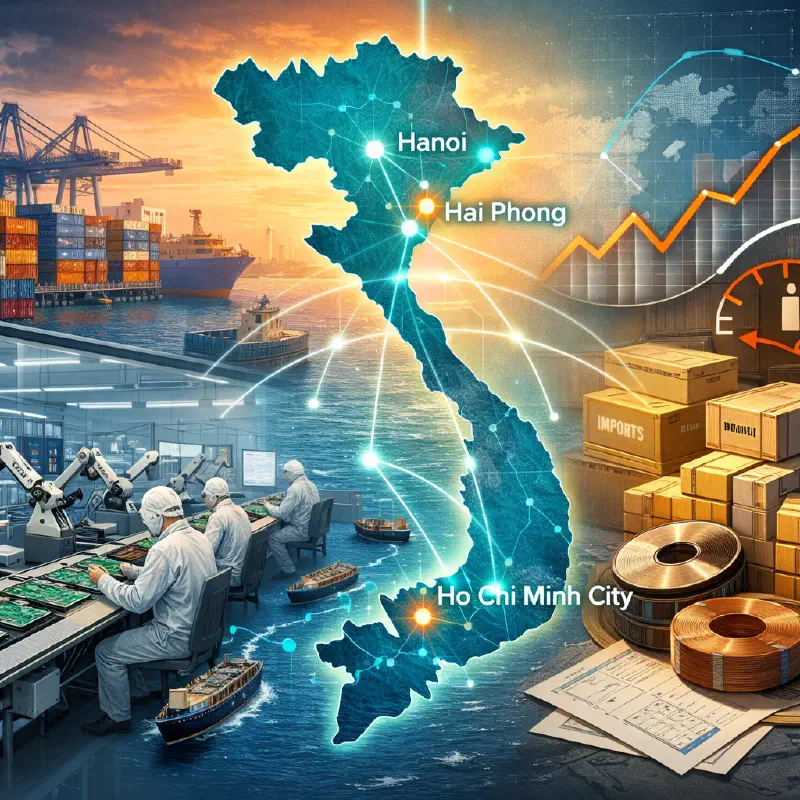
But the operating-level story is more demanding. Vietnam is recovering volumes faster than it is reducing dependencies. Input imports are rising alongside exports. Freight costs are climbing again before producers can fully reprice contracts. And origin-compliance pressure in the US market is forcing exporters to prove supply-chain integrity with more precision than in previous cycles. The right question in mid-2026 is no longer whether exports are recovering. It is whether this recovery can convert into durable margin and domestic value capture.
The rebound is real, and electronics is carrying it #
The strongest evidence comes from Vietnam’s own trade mix. Vietnam Investment Review, citing National Statistics Office data, reported that exports of computers, electronics, and components reached US$107.74 billion in 2025, up 48.4% year-on-year. Combined with phones and components, electronics-related exports exceeded US$164 billion and became the main engine of national export growth (Vietnam Investment Review, 06 Jan 2026).
That momentum did not disappear at the turn of the year. In early June reporting, Vietnam Investment Review said manufacturing new orders rebounded and PMI rose to 52.8 in May from 50.5 in April, indicating renewed expansion in factory activity (Vietnam Investment Review, 01 Jun 2026).
This matches what we argued in the June 2 cross-border deep dive: Vietnam still executes export manufacturing faster than most regional peers when demand normalizes. The difference now is that the domestic policy challenge has shifted from “can Vietnam attract orders?” to “can Vietnam keep more value from those orders?”
Why industrial inputs matter as much as finished exports #
A common analytical error is to read export growth in isolation from import structure. Vietnam’s 2025 electronics surge came with a parallel surge in imports for electronics-related categories. In the same VIR dataset, electronics imports hit US$150.7 billion, up 40.7% year-on-year (Vietnam Investment Review, 06 Jan 2026).
That is not automatically bad. In a processing-heavy model, strong input imports can signal capacity expansion and order confidence. But it does mean margin resilience depends on more than export volumes. If imported components, energy, and freight all move against producers at once, gross export growth can coexist with tighter profitability.
B&Company’s 2025 trade review reinforces this point: Vietnam’s foreign-invested sector still drives most of the trade surplus, while key export industries remain heavily dependent on imported intermediates. In other words, Vietnam’s export machine is strong, but the domestic-linkage depth remains uneven (B&Company, 2025).
FDI is still supportive, but the composition challenge remains #
The positive side is clear. Vietnam continues to attract manufacturing investment, and that keeps the production ecosystem deep: OEMs, contract manufacturers, logistics operators, and industrial parks remain coordinated enough to ramp output quickly. VIR’s May report showed manufacturing still taking the largest share of newly registered and expanded FDI in early 2026 (Vietnam Investment Review, 14 May 2026).
The structural side is less comfortable. VIR’s industry reporting also notes that Vietnam’s electronics sector remains dominated by foreign-invested firms, with a high share of imported components and limited domestic participation in higher-value R&D and tier-1 supply layers (Vietnam Investment Review, 03 Jul 2025).
This creates a two-speed recovery: throughput can recover quickly because multinationals can scale existing networks, but domestic value capture improves more slowly because supplier upgrading, certification, and process transfer take years, not quarters.
The near-term margin risk is shipping, not demand #
Most commentary still frames Vietnam’s 2026 trade risk around demand. The more immediate operational risk is cost transmission. Drewry’s World Container Index rose 23% week-on-week to US$3,433 per 40ft container in early June, with sharp increases on key Asia–US lanes (Drewry, 04 Jun 2026).
For electronics exporters, this matters because contract cycles do not always allow immediate pass-through. If freight rises faster than invoice repricing, margins compress even while shipment volumes hold.
Vietnam’s own reporting has been warning about this since March: logistics firms and exporters have faced persistent disruption from Middle East-linked shipping and energy volatility, especially in sectors where freight is a meaningful share of export value (Vietnam Investment Review, 16 Mar 2026; Vietnam Investment Review, 10 Mar 2026).
So yes, demand recovery helps. But in this cycle, cost stability is what determines whether recovery is profitable.
Tariff headlines are only half the story #
US tariff policy is often reported as a binary shock variable. In practice, origin traceability and transshipment scrutiny now matter as much as nominal rates. Vietnam Briefing’s 2025 electronics analysis points out that firms face rising compliance costs because proving origin and supply-chain documentation has become a commercial requirement, not a legal afterthought (Vietnam Briefing, 15 May 2025).
Commentary in The Investor reaches the same strategic conclusion from another angle: concentration risk and trade-policy volatility make market diversification urgent, especially for an economy with high trade intensity (The Investor, 28 Jul 2025).
For Vietnamese exporters, that means competitiveness in 2026 is increasingly procedural as well as productive. Firms that can document origin cleanly, diversify buyers, and secure resilient logistics contracts will outperform firms with similar factory efficiency but weaker compliance architecture.
What this means for H2 2026 #
Vietnam’s macro backdrop remains favorable relative to many peers. The World Bank still characterizes the country as one of the most trade-oriented economies globally, with strong medium-term growth expectations and a manufacturing-export base that has repeatedly shown adaptability (World Bank, 2025–2026).
But adaptability is not the same as immunity. S&P Global’s June cycle underscores that global manufacturing demand and price conditions remain choppy across major markets, which keeps planning uncertainty elevated for export manufacturers (S&P Global PMI, Jun 2026).
That is why Vietnam’s export-recovery narrative should now be tracked in three layers:
- Order layer: Are electronics and industrial-input volumes still expanding?
- Margin layer: Are freight, energy, and compliance costs being absorbed or passed through?
- Capability layer: Is local supplier participation in higher-value stages rising materially?
Vietnam is already proving layer one. Layer two is under active pressure. Layer three is where the long-cycle competitive gap will be decided.
The optimistic interpretation is still valid: Vietnam has the ecosystem density to keep winning export allocations. The stricter interpretation is more useful for decision-makers: until local value capture deepens and cost volatility is better hedged, export recovery will remain real but conditionally resilient.
References #
- Vietnam Investment Review (01 Jun 2026). “Vietnamese manufacturers record a rebound in new orders in May.” https://vir.com.vn/vietnamese-manufacturers-record-a-rebound-in-new-orders-in-may-153853.html (Accessed 05 Jun 2026)
- Vietnam Investment Review (14 May 2026). “Vietnam enters manufacturing and investment-led growth phase.” https://vir.com.vn/vietnam-enters-manufacturing-and-investment-led-growth-phase-152649.html (Accessed 05 Jun 2026)
- Vietnam Investment Review (06 Jan 2026). “Electronics drive Vietnam’s trade growth as exports hit record in 2025.” https://vir.com.vn/electronics-drive-vietnams-trade-growth-as-exports-hit-record-in-2025-144160.html (Accessed 05 Jun 2026)
- Vietnam Investment Review (03 Jul 2025). “Vietnam’s electronics sector rising fast, but structural hurdles remain.” https://vir.com.vn/vietnams-electronics-sector-rising-fast-but-structural-hurdles-remain-131838.html (Accessed 05 Jun 2026)
- Vietnam Investment Review (16 Mar 2026). “Middle East conflict disrupts supply chains, pressures logistics firms.” https://vir.com.vn/middle-east-conflict-disrupts-supply-chains-pressures-logistics-firms-148581.html (Accessed 05 Jun 2026)
- Vietnam Investment Review (10 Mar 2026). “Middle East tensions raise energy, logistics and FX risks for Vietnam corporates.” https://vir.com.vn/middle-east-tensions-raise-energy-logistics-and-fx-risks-for-vietnam-corporates-148209.html (Accessed 05 Jun 2026)
- Drewry (04 Jun 2026). “World Container Index.” https://www.drewry.co.uk/supply-chain-advisors/supply-chain-expertise/world-container-index-assessed-by-drewry (Accessed 05 Jun 2026)
- Vietnam Briefing (15 May 2025). “How Are US Tariff Threats Affecting the Vietnamese Electronics Industry?” https://www.vietnam-briefing.com/news/how-are-us-tariff-threats-affecting-the-vietnamese-electronics-industry.html/ (Accessed 05 Jun 2026)
- B&Company (2025). “Vietnam’s recovering trade landscape under the U.S. tariff scheme.” https://b-company.jp/vietnams-recovering-trade-landscape-under-the-u-s-tariff-scheme/ (Accessed 05 Jun 2026)
- The Investor (28 Jul 2025). “Navigating tariff shocks: Vietnam’s path forward through diversification.” https://theinvestor.vn/navigating-tariff-shocks-vietnams-path-forward-through-diversification-d16486.html (Accessed 05 Jun 2026)
- World Bank (2025–2026). “Viet Nam Overview.” https://www.worldbank.org/en/country/vietnam/overview (Accessed 05 Jun 2026)
- S&P Global PMI (Jun 2026). “Press Releases.” https://www.pmi.spglobal.com/Public/Release/PressReleases (Accessed 05 Jun 2026)